Clergy & Congregational Coach
laurastephensreed logo2 (1).png

Blog

Helping clergy and congregations navigate transitions with faithfulness and curiosity

My blog has moved to Substack! You can find new articles weekly there.

Visit my Substack

Use the button below to search the blog archives on this website.

Search the blog
Posts in clergy
Resource: Advent prayer calendar

My son is 2 1/2 years old, which means this will be my fourth Advent as a mom (or mom-in-the-making). As the lectionary takes us through the events leading up to and following Jesus’ birth, I will liturgically relive all the feels of the pregnancy and newborn stages: intense fear, hope, joy, love, the desire to share my very self with others, and the realization of how much help I need. It strikes me that these emotions overlap somewhat with the traditional themes of Advent, so I have used them to create a calendar of prayer prompts for Advent, Christmas, and the Feast of the Epiphany. While I used my experience as a mom to structure the calendar, the prompts are applicable to us all.

You are encouraged to print and/or share the calendar. The JPEG is below, and you can find a more printer-friendly PDF here.

praying through the holidays.jpg
Rising Strong: owning our stories

Here is my single biggest takeaway from Rising Strong:

When I am feeling overwhelmed, I need to ask, “What is the story I’m telling myself?”

I am too quick to assume – that the person who just tore into me is irredeemably ornery, that I’m not good enough, or that I am too good to be the one creating the problem. None of these default narratives points me toward reflecting more deeply on the situation, reaching out for help, or looking for a solution. They are interpretations, and narrow, blame-inducing ones at that.

As an extreme introvert, I am especially prone to spinning a whole story in my head without fact-checking it, then acting on it like it is true. “What is the story I’m telling myself?” is a way of getting out of my head and sharing my perspective without making hearers defensive, since I’m not claiming that my outlook is gospel.

Instead, Brené Brown suggests I get at the whole story by asking myself:

  • What am I leaving out in my default narratives?

    • What am I feeling? Why?

    • What am I thinking?

    • What am I believing?

    • What am I doing?

  • What information do I need to flesh out and own this story?

    • about myself

    • about others

Not only are these the questions that I often neglect to ask, they are the ones that congregations need help raising to address subversive narratives of shame and blame. Churches – especially well-established ones – will have trouble moving forward until they are able to unearth and discuss sources of  resistance. Only when they are well-aware of feelings and dynamics will they be able to love and trust enough to risk doing new things.

Rising Strong: dealing with hurt

In last week’s episode of The Big Bang Theory, the very logic-focused Sheldon was jarred into the realization that he does not have the ability to suppress all emotion. Unlike his hero, Mr. Spock, he has the capacity to hurt. So do we all.

Not all of us are as uncomfortable with emotion as Sheldon is. (Although I find Sheldon to be very relatable, truth be told!) But most of us do attempt to “offload” our hurt in a number of ways. If you’re interested in what those tricks look like, Brené Brown does a great job of identifying and describing them in Rising Strong (pp. 59-66). This unwillingness to feel the feels, though, only kicks the hurt down the road. It will have to be dealt with again later, often in messier form.

So it’s healthier – and easier, in the long view – to look hurt in the eye. But there are big differences between:

  • feeling hurt and acting out hurt

  • feeling disappointed and living disappointed

  • acknowledging pain and inflicting pain

  • caring about what others think and being defined by what others think

(Brown names these dichotomies in her introduction and first chapter.)

In the first half of each pair, we acknowledge our humanity and seek to understand what we’re feeling and why. When we can see the issue more clearly, we can deal with it better. If we lean toward the second half of these pairs, though, we’re really looking to avoid pain by passing it on to someone else. We disconnect from our inner life and from other people, making up stories instead about someone else and his/her intentions.

I believe much of the conflict in congregations comes from the desire to pass on pain rather than feeling and owning our discomfort. Church involvement is very personal. We encounter God and mature in our faith at church. We talk about close-to-home and sometimes controversial topics at church. We make some of our best friends at church. We invest much of ourselves and our resources at church. All of this growth-inducing vulnerability leaves us exposed to hurt, and we often don’t have the skills as individuals or communities to handle our disappointments in a healthy way.

In my next post I will outline what I believe to be the most helpful tool Brown offers us for reflection. This examination is the first step toward communicating, understanding, and connecting.

Rising Strong: parsing shame and guilt

It’s hard to muster up the will to be vulnerable when we absorb criticisms and failures into our identity: “I’m not good enough.” “I’m a screw-up.” That’s why Brené Brown’s distinction between shame and guilt is so helpful.

Shame focuses on our own or someone else’s (lack of) worth. It is rooted in the need to assign blame and in the reluctance to change, and it can quickly lead to a sense of powerlessness and even desperation in the shamee.

Guilt, on the other hand, focuses on behavior – not so much who was wrong but what went wrong: “I messed up” rather than “I’m messed up.” It fosters reflection about how to do differently and a sense of agency for making changes, resulting in hope for future successes.

In many churches those self-reflective muscles have atrophied, leading either to shaming (“Pastor So-and-So killed our congregation with X initiative”) or to feeling ashamed: “Pastor So-and-So left us to go somewhere else. What’s wrong with us?” “Our church is so much smaller than First Church. Why would people choose to come here when they could join a congregation with so much more to offer?” These kinds of mindsets, whether they are expressed aloud or not, can kill a church’s energy and become self-fulfilling prophecies.

How, then, can we help our congregations lay claim to hope? Questions can help flip the narrative from one of shame to one of guilt. For example:

  • What do we do well? What are some things we’re able to do that bigger/better resourced/more established/etc. churches can’t?

  • With regard to particular situations, what do we need to do differently the next time?

Notice that these questions focus on actions rather than personalities.

What narratives in your church – or in yourself – need to be flipped, and what questions will help you get there?

Rising Strong: the power of vulnerability

I just finished Brené Brown’s latest book, Rising Strong. Brown is a research professor whose work focuses on the negative effects of shame on individuals and relationships. She encourages her readers to embrace their vulnerability instead of being ashamed of it so that they can live with authenticity and compassion toward self and others.

Vulnerability, as Brown defines it, is “the willingness to show up and be seen with no guarantee of outcome” (Rising Strong xvii). Truth be told, I find this concept – and most of Brown’s work – to be spot-on, exhilarating, and … terrifying. I have a perfectionist streak that is about 4’10” long, and thinking about showing my less-than-best self makes me knock-kneed. I’m working on being more brave, though, because there’s a cyclical relationship between vulnerability and courage. It takes at least a bit of gumption to put myself out there, but the more I do it, the bolder I feel.

Rising Strong is a sort of culmination of Brown’s research because, as she points out, if we are able to risk being vulnerable, we will sometimes end up with our noses in the dirt. What then?

Throughout November I will be riffing on Brown’s insights about picking up, dusting off, and charging ahead and then making applications to congregational life, because communities as a whole can find themselves facedown as often as individuals do. My prayer is that we’ll learn more about how to be vulnerable together so that we can feel more alive, be more creative, and connect better with others, all with a view toward living more fully into God’s mission for us.

May we be vocal in our vulnerability, because our courage is catching.

The downside to fear

You might be asking, “Is there an upside to fear?” Sure there is. Fear is the emotion that tells us to run when there is danger. It’s a survival instinct. Fear cannot be our persistent state, however, because anxiety blocks learning. The part of the brain that deals in fear – the amygdala – focuses all the brain’s resources on self-preservation, making it impossible to take in new information and strategize movement beyond the moment.

Logic, then, is not the ticket out of this loop. Luckily, we have other options. We can take deep breaths, drawing our focus to another part of the body. We can break down the fear-inducing situation and find the lowest-hanging fruit to pick. We can tap into our imaginations and name the step forward we would take if there were no risks. We can utilize metaphors to look at our problem in a different way.

If your amygdala is in hyperdrive, how will you stop fear from feeding on itself? If your congregation’s amygdala is stuck in an endless loop, what will you do to switch the current so that your people can live into their collective calling?

It's Pastor Appreciation Month!

I’m not sure who decided it, but October is Pastor Appreciation Month. (Really, just one month?) I want to thank all the ministers out there who…

…work more hours than most of their care recipients realize.

…put their hearts and souls into creating worship services, learning experiences, and mission opportunities that help their people grow as disciples of Christ.

…don’t get real weekends.

…have trouble making friends or finding partners because others are leery of letting down their hair around a member of the cloth.

…are often the anxiety sponges for those who are mad at God, mad at the church, or mad at the world.

…lay down whatever they’re doing to be with a parishioner in crisis.

…stress about money because of seminary debt or shrinking church budgets, yet continue to serve faithfully.

…feel burdened by the ways humans do harm to one another and to the world, yet persist in hope that God is at work.

…risk their livelihoods by faithfully challenging their congregations to live toward God’s vision.

…live, along with their families – who deserve their own appreciation month – in the fishbowl.

…do so many tasks that weren’t taught in seminary and fall under “other duties as assigned.” (Emergency toilet repair, anyone?)

This is not an exhaustive list of reasons to appreciate a minister. I hope the people in your care tell you how much your leadership means to them, not just this month, but year-round.

Tapping into what you don't know you know

Monday was the first of eight sessions in “Coaching as a Learning Catalyst,” an online class I’m taking. The course teaches basic brain science so that the participants can better utilize coachees’ cognitive preferences and learning styles to promote forward movement.

An underlying theory for this class is the knowledge model (from Smart Things to Know About: Knowledge Management by Thomas Koulopoulos and Carl Frappaolo), which divides information into four types:

  • what we know that we know (I’m ready for the test!)

  • what we know that we don’t know (I need to take a class on X subject.)

  • what we don’t know that we don’t know (Ignorance is bliss.)

  • what we don’t know that we know (I have bits of information, but I haven’t connected all the dots yet.)

The goal of learning is to know that we know. Traditional teaching moves students from knowing that they don’t know toward true understanding. The purview of coaching, however, is helping people get from what they don’t know that they know toward confidence and a well-informed plan. The focused questions that coaches ask prompt coachees to bridge the gaps between pieces of information they already have. Unlike purging the brain after a big test, then, the coachee is more likely to retain the connections and act on them, because the parts of the equation were already ingrained.

I’m excited about this class, and I look forward to sharing and using what I (currently) know that I don’t know!

Soul vacation

This past week my family took a trip to the Gulf Coast. We played in the waves, took plenty of naps, and ate our share of seafood. It was a nice break after the intensity of moving this summer.

It turned out to be a different kind of vacation for me. Not because I haven’t spent much time at the beach, because I’ve been fortunate to feel the ocean lapping at my feet from the shorelines of several states. Not because my husband and I had our two-year-old in tow, though a toddler certainly changes the schedule and dynamics of time away. No, this trip was unique in my adult life because I truly enjoyed each moment. (Yes, I realize it’s sad that this is such an uncommon occurrence.) It didn’t take two days to decompress enough to kick back. I didn’t have any re-entry dread at the tail end, either.

I attribute this ability to focus on fun to the fact that I love and am energized by my work. I was glad to set it aside for a week, and I was just as happy to pick it back up yesterday.

What's on your playlist?

I once had to sit in my office, waiting for the members of my congregation’s personnel committee to invite me into what was sure to be a difficult discussion. A misunderstanding with the wrong person had quickly spiraled out of control, and I was finally going to have the opportunity to engage in a solution-focused conversation. I was excited and anxious and angry and terrified, and I couldn’t go into the room with all those emotions roiling just below the surface. So I made a playlist on my phone, which included “Freebird,” “I Will Survive,” the title song from the musical Rent, and other high-energy, tail-kicking songs. I sang them LOUDLY. I punched the air. The music gave me an emotional workout, after which the endorphins were pumping and my feelings were more defined.

As the mother of a preschooler, these days my playlist is mostly comprised of Daniel Tiger songs. But I have found Daniel’s short, simple ditties very helpful at times: “When you’re feeling frustrated, take a step back and ask for help.” “It’s ok to feel sad sometimes. Little by little, you’ll feel better again.” “When you feel so mad that you want to roar, take a step back and count to four.”

Music can be a powerful motivator, a calming agent, and an empathetic expression of our grief, not to mention a community facilitator and even a force for social change. What needs to be on your playlist when you’re headed into a dreaded meeting, when you’re having trouble focusing, when your heart is weighed down with sadness? How can music help you feel connected and prepared and alive?

Stewardship talk (sorrynotsorry)

Happy stewardship season!

[Collective groan.]

I get it. It’s incredibly awkward to preach about money, especially when the biggest chunk of most churches’ budgets goes to personnel – namely, your salary.

But please, for the love, do not approach stewardship messages with a “let’s just get through this” mentality. Do not make jokes about visitors choosing the wrong Sunday to try out your worship service for the first time. Do not blame your finance committee for making you talk about a significant spiritual issue. Preach that sermon as proudly as if you were riffing on Jesus’ two greatest commandments, because giving is one expression of loving God, loving others, and loving self.

Stretching to give more toward God’s work in the world is a spiritual discipline, an opportunity to grow closer to God and God’s children. In other words, you are not asking for charity in your stewardship messages. You are helping your people grow as disciples of Christ. (The flip side of asking people to stretch in their giving is making sure their money truly is being used to further God’s work in the world.)

Ok, rant over. Here are some tips to make sermons about money less antacid-requiring:

Explain how stewardship is a spiritual matter as well as a practical one. Many people don’t understand that a stewardship campaign is not just about keeping the lights on in the church.

Be honest about your own struggles/aspirations to give. Let your parishioners know that you’re preaching to yourself as much as to them.

Talk about your church budget as a ministry action plan. Make clear how every aspect of that plan helps the congregation fulfill its mission. (So it’s also important to have a current, carefully-discerned mission statement!)

Preach about stewardship throughout the year. This brings home its importance, and no one has to dread a drawn-out campaign in the fall.

May your stewardship season be inspiring and fruitful, and may your Tums supply remain untouched.

Shifting perspective

A few years ago I made a series of pastoral visits to a woman whose husband had died several months prior. Her grief repeatedly manifested as anger at her petite stature. Her husband had been a tall man and had always helped her reach the dishes and spices in her highest kitchen cabinets.

Recognizing these complaints for the expressions of anguish they were, I tried to empathize. I knew she was describing one way her relationship with her husband was symbiotic, and I did not want to discount her pain. But part of me was befuddled. This woman was an inch or two taller than me, yet rarely had I considered my height a handicap. (Perceptions of my age are another story.) When I need something that’s way above my eye line, I climb the shelves Spiderman-style, grab the item, and go on my way. In fact, I’ve found a number of outright advantages to being 4’10.” Most importantly to me right now, I can sit comfortably in children’s furniture, squeeze into playhouses, and ride playground equipment without worrying about size limits. Before my son was sure of foot, he got to do many more fun things (like go in bounce houses) because I could do them with him.

My visits with this parishioner prompted me to reflect on this flip side of my “short”coming. I wish I had more effectively returned the favor, asking her to tell me stories about how the height differential contributed to her happy marriage and getting her to think practically and proactively about the adjustments she would now need to make.

Shortcomings can be opportunities, if we embrace them as such. What muscles have we had to flex because of our quirks or circumstances? What specialized knowledge have we gained? To whom are we more connected? To what are we more sensitive? How are we more resolved?

It’s important to know our limits and own our pain. How can we then take hardship and use it not just for our own good, but also for others’?

Fleshing out underwritten characters

My newest pop culture obsession is the Gilmore Guys podcast, which features two men in their 20s discussing each episode of the now-defunct series Gilmore Girls. It is by turns hilarious (though I do need to slap a language warning on this endorsement) and deep with discussions about gender and race, entitlement and selflessness. The hosts, Kevin and Demi, are employed behind the scenes in the entertainment business, so they use some writing and production jargon.

At times Kevin and Demi have noted that some of the minor-but-recurring characters are “underwritten,” meaning the show’s creators missed an opportunity to give them a lot more dimension. That term caught my attention, and I began to wonder where the underwritten characters are in church life. Maybe they’re the folks we call on to help with one particular ministry, even though they have other gifts to share. Maybe they are our antagonists, the people we have trouble empathizing with because we haven’t grasped their deeper motives and backstory. Or maybe we as ministers seem underwritten to our parishioners because they can’t imagine us “out in the wild” (e.g., at a concert, or even in the grocery store).

How then do we flesh out our perceptions of underwritten characters, and how do we let the people in our care see our complexity?

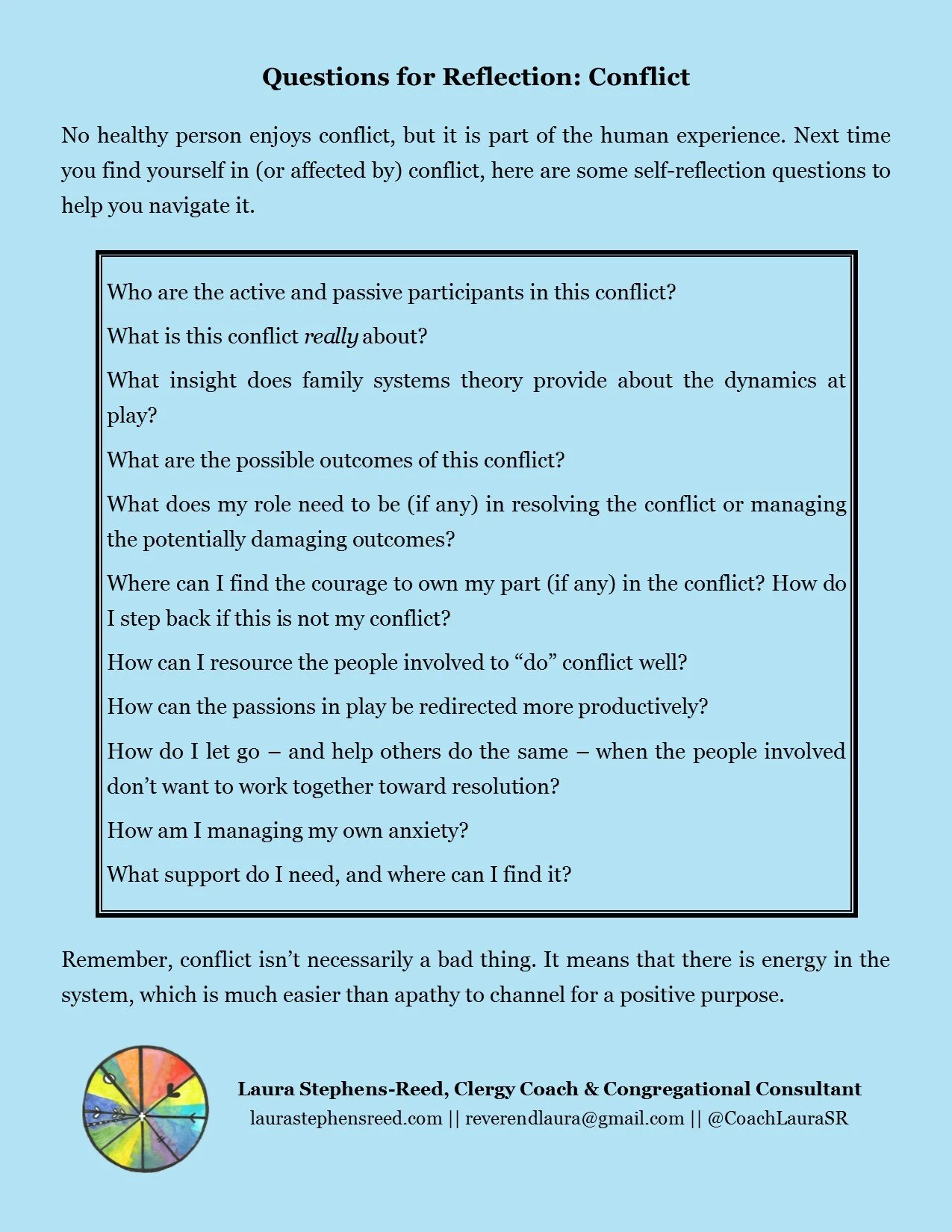
Questions for reflection in times of conflict

There are times when the future seems so murky – or so desolate – that we are utterly unsure what to do next. For many in the United States, this is one of those times.

There are no rewind, pause, or fast forward functions available to us. We can only press play and allow life to unfold. For times such as these, I offer some questions for reflection. They are intended to help us gain new awareness, focus our commitments, and make action plans for leadership and for self-care. Intentionality is our friend when chaos is afoot.

You are welcome to share the image above and/or to print the PDF version available here.

questions for reflection conflict.jpg
Resource: questions for reflection during conflict

Time and again, questions about how to navigate conflict pop up in coaching. (I have some theories about why conflict management has become such a huge time and energy suck in vocational ministry, but those hypotheses are not the subject of this post.) Building upon an earlier article, I have put together a list of questions to mull when conflict arises. I hope you find them useful, and if you do, please share! A printable PDF is available here.

questions for reflection conflict.jpg
A preacher's work is never done...or is it?

I suffer from the terrible scourge that is perfectionism. Until recently, this affliction meant that I’d still be editing my sermons until I stepped onto the chancel, no matter how long I’d been working on them.

Something has changed over the last couple of years, though. I’ve been able to stick a fork in my manuscripts and enjoy playing or even (gasp) just kicking back in the recliner on Saturdays. Maybe I’ve gained a smidge of insight about my process through experience and the passage of time. Maybe I have a different sense of priorities now that I sit across the breakfast table from 28 pounds of pure curiosity, cuteness, and mischief. Maybe I simply trust the Spirit more than I once did.

I don’t think the quality of my sermons has declined, but even if it has, God can hit the override and still speak through me. So if you are a long-suffering perfectionist preacher, here’s what I recommend:

Get an editor. I’m lucky to have one required by the marriage laws of our state (or something like that) to give feedback on my sermons, but in-town friends and online communities are great resources too.

Make plans for Saturday. This is counter-intuitive for many ministers, but it may provide the inspiration needed to finish writing early and set the manuscript aside.

Learn when to call it. Not every sermon will draw Barbara Brown Taylor comparisons. Know when to say, “I’ve worked hard, I’ve tried to be faithful to the text, and it’s up to the Spirit to do the rest.”

Ask for post-sermon feedback. Approach a cross-section of parishioners for their honest, constructive reactions. Knowing what they heard and where they engaged will help with the next week’s preparation.

Thankfully, while it is essential to approach homiletical work with all due reverence, the Word is proclaimed in so many ways – through music, communion, prayer, the passing of the peace, and so many other experiences of the divine. So preaching is not all about us as ministers, and it is certainly not all done by us!

Pruning programs, part 2

You and your leadership have decided it’s time to prune the list of ministries your congregation offers. Now it’s time for the fun (AHEM) part – actually killing what is sure to be an earnest, devoted church member’s pet project.

Sigh. So how do you rip off the Band-Aid with those for whom this will not be good news?

Listen deeply to stories about the ministry’s glory days. This conversation may be uncomfortable, but it is also an opportunity to learn more about the history and culture of the congregation and community.

Show sincere gratitude for the ministry’s impact and the time and energy put into it. There was a need for this ministry at some point, or else it never would have been launched.

Ask the church members whose claw marks are in the ministry what they want its/their legacy to be. What would best honor the people who have poured so much of themselves into this ministry – to end it with joy and intentionality or to let it limp along until it dies of natural causes?

Talk through the importance of letting the ministry go, acknowledging the grief involved. Help the ministry’s proponents come to their own realizations about the potential in reallocating money, time, and person power.

Decide together what elements of the ministry it is important to carry forward. One ministry pollinates another.

Publicly celebrate the ministry and the people who made it happen. This ministry has helped shape the church and its surroundings. Thanks be to God!

Pruning programs, part 1

In many (most?) churches, new ministries are added at a faster rate than dying ones are eulogized. Add to that the new standard for active membership – attending a couple of Sundays a month as opposed to three or four – and congregations are cruising for some big-time leadership fatigue.

It’s important, then, to evaluate ministries for their missional value versus energy expended. Here are some questions to ask staff and lay leaders on a regular basis:

Which ministries…

…embody the core values of our congregation as a whole

…help us share the love of Christ in ways that meet others’ needs, not just our own?

…are reaching people who would otherwise go underserved?

…allow room for initiative, creativity, and new participants/partners/leaders?

…meet the above criteria and are either going strong or have real potential to be re-energized?

Highlight these ministries and determine how to give more oomph to flagging but critical initiatives.

As for the ministries that don’t make this list, stay tuned for part II of this topic.

Picking the low-hanging fruit

At The Young Clergy Women Project conference this summer, keynote speaker Dr. Margaret Aymer taught participants how to design contextual Bible studies with a missional bent. Every discussion of scripture, she said, should conclude with a commitment to action: what small, immediately-doable step can we take in light of what we’ve learned together?

Dr. Aymer used a fruit tree metaphor for sorting possible action items. Low-hanging fruit can be gleaned without too much effort. As you reach for fruit further up the tree, you’ll need a taller stepladder, exert more energy, and take more risk. (You’ll also be able to pick fewer fruits at a time, since you’ll have to juggle your harvest and hold onto the ladder.)

I’ve found the fruit tree metaphor very useful the past few weeks:

What fruit is hanging within easy reach? What small course corrections can I make that will yield big results?

What low-hanging fruit do I need to leave hanging so that others can glean it? How can I be a Boaz and empower the Ruths around me?

When do I really need to break out the stepladder? Have I plucked all the fruit I can/should with both feet on solid ground? Or is the fruit that grows further up somehow more substantive?

How can I minimize the risk? Or, shifting perspective a bit, whom do I need to hold the ladder for me as I climb and to tell me how to reach fruit I can’t easily see?

May your theological discussions and the initiatives that come out of them be fruit-full.

Telling your origin story

During Conan O’Brien’s week of broadcasts from Comic Con, he shared a video about his origin story. (For those who are unfamiliar with the concept, an origin story is an accounting of the events that lead up to the rise of a superhero.) Aside from getting me laughing, the video also got me thinking.

Most Christians will be asked at some point to share their journey to professing faith in Jesus. I wonder how the origin story framework might shift the perspective a bit. Origin stories often begin before the superhero is born, connecting the hero to a larger narrative. They describe the acquisition of special powers, which generally come from a source beyond the hero. And these backstories often point the hero toward some sense of responsibility – a mission, if you will.

It seems to be that origin story thinking might help us widen our view of what people and events shaped us, what gifts have been ingrained in us, and how those gifts might serve the greater good (i.e., reign of God) than many accounts of our call to faith allow.

What, then, is your origin story?