
Clergy & Congregational Coach
laurastephensreed logo2 (1).png

Blog

Helping clergy and congregations navigate transitions with faithfulness and curiosity

My blog has moved to Substack! You can find new articles weekly there.

Visit my Substack

Use the button below to search the blog archives on this website.

Search the blog
Posts in congregations
Fleshing out underwritten characters

My newest pop culture obsession is the Gilmore Guys podcast, which features two men in their 20s discussing each episode of the now-defunct series Gilmore Girls. It is by turns hilarious (though I do need to slap a language warning on this endorsement) and deep with discussions about gender and race, entitlement and selflessness. The hosts, Kevin and Demi, are employed behind the scenes in the entertainment business, so they use some writing and production jargon.

At times Kevin and Demi have noted that some of the minor-but-recurring characters are “underwritten,” meaning the show’s creators missed an opportunity to give them a lot more dimension. That term caught my attention, and I began to wonder where the underwritten characters are in church life. Maybe they’re the folks we call on to help with one particular ministry, even though they have other gifts to share. Maybe they are our antagonists, the people we have trouble empathizing with because we haven’t grasped their deeper motives and backstory. Or maybe we as ministers seem underwritten to our parishioners because they can’t imagine us “out in the wild” (e.g., at a concert, or even in the grocery store).

How then do we flesh out our perceptions of underwritten characters, and how do we let the people in our care see our complexity?
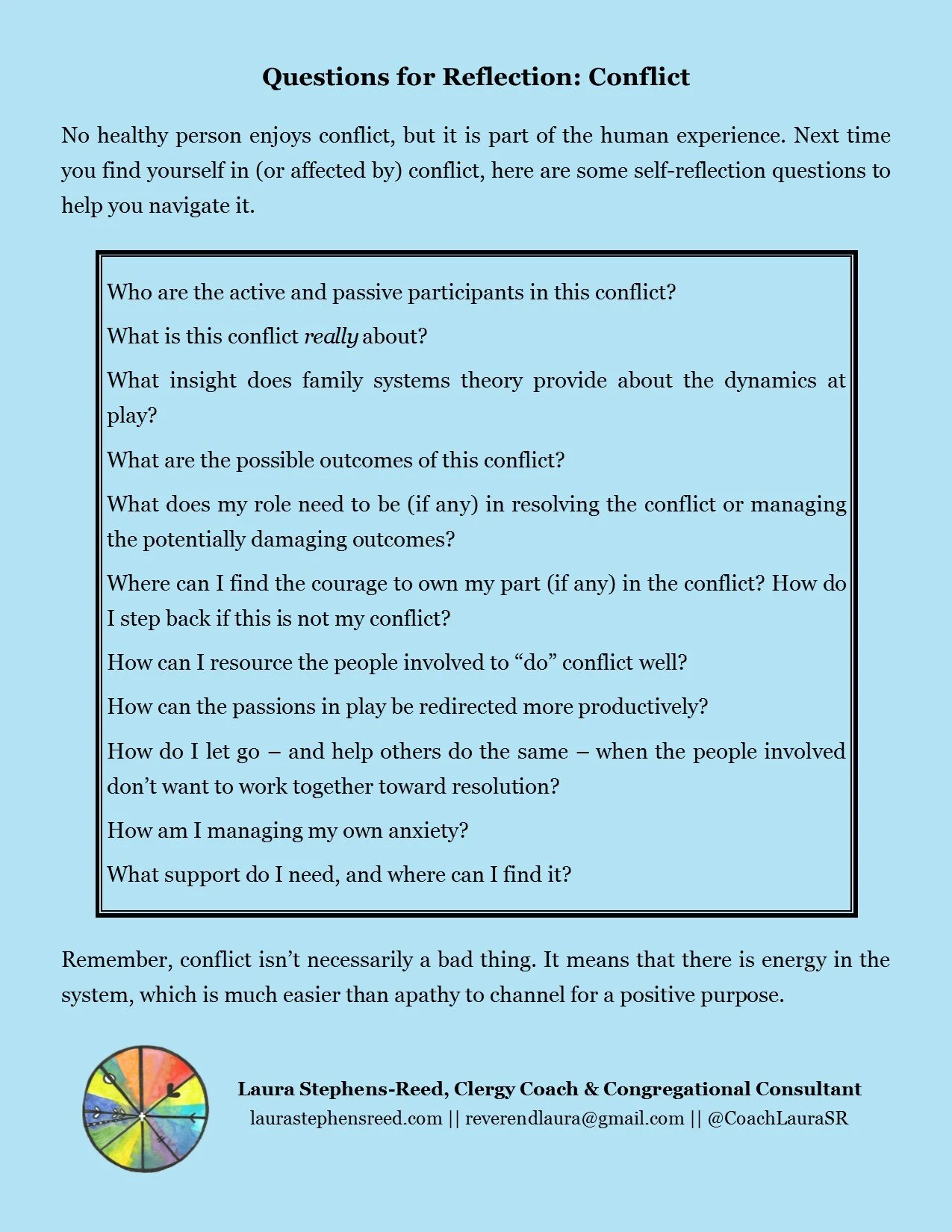
Questions for reflection in times of conflict

There are times when the future seems so murky – or so desolate – that we are utterly unsure what to do next. For many in the United States, this is one of those times.

There are no rewind, pause, or fast forward functions available to us. We can only press play and allow life to unfold. For times such as these, I offer some questions for reflection. They are intended to help us gain new awareness, focus our commitments, and make action plans for leadership and for self-care. Intentionality is our friend when chaos is afoot.

You are welcome to share the image above and/or to print the PDF version available here.

questions for reflection conflict.jpg
Resource: questions for reflection during conflict

Time and again, questions about how to navigate conflict pop up in coaching. (I have some theories about why conflict management has become such a huge time and energy suck in vocational ministry, but those hypotheses are not the subject of this post.) Building upon an earlier article, I have put together a list of questions to mull when conflict arises. I hope you find them useful, and if you do, please share! A printable PDF is available here.

questions for reflection conflict.jpg
Pruning programs, part 2

You and your leadership have decided it’s time to prune the list of ministries your congregation offers. Now it’s time for the fun (AHEM) part – actually killing what is sure to be an earnest, devoted church member’s pet project.

Sigh. So how do you rip off the Band-Aid with those for whom this will not be good news?

Listen deeply to stories about the ministry’s glory days. This conversation may be uncomfortable, but it is also an opportunity to learn more about the history and culture of the congregation and community.

Show sincere gratitude for the ministry’s impact and the time and energy put into it. There was a need for this ministry at some point, or else it never would have been launched.

Ask the church members whose claw marks are in the ministry what they want its/their legacy to be. What would best honor the people who have poured so much of themselves into this ministry – to end it with joy and intentionality or to let it limp along until it dies of natural causes?

Talk through the importance of letting the ministry go, acknowledging the grief involved. Help the ministry’s proponents come to their own realizations about the potential in reallocating money, time, and person power.

Decide together what elements of the ministry it is important to carry forward. One ministry pollinates another.

Publicly celebrate the ministry and the people who made it happen. This ministry has helped shape the church and its surroundings. Thanks be to God!

Pruning programs, part 1

In many (most?) churches, new ministries are added at a faster rate than dying ones are eulogized. Add to that the new standard for active membership – attending a couple of Sundays a month as opposed to three or four – and congregations are cruising for some big-time leadership fatigue.

It’s important, then, to evaluate ministries for their missional value versus energy expended. Here are some questions to ask staff and lay leaders on a regular basis:

Which ministries…

…embody the core values of our congregation as a whole

…help us share the love of Christ in ways that meet others’ needs, not just our own?

…are reaching people who would otherwise go underserved?

…allow room for initiative, creativity, and new participants/partners/leaders?

…meet the above criteria and are either going strong or have real potential to be re-energized?

Highlight these ministries and determine how to give more oomph to flagging but critical initiatives.

As for the ministries that don’t make this list, stay tuned for part II of this topic.

Picking the low-hanging fruit

At The Young Clergy Women Project conference this summer, keynote speaker Dr. Margaret Aymer taught participants how to design contextual Bible studies with a missional bent. Every discussion of scripture, she said, should conclude with a commitment to action: what small, immediately-doable step can we take in light of what we’ve learned together?

Dr. Aymer used a fruit tree metaphor for sorting possible action items. Low-hanging fruit can be gleaned without too much effort. As you reach for fruit further up the tree, you’ll need a taller stepladder, exert more energy, and take more risk. (You’ll also be able to pick fewer fruits at a time, since you’ll have to juggle your harvest and hold onto the ladder.)

I’ve found the fruit tree metaphor very useful the past few weeks:

What fruit is hanging within easy reach? What small course corrections can I make that will yield big results?

What low-hanging fruit do I need to leave hanging so that others can glean it? How can I be a Boaz and empower the Ruths around me?

When do I really need to break out the stepladder? Have I plucked all the fruit I can/should with both feet on solid ground? Or is the fruit that grows further up somehow more substantive?

How can I minimize the risk? Or, shifting perspective a bit, whom do I need to hold the ladder for me as I climb and to tell me how to reach fruit I can’t easily see?

May your theological discussions and the initiatives that come out of them be fruit-full.

Telling your origin story

During Conan O’Brien’s week of broadcasts from Comic Con, he shared a video about his origin story. (For those who are unfamiliar with the concept, an origin story is an accounting of the events that lead up to the rise of a superhero.) Aside from getting me laughing, the video also got me thinking.

Most Christians will be asked at some point to share their journey to professing faith in Jesus. I wonder how the origin story framework might shift the perspective a bit. Origin stories often begin before the superhero is born, connecting the hero to a larger narrative. They describe the acquisition of special powers, which generally come from a source beyond the hero. And these backstories often point the hero toward some sense of responsibility – a mission, if you will.

It seems to be that origin story thinking might help us widen our view of what people and events shaped us, what gifts have been ingrained in us, and how those gifts might serve the greater good (i.e., reign of God) than many accounts of our call to faith allow.

What, then, is your origin story?

Embracing the new normal

In seminary I searched for my denominational identity. I had always been a Baptist, but that label came with a lot of baggage. I tried on a few other denominations that first year, but none of them really fit. It was only when I attended a local congregation’s Bible study on Baptist distinctives that I realized I was – am – in fact a proud Baptist.

The struggle then was being a future-oriented Baptist in the south, where many of my progressive peers were expending a lot of energy mourning a pre-fundamentalist Southern Baptist Convention that I had never known. I tried to understand their pain, but it was tough. There was no pendulum swing coming in the SBC, and new networks were emerging for centrist and left-leaning Baptists. There was clearly a new normal at play, one that I was enthusiastic about.

I heard echoes of my experience in this blog post by a new(ish)comer to the Christian Church (Disciples of Christ), which gathered in Ohio last week. (Discipledom is my second home these days.) Sara Fisher writes this about the passion and faithfulness she witnessed at her first General Assembly, even as longtime Disciples grieved the shrinking attendance:

“As a new-ish Disciple, this IS normal….This is what I signed up for.

Yes, newbies need to be historically aware and sensitive to those who see demise where we see life. But as long as people are joining us and saying, this IS what I signed up for, the church has a future. May those with institutional memory allow the whippersnappers to infuse some energy into the system, and may we young’uns remember that the long-timers still have vast knowledge and needed leadership to offer.

Contextual Bible study

A couple of weeks ago I attended The Young Clergy Women Project conference in Austin, Texas. I have gone to seven TYCWP conferences primarily for the fellowship, but the content is invariably excellent as well. Led by Dr. Margaret Aymer, this year’s plenaries focused on how to design a Bible study that emerges from the questions of the community.

The first step in the process is to gather some of the community’s leaders and ask them to name the most pressing issues facing the community. This group then brainstorms some passages of scripture that could potentially speak to the selected issue and chooses one to study.

The Bible study facilitator then takes the passage and creates discussion questions about it with the issue in mind. The questions attempt to draw out and privilege the wisdom in the room. They address such angles as:

  • what the scripture passage is about

  • who’s in the passage and what they’re doing

  • what the context (historical, narrative, etc.) is in relation to the selected issue

  • how the passage speaks to the issue and the community’s context

The Bible study is not just an academic exercise, however. It ends by asking, “Now what are we going to do about the issue at hand, given our discussion of this passage?” The students name possible actions and choose an easily doable one to tackle.

The contextual Bible study would be an effective approach in any situation, but I believe it would be especially helpful in situations of conflict and/or transition. If you’d like a fuller explanation of this method, the Ujamaa Centre for Community Development and Research has a manual here.

Here I raise mine Ebenezer

I ran across a great tool for intentional interim ministers leading congregations through the heritage focus point. My husband’s church is undergoing a visioning/renewal process, and the leadership team for this process was asked to create an Ebenezer.

Ebenezer literally means “stone of help,” and it refers to Samuel’s placement of a marker that witnessed to God’s faithfulness (I Samuel 7:12). It signified the Israelites’ recognition of God’s constant presence with them up until the Ebenezer’s dedication. It was a visual reminder that the Israelites were purposefully entering a new era in their relationship with God.

In the heritage focus point, a congregation in transition acknowledges, celebrates, and grieves its history up until the current moment. Churches cannot move forward without first looking backward, noting where God has been at work all along and bringing closure to old hurts. After an intentional interim minister and transition team lead the congregation through their exercises of choice to accomplish these goals, I can see where it would be healing and hopeful for everyone to work together on creating an Ebenezer. Such a visual would mark the move from hindsight to foresight, and it could be incorporated into liturgical design or placed in a high-traffic area of the church as a sign that the always-faithful God is about to do a new thing.

The power of yes

In improvisation the rule is always to say “yes, and” to your fellow actor. In other words, take what that person gives you, however bizarre, and build on it.

In our everyday, walking-around lives, there are occasions when we have to say “but” or “no.” We bracket our yesses when a toddler is about to lurch onto a busy street, for example, or when a perpetrator does unspeakable harm to a victim.

But I think that in general, the “yes, and” guideline is a helpful one. It notes an understanding of current circumstances and a willingness to move forward in light of them. It signifies that we can make choices and build relationships that add value to our lives and the lives of others.

Saying “yes” is inclusive. It calls for flexibility. It is hopeful without being naïve. It also forces us to consider how we might become more versatile, dancing in the moment, however messy that moment is.

The “and,” though, is the real key. It is the difference between mere people-pleasing and maintaining a non-anxious presence in the face of challenges. The “and” is a mark of creativity rather than reactivity.

May we focus on the yesses being offered to us in this complicated time, and may we then use our gifts and passions to influence the arc of humankind for the better.

Creating networks of support

At my denominational meeting last week, I co-led a workshop on creating networks of care. Below are some of the notes for my piece of the workshop, which focused on finding non-peer professional support. (Note that my section followed a discussion of the value of peer learning groups.)

What are the benefits of non-peer professional support?

  • Non-peer professionals come with particular expertise and credentials. They are also often able to be more objective about your situation and needs than peers.

  • Professionals are generally bound by confidentiality clauses in the professional-client covenant and in the ethical codes of their disciplines, thus creating a safe environment for you to share freely.

What are the biggest differences between a coach, spiritual director, and therapist/counselor?

  • Coach: Coaches concentrate on forward movement from the present, helping the coachee name particular action steps toward reaching goals. The coach believes that the coachee is the expert on his/her situation, and the coach asks focused questions to draw out inherent wisdom and new awareness in the coachee. The coachee sets the agenda, meaning the coach asks questions that help the coachee reach her/his stated goal.

  • Spiritual director: Spiritual directors help clients pay attention and respond to where God is at work, letting go of whatever is in God’s way. Spiritual direction’s main emphasis is growth in relationship with divine. The spiritual director’s primary tools are study, narrative, questions that prompt reflection on the spiritual life, and spiritual disciplines.

  • Therapist/counselor: Therapists assist clients in healing from past events and learning how to move forward in light of them. Therapy uses narrative, problem-solving, and various exercises to help the client find health.

Each of these fields has nuances, and many ministers engage more than one of them. The different approaches often complement one another.

Where would a minister look for one of these professionals?

  • Ask for referrals from ministerial colleagues and/or denominational staff.

  • Additionally, if you’re looking specifically for one of these professionals:

    • Coaches: Check with coach accrediting bodies, seminaries, and parachurch organizations.

    • Spiritual directors: Look for spiritual direction accrediting bodies and retreat centers.

    • Therapists/counselors: Contact nearby pastoral counselor centers, your insurance provider, or your physician.

How does a minister determine a good match with a professional?

  • Comfortable talking with the professional

  • Clear about nature and goals of relationship

  • Confident in professional’s skills, willingness to listen, and commitment to confidentiality

  • Sense support and/or progress in the issues raised

Don’t hesitate to end a relationship if you and the professional are not a good match!

How does a minister pay for this professional support?

  • Check on insurance coverage for counselors/therapists.

  • Use professional expenses as appropriate. (Check with your ministry setting or a tax professional if you have questions about appropriate uses of funds.)

Blind spots

Last week well-known Christian author Anne Lamott caught a lot of flak for her tweets about Caitlyn Jenner, many of which were deemed insensitive by transgendered people and their allies. In response, writer Jonathan Merritt called for grace, noting that many of us are just now learning about transgender issues: “…[W]hen people with limited knowledge begin to engage complex issues, those people often misspeak and

All of us have blind spots about other people’s experiences. I am a straight, white, cisgender, middle-class, Christian, American female. I can know and speak with certainty only out of the overlap of those categories. To know about the privileges and concerns of people from different intersections, I have to be willing to learn, and the experts on those intersections – i.e., the people who live in them – have to be willing to teach me.

How, then, do I deal on a practical level with my gaps in understanding?

Acknowledge having blind spots. There’s plenty I don’t know, and sometimes I don’t even know what I don’t know.

Look for conversation partners. Who will take the risk of sharing truthfully with me about their struggles? It’s important to seek out these generous souls without shifting the onus of the work - which is rightfully mine - to them.

Refrain from arguing with someone else’s experiences. They were there. They have lived this. I was not and have not.

Ask for feedback. Whose perspective(s) am I still overlooking? What language should I be using?

Let the dialogue change me…and my ways of doing and being. Now that I have this knowledge, there are realities that I can no longer ignore. So what now?

No one wants to be told that their understanding is deficient and that their comforts come at the expense of another. But the hard work of knowing and being known by others pries ever more open the curtain between this world and the one to come.

Sacred cow-tipping

In every new call there are landmines that must be sussed out and avoided, at least in the early days. You’ve got to figure out what topics can’t be discussed without hushed tones, what habit the last pastor had that drove everyone crazy, whose blessing is needed to launch a new initiative. Early wins + landmines avoided = longer honeymoon period for church and minister.

And then there are sacred cows. These are the preferences and rituals that church folk sometimes seem to love more than Jesus himself, bless their hearts. Every church has them, and they are the stiflers of new leadership, new ideas, and new life. They trap congregations in permanent maintenance mode.

In his article “Eight Common Characteristics of Successful Church Revitalizations,” Thom Rainer emphasizes the importance of taking on those sacred cows. He notes that one church listed all of its ministries and labeled them as biblically essential, contextual, and traditional. In other words, where in scripture do you find a directive for this ministry? If it’s not in the Bible, do we hold onto this ministry because it serves our community well or because we have “always” done it?

I think this kind of parsing – done by leadership teams or by the congregation as a whole – could be very eye-opening. “Why do we do what we do?” leads into “Is it helping us accomplish our God-given mission now, and if not, where would our efforts and resources be better spent?”

Ministers cannot tackle sacred cows alone. They must help the congregation come to its own realization that it is a new day with new needs.

Congregational discernment

Church strategic plans – in the traditional sense – are tricky. They require congregations to predict cultural shifts, the economic fortunes of the surrounding community, and technological innovations (including social media) for the next five to ten years. In other words, they can quickly become outdated.

There’s a better way. Following the lead of some uber-productive businesses, some congregations and denominations are visioning in one-year chunks. (I know, I know. I generally don’t like the thought of patterning ministry after business, but in this case I’ve found it’s helpful.) Yes, the church still has to have a larger understanding of its purpose for longer-term needs like facilities and staffing, but these single-year processes make sure that specific projects are fresh, meet the current needs of neighbors, and utilize assets to their fullest.

The Cooperative Baptist Fellowship’s Dawnings initiative, for example, teaches spiritual practices to a congregation’s leadership team and guides the team in using those practices to discern God’s mission for this church in this time. The arc of Dawnings goes something like this:

  • How do we attune ourselves to perceive God?

  • Now that we’re better able to pay attention, what work does God have in mind for this church to do in the community in the coming year?

  • What resources do we already have toward these ends?

  • What additional resources do we need, and where will we find them?

The result is doable ministry that will make an immediate impact. A side benefit is that a congregation is not forever wedded to these projects, so there’s more willingness to try something new. And the overall impetus is entirely different from a strategic plan. Rather than a church creating a scratch blueprint out of its desires and hopes, it is taking an in-depth look at its neighborhood and adding its energy and assets to places where God is already at work.

A tool for tough conversations

Conflicts often go from a simmer to a roiling boil when a person or group feels powerless to affect the narrative. Maybe there’s a quiet person who needs extra time to process or doesn’t like to interrupt. Or someone on the fringes who feels self-conscious putting forth a minority viewpoint. While it seems simpler in the short run to let the loudest voices propel a cause, those who feel ostracized may leave the conversation altogether or nurse resentment that later manifests in destructive ways.

Power sharing is one answer to this imbalance. Recently one of my coachees introduced me to the concept of mutual invitation as outlined by Eric H. F. Law. In this process the leader gives personal perspective on the issue at hand, then invites someone else by name to do the same. That person can speak, pass for the time being, or pass altogether, then invites the next person to share. These steps repeat until everyone in the room gets two choices: whether to speak, and whom to invite to speak next.

Mutual invitation could be a very useful tool for potentially divisive conversations. Each person has the chance to contribute uninterrupted, and no one can later claim not to have been given a forum. And since people invite one another to speak by name, everyone has not just a listened-to voice but also an acknowledged identity in the process. Mutual invitation would work well with a leadership team or other small gathering. In larger groups, it could be employed in table discussions, with findings then reported to the whole body.

Practice like you play

Recently I was directing my youth in a run-through of their Youth Sunday worship service. This was a full rehearsal so that we could work out the rubics, troubleshoot AV issues, and make sure every aspect of the service pointed back to the youth-chosen theme. Several times I was asked – since there were all-important lock-in games like Sardines and Mafia to get to – “Do I have to read my whole part? I know what I’m supposed to do.” And each time I replied, “Practice like you play.” (I guess that old desire to coach basketball still lurks in the back of my brain.)

There are some worship leaders who think that writing out liturgy and sermon manuscripts (if that suits your preaching style) and rehearsing worship prevents the Holy Spirit from moving in the moment. But I believe that good preparation is a sign that a worship leader takes seriously his/her responsibility to God and to the gathered body. It’s a mark of hospitality when a worship leader ensures important details are highlighted and good transitions are made, because otherwise visitors won’t know what to expect. Preparation and rehearsal also create muscle memory in a worship leader so that if he/she is having an off day, the advance work can fill in some gaps.

But perhaps most importantly – and ironically – practicing creates more space for the Holy Spirit to operate. The Spirit isn’t limited to influencing the worship hour but instead can guide all the planning, study, writing, rehearsing, physical space arranging, and recruiting of liturgists, musicians, and greeters.

Practice like you play…and invite the Holy Spirit to redirect you in the moment and to translate all that happens into the message(s) the people in the pews need to hear.

Channeling conflict

No one – well, no healthy person – loves conflict. But since we are neither clones nor automatons, conflict happens.

Actually, I’ll take it a step further. We need conflict to grow as individuals and as communities. That tension prompts us to reflect on and clarify what we’re passionate about and why. It (ideally) makes us more carefully consider our positions and interactions and keeps us engaged with those who believe differently than we do. Conflict also shakes us out of complacency by spicing things up.

But conflict is still uncomfortable and potentially destructive if it’s not managed well. Here are some questions to ponder when dealing with conflict in a ministry setting:

What is really driving the conflict? Often the presenting issue is not the real issue.

What does your role need to be in managing the conflict? Know where your involvement should begin and end. Don’t enable others’ bad behavior by stepping in out of your own anxiety.

How can the passions at play be redirected? Apathy is a much bigger problem than conflict. So what are some positive outlets for the care being shown?

What culture changes need to occur so that future conflict is productive? Be proactive about teaching your people how to fight well. It will be worth your effort!

The endgame is not to eliminate conflict but to do conflict well. If you know people or churches who model this, find out what their conflict hacks are and try them on for size.

The power of small

One of my son’s favorite books is Mousetronaut: Based on a (Partially) True Story by Astronaut Mark Kelly. It is the story of Meteor, a diminutive mouse chosen for a spot on the space shuttle based on his hard work and confidence. Meteor is happy to be along for the ride, but he’s not sure what his role in the mission is supposed to be. When the key to the control panel drops into a crevice unreachable by the astronauts, though, Meteor uses his size to squeeze into the space and dislodge the key. For his efforts Meteor is heralded as a mousetronaut, and he relishes this new identity and proudly proclaims the power of small.

There’s a lot of focus on size in church life. How many people are in the pews on Sunday mornings? How big is the offering? These questions come internally when corporate self-esteem is based on nickels and noses or when the membership has reason to wonder if God has left the building. They also come from outside sources, such as judicatories that ask churches to keep score of professions of faith, membership transfers, and the exact number of sweet peas donated to the food bank each year.

This numbers emphasis could mislead us to believe that there is something wrong with small churches. Yes, congregations can remain small because they are cliquish or uninterested in discipleship and mission. But sometimes churches are small because that is the size they need to be to fulfill the task God has for them. A 75-member congregation can’t offer all the life groups, children’s programming, or worship time choices that a megachurch can. But it can throw open its doors to the community with less red tape, welcome people looking for a faith community without the intimidation factor, and build lasting relationships with service organizations since lay leader turnover is less frequent.

Sometimes impact is inversely proportional to size. If your church has earnestly discerned the mission God has for it and that assignment lends itself to a smaller membership, wear your corporate identity with pride. The goal, after all, is not nickels and noses. It’s going forth to share the love of God with people who need to hear it.

Being a good teammate

As the NCAA tournament has played out the past few weeks, I’ve spent some time reflecting on what makes a good teammate. Ministry is a vocation that can lend itself to Lone Rangerdom, but it bears the longest-lasting fruit when it is done collaboratively. (Hey, even God needs three aspects working together to get the job done.) Whether you are part of a big staff or a solo pastor who recruits laypeople for some of the tasks covered by ordained ministers in larger churches, the following observations apply.

Good teammates:

Cooperate. This seems obvious, but it doesn’t always happen.

Coordinate. The most effective ministry requires some measure of advance planning – together – not just in our individual areas of responsibility.

Communicate. Learning teammates’ verbal and non-verbal cues cuts down on costly misunderstandings and allows the team to roll more easily with the unexpected.

Practice and play hard. The whole team looks good when everyone has prepared. On the other hand, one person’s lack of preparedness can make the whole team look like it hasn’t taken the task at hand seriously.

Share credit. Spread the word about how others contributed to a good outcome. Your teammates will become more deeply invested in your relationship and in your shared mission.

Encourage one another. We all get down. And when we get down, we rarely do our best ministry.

Know how and when to confront one another… Teams run into personality conflicts and differences of opinion. Don’t let them fester.

…but also maintain a unified front. Nothing tears a team apart faster than teammates talking behind one another’s backs.

Being a teammate is about working with others toward a common goal and making those around us better. And there are few things as exhilarating and productive as being part of a team that has really gelled.