
Clergy & Congregational Coach
laurastephensreed logo2 (1).png

Blog

Helping clergy and congregations navigate transitions with faithfulness and curiosity

My blog has moved to Substack! You can find new articles weekly there.

Visit my Substack

Use the button below to search the blog archives on this website.

Search the blog
Posts in congregations
The fatigue that goes beyond burnout

By now many clergy have been introduced to the good work of the Nagoski sisters on burnout, which they define as emotional weariness, the inability to give a crap anymore, and the persistent sense of yelling into the void. The Nagoskis talk about completing the stress cycle as a way to avoid the desire to collapse in a heap or run like your hair is on fire in the opposite direction from your current one. This means going all the way through the feeling (once you’re safe from the stressor itself) instead of stunting the emotion. If you haven’t read Burnout: The Secret to Unlocking the Stress Cycle, I highly recommend it. The book offers some practical tips for mitigating a persistent problem for people, and particularly women, in the helping professions.

But even as I read Burnout, there was something nagging at me. It wasn’t until reading a recent piece by culture study author Anne Helen Petersen that I figured out the issue. When we talk about burnout, we largely frame it as a personal problem: we need to set good boundaries and take better care of ourselves. And while that is absolutely true, completing stress cycles alone will not fix what I think is weighing heavily on so many ministers - demoralization. Petersen quotes an article on teachers by Doris Shapiro:

“Demoralization occurs when teachers cannot reap the moral rewards that they previously were able to access in their work. It happens when teachers are consistently thwarted in their ability to enact the values that brought them to the profession.”

Many teachers approach their vocations as callings, just like pastors do. And I see a direct connection from the difficulties teachers have faced during and even before Covid to those clergy are reckoning with. Yes, ministers work too much and bear responsibility (though not sole responsibility) to tend to their physical, mental, emotional, relational, and spiritual health. But underneath all the stress is a bigger problem, which is that pastors were called to partner with God in transforming lives and communities, and many of the people in our pews mightily resist even the smallest of changes. That is neither a personal problem nor an easy fix.

We cannot control what those in our care do. They might not ever change, and if that’s the case, it might be time to move on. But we can adjust how we show up as leaders and what questions we ask so that we invite our people to consider new modes of being and operating. We can do what some see as “soft” work but is actually wisely playing a long game, building the trust, spiritual muscle, and imagination required to make permanent changes. We can start with curiosity, simply saying, “Tell me more” or “What’s important to you about that?” We can bring in spiritual elements, musing aloud, “I wonder what God is up to in this.” We can incorporate regular reflection as individuals and teams to celebrate what we’ve done well and learn from our mistakes, taking the sting out of “failure” in the process. If we take this posture with our congregations, it might just initiate incremental experimentation that can pick up momentum.

Teachers, unfortunately, have limited say in curriculum standards, teaching methods, and learning benchmarks. Pastors have much more freedom. Let’s leverage it, encouraging and noticing a widening gap between what we’ve always done and what is possible so that we all can live fully into our callings and not become mired in the quicksand of demoralization.

Photo by Luke Porter on Unsplash.

A shout out to all the unintentional interim ministers out there

I had a short tenure in my first call. Don’t get me wrong, I loved the church. It was full of people who believed like I did, a relative rarity in the southeastern US. I heard exceptional preaching every week from the senior pastor, and I got my own opportunities in the pulpit. And, my office was located on a college campus, which meant I was a short walk away from all the books in the university library. Drool.

But my now-spouse lived a 10-hour drive away. As a United Methodist provisional pastor, he could not leave Alabama without setting back his ordination process. When we got serious about our future together, I was the already-ordained and thus more mobile pastor. I was ok with moving. For one thing, I was awfully naive about my professional prospects in what would be my new home. For another, the church I was departing, as wonderful as it was, had some challenges. I had followed a long-time, much-loved associate pastor who, a couple of years after her departure, was still present in many ways. She had also led the church through a significant change for which there was little lead-up process, leaving church members’ trust in one another, in the university, and in the pastoral staff iffy. While her actions were not in any way intended to cause conflict, they resulted in a number of difficult circumstances. When the senior pastor took his long-delayed sabbatical a few months into my tenure, I ministered solo through a messy situation for three months. By the time he returned, I was wrung out.

The chair of deacons (in this context, he was the key lay leader) was the first layperson I told about my imminent move. He said, “You’ve been a great unintentional interim for us.” That was a gut punch. I hadn’t taken this call to be a short-timer, and this statement dredged up some serious shame. With time, though, I saw his comment differently. I had provided much-needed consistency and clarity during an anxious time. This was a gift I was uniquely suited to give as someone who had barely put both feet in before taking one, then the other, out. This experience set me on a ministry trajectory toward intentional interim ministry and coaching, both of which fit me and my circumstances as an itinerant clergy spouse well. Today, I treasure that deacon chair’s observation and the work it began in me.

Many ministers have found - or will find - themselves in that unintentional interim role. You came into your call with great hope for a long, fruitful tenure. When you arrived, though, you found a church that either had not done the hard work of self-reflection during the pastoral transition, or that had so many issues to address that they couldn’t all be covered in one stretch, or that developed deep fissures over, say, pandemic response. You have realized that your remaining time at your church will be shorter and more intense than planned. You probably have Feelings about that. Whatever they are, they are valid.

Know, though, that just because you are an unintentional interim, that doesn’t mean your leadership isn’t incredibly valuable. You are steadying the ship during a very fraught time. You are allowing problems to surface so they can be named and dealt with. You are loving your people. You are paving the way for your successor to succeed. All of this is the Lord’s work, and you will leave your congregation better than you found it.

So I see you, unintentional interims. You are my people. I am cheering you on, and I’m praying for you.

Photo by Juliana Romão on Unsplash.

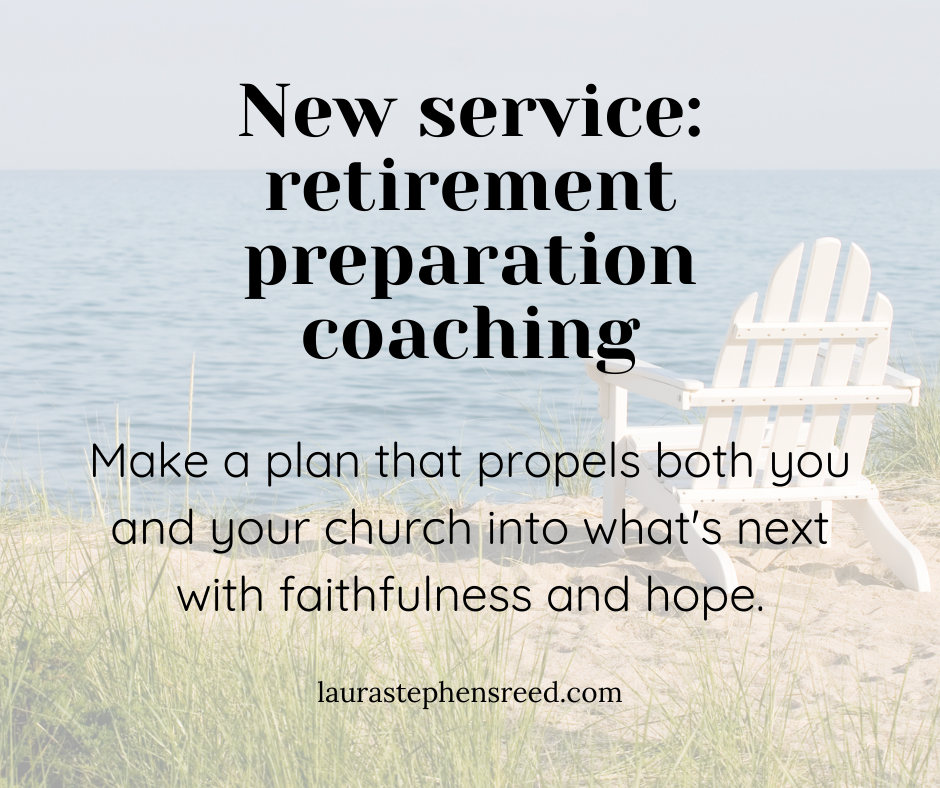
New service: retirement preparation coaching

By sheer force of demographics, there is likely to be a big wave of pastoral retirements in the next few years. That number will be augmented by the strain that the pandemic has placed on clergy. After navigating the tensions around safety precautions and noting that some version of online ministry is here to stay, many pastors who have the financial means will, understandably, decide that the time is near to enjoy the fruits of their labors and spend more time with people they love and activities they haven’t had time for previously.

This retirement can be a celebration, a forward-propelling moment for both the pastor and the church. When clergy retire with intentionality, it

  • Allows the ministry pastor and congregation undertook together to carry forward

  • Shows care for the church

  • Gets the departing minister in a good head and heart space for what’s next

  • Helps set a helpful tone for the transition period, including the pastor search

  • Strengthens congregations’ connections to bodies itself useful in the transition and beyond

  • Paves the way for next minister to get off to a smooth start

  • Can be spiritually transformative for all involved

In short, pastors can do as much leading in the ways they retire as in all their time leading up to their departures, setting themselves up to enter a new chapter with fulfillment and hope. Thoughtfulness, though, is key. That’s why I’m introducing a new coaching package for those clergy who are considering retirement. Over a series of 6 one-hour sessions, we will develop a plan to address the Ps of finishing well:

  • Processing. What aspects of your identity are bound up in being a pastor, and what might be some healthy ways to have those needs met in retirement?

  • People. How can you show grace to those you’re leaving behind?

  • Priorities. What big picture pieces are you holding that you need to follow through on, pass to others, or set aside?

  • Preparations. What logistics need to be tended to and by whom to pave the way for a good transition?

  • Promotion. Whose voices, inside the congregation and beyond, need to be heard now in order to broaden the church’s imagination about what will be possible after you leave?

  • Personal planning. What financial support will you need in retirement, and where might you find it? Where will you continue to find purpose, routine, and support once you are no longer the pastor of your church?

The cost for the six sessions plus a planning sheet organized by the 6 Ps of retirement planning is $900, and you can schedule a free exploratory call to talk about through your questions and hopes for retirement coaching here.

The window of opportunity to make changes based on pandemic learnings is closing

A couple of months ago, I believed my turn at vaccination against Covid-19 was way in the distance. But I suddenly found myself with an appointment in late February, and now here I am, fully inoculated. I cannot overstate how grateful I am to have had my turn. (Please take yours when it comes up!)

I’m not the only one with this sense of whiplash. The vaccine rollout was so slow, so discombobulated, at first that normal-ish still seemed out of reach for many of us. But then production ramped up and more vaccination sites opened. All people ages 16 and up in my state are now eligible to receive their doses, and President Biden stated that all adults could have had shots in arms by July 4.

This is fantastic news. It means that the timeline for fully returning in in-person church activities has shortened greatly. And that means that the conversations pastors were planning to have about what post-pandemic church looks like need to start happening now.

Most clergy knew pre-Covid that the church was headed toward major changes - or at least needed to be. Congregations are shrinking. In many cases it’s because members have dug in their heels, building fortresses around ministries that feel familiar instead of responding to the gifts and needs of younger demographics and surrounding communities. When the pandemic struck, so much had to change for safety reasons. And while we all have an understandable desire to reclaim our lives and our routines, we must not pass up this opportunity to think about what could be faithfully different. We might not ever get another moment like this - to reflect on God’s dream instead of simply springing back to what was - while our churches still have critical mass and decent budgets and a chance to flourish.

I believe that the world needs the church. At their best, congregations connect us to each other and to God, affirm the goodness of each person made in God’s image, promote thriving by accompanying people through life’s peaks and valleys and giving them tools to make meaning out of those experiences, offer tangible help to those inside and outside its walls, and push for equity based on the teachings and example of Jesus. Let’s imagine together what this can look like at this time, in our evolving contexts. Here are some questions to reflect on the learnings of the past year and prompt forward-thinking discussion:

  • What has this church done well for a long time?

  • What did we learn was possible this year that we didn't know before?

  • How have these learnings excited us? Revealed God at work among us and through us? Built on whom we know ourselves to be (or whom we aspire to be) as a congregation?

  • What have we learned this year about what we want to stop doing?

  • What have we missed doing this year that we want to pick back up?

  • What do we want our role in this community to be?

  • What gaps do we need to fill in to make this happen?

  • What do we want to try and then reflect further on based on all of the above?

  • How might these choices help us live more fully into our values as a congregation?

As we move into the season of Easter (in which Jesus invites us to consider what resurrection means for us) and Pentecost (in which we celebrate the openness of Jesus’ followers to new people and ways), there is no better time liturgically and public health-wise to consider what God is nudging us toward. If we wait too long to have these conversations, our church members might settle so deeply back into the worn places in their seats that we’ll have to wait for another crisis to drive us to change - or to close our doors permanently.

Photo by Debby Hudson on Unsplash.

The grief that comes with returning to normal(ish)

When school was closed temporarily last March, I didn’t think I could handle it. I love my child more than my own life. And, I didn’t want to be his primary teacher. I didn’t know what first-graders were supposed to learn in the year of our Lord 2020. I also needed him to be out of the house so that I could work and get my essential introvert time.

When school was called for the rest of the year, I curled up in the fetal position.

One year later, it is astonishing to me that he’ll return to a classroom in the fall and that I’ll probably feel ok about the safety of it. On the virtual school mornings when we are frustrated with each other (these occur often, by the way), I dream of August 10. The rest of the time, though, I’m sad about sending him back. I have learned a lot from his resilience and adaptability. I have delighted in midday snuggles. I have laughed at the stand-up comedy routine he’s developed and shaken my head in wonder about everything techy he’s taught himself to do while he’s been at home. I am relieved that his quirky spirit and big dreams remain intact, uncrushed by teasing peers and unimaginative adults.

Sending my child back to school isn’t the only part of the world re-opening that I’m not too sure about. It’s been fantastic not worshiping in the fishbowl as a clergy spouse. I have not missed the seasonal flu one bit. Though there was a brief stretch when I lamented not traveling for work, I’m not looking forward to the prospect of having to do it again. And my beefs are small compared to many others.’

There’s a lot we have lost this year, individually and collectively. It’s vital that we process our reactions to it all. But I don’t hear many people talking yet about the grief that awaits us when we emerge from lockdown. Any change, even one that is largely for the better (and a world not held captive by Covid-19 is of course a positive change) brings grief. If we’re not ready for it, it will knock us on our butts. If we feel shame about it - why am I down when everyone else is celebrating? - we will replace physical isolation with its emotional and relational cousins.

With regard to clergy specifically, I hear anticipatory grief about what the After will mean for their vocations. They have pivoted and innovated, and what has not been ideal has nevertheless become familiar. What will it mean to leave the safety of this new familiar? If the church tries to make them pull double duty, continuing online ministry while leading in-person versions of the same events, they will burn out. If the church tries to forget the last year and all its lessons, grasping for a pre-pandemic iteration that was already in need of rethinking, they will not abide it.

Grief points us to what we value. Don’t ignore it. Don’t try to process it alone. Instead, let’s listen to and learn from it. If we allow it, our grief will be an unforgiving but invaluable teacher about how we can move forward together with faithfulness, grace, and intention.

Photo by Karim MANJRA on Unsplash.

I hit the wall a couple of weeks ago

Two weeks ago, I started having trouble getting out of bed. Once I did, I felt foggy and sluggish all day. My usual discipline and drive felt blunted. Whenever I had an unscheduled hour, I’d curl up in the guest bed, hoping to regain some of my strength.

What is going on here? I wondered. I didn’t have the usual symptoms of physical illness, like fever or chills or congestion. I was sleeping terribly, but that was nothing new. There hadn’t been any significant changes in my circumstances, and any minor alterations were for the better, like warmer weather and my first Covid shot.

Then it clicked. It was the one-year anniversary of lockdown. 12 months of pivoting in parenting and working. 52 weeks of not going much of anywhere. 365 days with no time to myself. 525,600 minutes of worry about the state of the world and the physical, mental, and spiritual health of the ones I love. Of course I felt like I’d run full-tilt into a cinder block wall.

Once I realized what was happening, I started making changes immediately. I’d gotten lax about my internet use, checking email and Facebook before I got out of bed in the morning up until I went to bed at night, and it was ramping up my anxiety. I began enforcing a boundary of no internet until after I got ready and none after dinner. I also purposefully left my phone in a different room at points between those start and end times so that I would be less tempted to look at it.

I paid more attention to what I was eating. As someone who had gestational diabetes, I am at risk for developing the non-pregnancy kind, and I’ve been sensitive for years to big fluctuations in my blood sugar. I made sure I was getting more protein into my diet, particularly at breakfast and snack times, so that my blood sugar wouldn’t bottom out.

And - arguably most importantly - I acknowledged what was happening in my body and mind and what my limits were. This was (and is) a time to be gentle with myself, not to bulldoze ahead as I typically do.

When so much is out of my control, these were three steps I could take that were in my purview. I am still weary. After all, Covid hasn't gone anywhere. But these changes have helped a lot, and I hope that they have laid the groundwork for ongoing adjustments as the ebb and flow of the virus impact continues. If you have hit the wall, what are some tweaks you can make to clear out the concussive fog?

Photo by Pete Willis on Unsplash.

This could be the hardest period of the pandemic for pastors

I still tear up every time I read about Facebook friends receiving round 1 or 2 of the Covid vaccine, the photos of their faces reflecting a whole range of emotions: relief, utter joy, regret that people they’ve lost didn’t live to see the vaccine rollout. It feels like we’re collectively turning a corner, especially as vaccine availability ramps up. Praise God from whom all blessings flow.

And yet, this very good news has a shadow side for pastors. Our churches are increasingly made up of the fully-vaccinated, since those who are currently eligible to receive shots are disproportionately represented in most mainline congregations. Those folks are saying, “Woo-hoo! I’m vaccinated. Let’s throw the church doors open.” It’s an understandable impulse after a year of no hugs and unchanging surroundings, but it’s not without issues:

In many states clergy are not yet included in the ranks of those who can sign up for vaccine appointments. Unless your pastor is eligible by virtue of inclusion in a different qualified category, your minister does not yet know when to anticipate inoculation. It can make a clergyperson feel like a hired hand rather than an integral part of the faith community when church members say, “It’s safe for us,” with the implication that that’s the only consideration.

The vaccination of some populations is still an indefinite number of months away. Shots for children, for example, are still more promise than reality. What do we do with that knowledge as a congregation? How do we balance the needs and hopes of those who feel safe coming inside the building with those who do not? What are our deeply-held values as a church, and how are they being lived out (or not) through the decisions we’re making about re-opening? It often falls to your pastor to ask these essential but complex questions.

There’s a lot of pressure associated with Easter. That’s always true, but it’s even more the case this year. Easter is a catharsis after the sometimes painful introspection of Lent. Nobody got their Easter blowout in 2020, and in some ways it feels like Lent 2020 never ended. With vaccines coming online right now, many church folks are clamoring to be in church for that long-delayed sigh of relief and subsequent celebration. That’s not a lot of time for your leadership to put all the necessary precautions in place and communicate those to all who might want to attend.

There are bigger unresolved questions about the shape of ministry, and by extension, the pastor’s job description. Your pastor has learned how to lead worship and Bible study, provide pastoral care, and carry out other key tasks from a distance. And here’s the thing - even when we’ve reached herd immunity, some of those virtual tasks will still be important. People who would never walk through the church doors have found spiritual support through online worship and interaction. Members who are homebound or who don’t drive at night have found new ways to engage with their congregation. This means that your pastor is in danger of having to do everything twice over, when ministers already (both now and in pre-pandemic times) feel stretched too thin.

Pastors are so very, very tired. Your pastor has worked extremely hard this year to care for you, help you stay connected with others, and bring church ministries to you in innovative ways. Beyond the complicated logistics of ministering while distanced, clergy have had to make public health decisions - something no minister signed up for - in a climate that has politicized mask-wearing and staying at home. As a result physical, mental, and emotional fatigue has set in, making all of the above issues that much more daunting.

All of these realities are contributing to high anxiety for clergy right now. Church folks, you can both help your pastor right now and pave the way for your congregation’s effective post-pandemic ministry by asking questions in informal interactions, meetings, and group gatherings:

  • What are the values that define us and that we must stay true to as we make decisions?

  • Who might get left behind if we do things this way?

  • What opportunities (and newly-discovered tools) do we have to be creative in this situation?

  • How have our priorities permanently changed in the past twelve months?

  • What parts of this decision and its implementation belong to the congregation as a whole?

  • What has our pastor taken on during the pandemic that needs to shift back to lay leadership, and how do we aid that smooth transition?

  • What are we hearing from the larger community about its hopes and needs at this stage in the pandemic, and how might we contribute in ways that align with our values and gifts?

  • What support does our pastor need to be healthy and effective?

There are upsides and downsides to every situation. With curiosity and reflection, though, we can lean into the former in ways that propel us closer to what is possible in partnership with God.

Photo by John Cameron on Unsplash.

Remembering, reflecting, and rolling gifts forward

On my last work-related trip in the Before, I watched the CBS Morning News in my hotel room as I got ready for the day. It was March 10, and Italy had just gone into lockdown. I shuddered at the tv footage of desolate public spaces. With equal parts naivete, willful denial, and internalized American exceptionalism, I thought, that could never happen here. Then I went to my conference, where I sat in a room full of people crowded around tables, shook hands with new acquaintances, and ate my buffet lunch after touching the same serving utensils as everyone else.

The reality of what was unfolding didn’t become real until the next day. The NBA suspended operations until further notice. The SEC men’s basketball tournament sent fans home in the middle of a game as a precursor to canceling the event entirely. These actions grabbed my attention since pro and college sports are big moneymakers with a lot of beneficiaries. Decisions to pause or end seasons would only be made under the most dire circumstances.

The dominos toppled from there. Church gathered for the last time in the building, but hardly anyone was there. The school system made attendance optional the next week before ending in-person instruction for the rest of the year. Stores began closing. Toilet paper became scarce.

All of this unprecedentedness drove me to a depth of uncertainty and fear that I had never known, compounded by the fact that it was taking place everywhere. There was nowhere a person could go within the surly bonds of earth to escape it. How could we stay healthy? Where could we turn for reliable guidance and help? How long would all of this last? What would it mean on the other side? How could I keep from pulling out every last chunk of my hair in the meantime?

I adapted, of course, like we all did. We had to. I mourn all that we have lost along the way: people, trust in leaders and institutions, jobs, small businesses that couldn’t hang on, time with loved ones, planned experiences we had to cancel, milestones we couldn’t celebrate in the same ways, position descriptions that have long since been tossed out the window, relationships with our church members uncomplicated by disagreements about masks and re-opening pressure, and so much more. And, as we all army crawl toward hope in this season of evermore available vaccines, some of the ways I am different now are good.

I’ve written before about reflecting on lessons from the pandemic. I decided recently to approach this from a slightly different angle, that of asset mapping. In this exercise you take all of the gifts you have access to - financial, physical, relational, skill-based, and anything else you can think of - and put each on a separate sticky note. Then you put them all on the wall, take stock, and dream of new ways to put those gifts together in service to your (individual or corporate) mission.

I decided to do this virtually, using Google Keep to visualize gifts I gained or unearthed during the pandemic. (If you haven’t used it before, Google Keep is very intuitive. You can find it in the Google apps tab in your Google-based email account.) I brainstormed all the gifts I could think of, then I color-coded them:

  • brown for new physical assets

  • yellow for new outlets/platforms

  • blue for new teaching/leading opportunities

  • green for new products I’ve created or credentials I’ve earned

  • pink for new discoveries about myself

  • purple for new skills

Here’s what this looked like:

Screenshot (2).png

If you want to do this exercise for yourself, your leadership team, or your church, you can start with specific gifts or with categories that prompt thinking about particular assets. Create any buckets you’d like, and make sure you think broadly about intangibles. Note that you don’t have to come up with a lot of post-its or pins for the reflection to be fruitful.

Now that I have my virtual sticky notes, I can easily refer to them when I get discouraged, and I can group them to think about what my ministry looks like in ways that take into account what this year has wrought. This asset mapping is a means of honoring the experience of this year and to using it to reimagine as necessary, even as I do the parallel process of muddling through grief.

On this one year anniversary of my initial (and slow on the uptake) understanding of what this past year would look like, I celebrate with you all the resilience you have tapped and survival skills you have developed. I can’t wait to see how you will put these gifts to faithful, ongoing use in the After(ish).

Book recommendation: Blessed Union

The healthiest pastors - the healthiest people - I know either are currently in or have been in counseling, or they have a plan for whom they would call if they experienced a mental health crisis.

To me, health - mental or otherwise - is not indicated by a lack of vulnerability. Instead, health begins with an awareness of and willingness to engage vulnerability.

Looking health issues squarely in the face is easier said than done, of course. There’s a lot of fear around admitting that one is not well, especially when we’re talking about mental well-being. What will this acknowledgment and treatment of vulnerability mean for my quality of life? My work? My relationships? Others’ opinions of me?

These last two questions in particular can create a fog of shame through which it is hard to see the path forward and to reach out to those who could be grounding companions - even those closest to us. That’s why Rev. Dr. Sarah Griffith Lund’s new book Blessed Union: Breaking the Silence About Mental Illness and Marriage is so important. In it she shares stories about marriages impacted by mental health struggles and the ways those couples dealt with them. She gives short, easy-to-understand definitions of the diagnoses included in the anecdotes. She notes available resources. And, most noteworthy, she bookends each chapter with verses from and interpretations of 1 Corinthians 13 at the beginning and a plain-spoken prayer that acknowledges God’s love and asks for God’s help at the end.

Since I am a clergyperson, a clergy spouse, and a clergy coach, however, the aspects of the book that most grabbed me were the stories about mental illness in a pastor or a pastor’s family, including the author’s own. It is time for the church to recognize that ministers are human, that we might have treatable mental illness in ourselves or in our families, that church support (or lack of) can have a big impact on leaders’ wellness, and that the vulnerability of mental illness can - if managed well - can open up important discussions and ministries in the faith setting around mental health.

These conversations are all the more crucial right now, as study after study shows that navigating the pandemic has adversely affected everyone’s mental well-being. Not only that, some research is indicating that having Covid-19 can cause psychosis.

I encourage you to pick up a copy of Blessed Union and to work through the reflection questions and journal pages that allow you to make the content personal. Let’s make it ok to talk at church about mental health, a subject that affects us and so many of our loved ones and people in our care.

New resource: online course for pastor search teams

[Note: interim pastors, settled pastors planning to transition out, and judicatory leaders, please share this post with your churches.]

You’ve been selected to serve on your church’s search team for a new pastor. This is an exciting task! You will be part of a process that will deeply impact your congregation’s ministry for years to come. Pastor searches are daunting for that very same reason, along with the time commitment required to do the search work well. If you are feeling a swirl of emotions about being named to the pastor search team, that is completely normal.

After your initial reactions, your next concerns might be about how to carry out the work of the search. Most members of pastor search teams have never served in this capacity before and have no background in hiring (or in the case of a pastor, calling). You might not even be totally sure what a clergyperson’s day-to-day schedule looks like.

That’s ok. A congregation’s laypeople are still in the best position to call a great-fit pastoral candidate, because you know your church better than anyone. You just need the search framework and tools to carry out your task faithfully.

In the new online course version of Searching for the Called, you will find what you need to set up your search process and ground it in God, tamp down your own (and the congregation’s) anxiety, engage well with pastoral candidates, discern which candidate with which you can envision fruitful ministry, and help your new minister get off to a fast start. The course breaks the pastor search into bite-sized chunks to eliminate overwhelm and utilizes videos, tools, and assessments to move you along the search timeline. There are also sections dedicated to helping your search team think through common questions that pop up during pastor searches, including anytime questions as well as pandemic-specific issues.

You can purchase two years of unlimited access for your entire search team for $250. (For reading this blog post, I’m happy to offer your team 10% off! Enter the code BLOG10OFF at checkout.) Simply have one member of your search team enroll in the course, and then I will contact the enrollee with login information for fellow search team members. You will also have the capability to contact me through the course with brief questions about your search.

The pastor search can be formational for your search team members, church, and pastoral candidates. Let Searching for the Called assist you in claiming that opportunity.

Judicatory and denominational leaders, I invite you to use my contact form to email me for a free preview version that will allow you to see all course content so that you can recommend it to your churches with confidence.

Top ten questions that churches just beginning a pastoral transition should consider

We’re in a time when many pastoral departures are imminent. Some clergy were on the brink of retiring or searching for a new call when the pandemic began. Not wanting to leave their churches in the lurch, they decided to hang on for a while longer, not realizing the pandemic would go on for nearly a year now. Others were already actively looking for a new place to serve and hit pause on their searches for the same reason. Then there are those ministers who were happily serving when the pandemic hit. Maybe conflict started or deepened in their churches over the challenges of the past months. Maybe they don’t want to pastor in the ways that the pandemic has required, some of which will carry forward afterward. Or perhaps they simply - understandably - want to protect their own health and that of their loved ones.

In short, many churches are looking down the barrel at a time of leadership transition.

If your settled pastor is thinking about leaving or has just departed, here are ten questions to guide your congregation into the early stages of the between-time:

  • How do you bring healthy closure to your departing pastor's tenure?

  • What are the primary pastoral tasks that need to be picked up by others?

  • What are the opportunities and challenges presented by the time between settled pastors?

  • What does your church need to figure out about its identity, direction, and pastoral needs before starting a pastor search?

  • Keeping responses to all of the above in mind, what kind of leadership does your church need in the transition time?

  • How might your church approach the search as a means of spiritual formation?

  • What are the qualities needed in pastor search team members?

  • How can your pastor search team members deepen their relationships with one another and their mutual trust with the church as a whole?

  • What resources does your pastor search team need to conduct its process well?

  • How can your church come alongside the pastor search team in its work?

If your church or pastor search team needs more resources, check out Searching for the Called. You can download the manual here, and an online course is coming next week.

Photo by KT on Unsplash.

Lay leader qualities

Popular church wisdom about filling lay leader positions says that it’s important not just to get the right people on the bus, but also to make sure they’re occupying the right seats. Otherwise, your bus might run off the side of the road.

With the anxiety heightened by all of the events of the past year, some church buses haven’t just gone off the side of the road. They’re teetering on the edge of a cliff. That board chair whose inability to make a decision might frustrate you during normal times, but now that person’s indecisiveness could have public health consequences. That personnel chair whose power plays gave you heartburn before the pandemic might now have you questioning your future in congregational ministry.

Many churches have just completed a cycle of bus seat assignments, but it doesn’t hurt to begin thinking about what qualities you need in key lay leader roles for the next nominations season. Here are a few thoughts to get you started:

All people in key leadership roles:

  • Spiritual maturity

  • Deep listening

  • Ability and willingness to communicate well

Personnel committee chair:

  • Trust of the staff and congregation

  • Empathy

  • Ability and willingness to have hard conversations with compassion

  • Generosity

  • Consistency

Board/council/deacons chair or clerk of session:

  • Trust of the staff and congregation

  • Finger on the pulse of the congregation

  • Creativity

  • Vision

  • Meeting facilitation skills

  • Ability and willingness to have hard conversations with compassion

  • Consistency

Trustee chair

  • Sense of church’s physical assets as means of ministry

  • Pragmatism

  • Generosity

  • Open-mindedness

  • Ability to think both short- and long-term

Treasurer

  • Sense of church’s physical assets as means of ministry

  • Financial assessment skills

  • Pragmatism

  • Problem-solving

  • Generosity

  • Open-mindedness

  • Ability to think both short- and medium-term

Spiritual caregiving team chair

  • Compassion

  • Equipping skills

This is not an exhaustive list of lay leader roles or qualities, just a jumping-off point. What would you add? How might you begin to cultivate potential leaders with these gifts? How might you help your nominating committee keep an eye out for these characteristics in church members?

Photo by CHUTTERSNAP on Unsplash.

What will you need when this pandemic is over?

I got teary when I began seeing pictures on Facebook of people I know - medical professionals, chaplains, hospital administrators and support staff - getting the Covid-19 vaccine. (Thank you for doing your part to protect us all!) Every photo was a glimmer of hope that we are collectively headed in the right direction, that one day we might be able to move about the world and gather in groups again. It feels like it’s been a long time coming, even though the vaccines are something of a technological and chronological miracle.

It’s time, then, for you as ministry leaders to begin mulling what you will need after the worst is over. You have all worked so damn hard. Many of you have been questioned and criticized by your people more than you ever have. You’ve learned new skills out of necessity, not all of which you’ll want to carry forward. What, then, might you need to maneuver in a church and world that will be more recognizable but will never again look just like they did in the first quarter of 2020? Here are a few thoughts:

Renewal leave. If you read no further, this is priority one. Many of you have not been able to take the time away that you needed in the past ten months, whether it was because there was nowhere safe to go or plans were canceled or there was still worship to record for your Sunday “off.” Some of you even missed sabbaticals. I believe that all pastors will need at least four consecutive (paid) weeks for recovery and replenishment once they have access to safe avenues for it. Maybe this means your judicatory or denomination steps in with worship services they have recorded. Maybe you recruit seminarians or retired pastors to cover for you. Maybe you task your key laypeople with preaching and other essential functions. Whatever it takes, you need and deserve renewal leave.

Intentional re-prioritization of job responsibilities. Everybody’s duties changed when the pandemic hit - yours, those of other staff, and those of lay leaders. They will not and should not simply bounce back to what they were ten months ago. It’s possible you discovered new passions or tasks you never want to do again. It’s likely you took on more than you could sustainably handle, but you felt guilty delegating to others who were also feeling overwhelmed. Work with your personnel committee and key leaders to sort all of this out purposefully.

Reflection with others on lessons from the pandemic. Covid was the crash course we didn’t ask for but learned from nonetheless. You likely identified areas your church thought were essential but turned out not to be. Conversely, congregations who were hesitant to do much online found out that they could reach more and different people than they ever thought possible. What is it that your church has paused that either needs an official end or new life? What is it that your congregation has picked up that it wants to celebrate and kill or lean more fully into?

Lay leadership that is willing to dream about how to incorporate those lessons. As you begin thinking about the next nominating season - which seems eons away for those who just went through it - what are the qualities that you need in key roles? Creativity, flexibility, and calculated risk-taking might be among them.

Outside voices to help church members understand that church will never again look exactly like it did in early March 2020 and to guide them in looking forward. Every congregation will have a significant percentage of people who will breathe a sigh of relief and expect everything to go back to business as usual. You know that’s not going to happen. You know it shouldn’t happen, because church needed to make big shifts even before Coronavirus. You might need help conveying that to people who are craving “normal.” Look to your judicatory or denominational leaders to say hard things that you can’t or that need underlining. Congregational coaches can help too, leading your church in conversations that focus on what is now possible.

Ongoing colleague support to be creative and courageous. There are going to be times you simply want to go back to what is familiar too. It’s understandable after such upheaval! Make sure you have pastor friends for mutual support and sharing best practices. It’s important you know you’re not alone in trying to move your church into its post-Covid iteration.

Don’t let this list overwhelm you. Instead, think of these suggestions as seeds to plant in the hearts and minds of your church folks as well as in your own for tending in the coming months.

Photo by Daniel Schludi on Unsplash.

My favorite books of 2020

As a child, I was an avid reader. In fact, I read my eyesight into oblivion and required glasses (and later contacts) from second grade on. They would have been Coke bottle thick if not for the compression technology that prevented me from looking like Stephen Root’s character in Office Space.

Reading, then, has been a constant in my life, and it was a great comfort and companion to me last year throughout all the change and challenge. (Thank goodness for e-books during stay-at-home orders!) Here are some of my favorite books that I read:

Fiction

The Testaments by Margaret Atwood. The Handmaid’s Tale was formative for me from the summer I read it by the pool as a teenager, my mother having given me her well-worn copy. The sequel did not disappoint, filling in some of the other characters’ points of view and advancing the story with surprising twists.

Such a Fun Age by Kiley Reid. This the story of a Black young adult woman finding her place and voice in the world among several well-meaning white people who are unable to examine their own bias and condescension (which is to say, it prompted some soul-searching). I highly recommend the audiobook version.

The Vanishing Half by Brit Bennett. The author explores race and identity through Black twins who make very different life choices.

Anxious People by Fredrik Backman. This book is a delight, which is unexpected since death and suicide are ongoing themes. It is woven through with grace, humor, quirky characters who capture your heart, and a surprise you won’t see coming.

Non-fiction

The New Jim Crow: Mass Incarceration in the Age of Colorblindness by Michelle Alexander. The bulk of this book is a much-needed primer (for me) on the problems - not just for those in prison, but for entire communities and for us all - caused by the War on Drugs and related initiatives. But the background Alexander gives on race relations and the various iterations of slavery over the course of four centuries in America was especially important context for me.

Jesus and John Wayne: How White Evangelicals Corrupted a Faith and Fractured a Nation by Kristin Kobes Du Mez. Finally, someone has made it all make sense - how politics, patriarchy, militarism, racism, growing communications capacity, the entertainment industry, and conservative Christianity together have brought us to where we now find ourselves culturally.

White Too Long: The Legacy of White Supremacy in American Christianity by Robert P. Jones. Jones shows how racism is strongly tied to the theology, practice, and roots of the Southern Baptist Convention, among other denominational bodies.

Burnout: The Secret to Unlocking the Stress Cycle by Emily Nagoski and Amelia Nagoski. The Nagoski sisters explain burnout and its effects and offer practical tips for women - and really all those geared toward helping - to combat it.

The Warmth of Other Suns: The Epic Story of America’s Great Migration by Isabel Wilkerson. I read this as I waited (and still wait) for my turn in the library queue for Caste. I’m glad I did. I knew ridiculously little about how so many southern Black people ended up in other parts of the United States and what kind of welcome they found there. Wilkerson tells this history largely through the stories of three individuals who made the journey north and west.

If Then: How the Simulatics Corporation Invented the Future by Jill Lepore. I have developed a fascination with all things Cold War-era related, but I narrowed this year’s books down to one for this list. Lepore tells of the origins of Big Data, which has had huge repercussions for politics and global conflict, not just advertising.

Ministry-related

Dynamic Discernment: Reason, Emotion, and Power in Change Leadership by Sarah Drummond. Drummond not only gives tools for discerning a new thing but also helps the reader understand burnout and how it comes about, conflict and how to navigate it, and power and how to unearth it.

Part-Time Is Plenty: Thriving Without Full-Time Clergy by G. Jeffrey MacDonald. The church is headed toward more multi-vocational leadership. This book is an exploration of what is possible from someone who embraces part-time pastoring and who has talked to other pastors and churches who flourish under this model.

What were your favorite books that you read last year, and what’s on your bookshelf for this year?

Photo by Susan Yin on Unsplash.

Setting new standards

On this holiday week, as ever, I am grateful for who you are and what you offer to the world.

Normally, I’d be hard on myself for not composing a new blog post, even on a holiday week. Instead, I decided to practice what I write and link you to a piece I published recently on the CBF blog about setting new standards. I hope it resonates.

May you enjoy a time of reflection and rest this week.

Photo by Joanna Kosinska on Unsplash.

Dear churchgoers

I recently posted the thoughts below on my Facebook page. They seemed to strike a chord, so I’m offering them here as well. Lay leaders, judicatory and denominational leaders, and ministers working outside the congregational context, I urge you to share these reflections on behalf of those local church pastors who cannot.

Churchgoers, I know you are tired of this pandemic. I know you want to hug your friends and see their full, unmasked faces on Sunday mornings. I know you are frustrated when your fellow church members start attending services and programs in congregations that are taking fewer precautions. I know you are heartbroken that Advent and Christmas observances won't look the same this year.

Your pastors are feeling all these same things. AND, their personal faith and their call to pastoral leadership are the reasons they are holding the line with - and doing all the additional labor that comes with maintaining - safeguards. You can't see it, but your ministers are working harder than ever. Worship, pastoral care, spiritual formation, and coordination with lay leaders all require many more steps and much more intentionality than in normal times, and pastors are taking these steps because they love you and take their jobs seriously. They have been getting extra creative (and exerting a lot of effort) to help you celebrate the coming season in new, meaningful ways.

Many ministers are feeling like people hired to do the bidding of their church members rather than leaders freed up to fulfill the call of God lately, though. When they get pressure to do things they don't feel are safe, or when they hear that the very people they're trying to protect are complaining that the pastor isn't doing enough, here's what happens. Their anxiety ratchets up. They overfunction or don't know what to do first. They can't sleep. Their health suffers. They question whether serving a congregation is worth all the angst. Any ticket out begins to look really good, and I'm not just talking about another job.

Please, please, please, pray for your ministers. Ask what help they need. Notice to them and to others what they are doing to help your congregation stay connected and encouraged. Join them in innovating. Above all, though, refrain from offering any feedback right now that is not constructive, because I guarantee it will be much more destructive than you intend, to the detriment of your pastor, your church, and the Church.

Photo by K. Mitch Hodge on Unsplash.

The objectives you set and metrics you use make a big difference

It is no secret that I dislike the metrics most commonly used - particularly by judicatories and denominations - to measure a church’s health. Giving and attendance are not only lagging indicators, which show us what has happened rather than give us a sense of what is possible, they are only loosely connected to spiritual growth and showing Christ’s love in the world. Those two things, after all, are what we are to be about as Jesus followers.

And in this time of Covid, these numbers tell us even less. You may have 40 views of your worship service on YouTube, but how many people were watching per device? How engaged were they as they watched? Did they hop on for five minutes or the whole service? What helped them feel most connected to others and to God? Depending on how we interpret online participation in worship, Bible study, meetings, and other gatherings, we can have an inflated or (more likely) a discouraging sense of our church’s and our pastoral leadership’s impact. Feeling like we’re spending all this extra prep time to reach only a few people can have a devastating effect on our sense of efficacy, our proximity to burnout, and even our call to ministry.

Lately I have been working with several coachees on establishing objectives and metrics that do not depend on these minimally-informative numbers. On the objectives side, what could the benefits of your worship service or event be no matter how many people attend? It could be that participants are spiritually nurtured or challenged or that they will have the opportunity to connect with others. It could be that you will have the chance to test out a new idea or approach and get feedback on it, allowing you to improve it for the next time. Metrics might include the takeaways from your offering, which you could ask for in live voices, chat, or comments, or the number of smiles or laughs you notice, or the amount of interaction among participants as opposed to responses just to you.

Notice that all of these examples are within some level of your control as the leader, unlike monetary giving and attendance. They also call for some creativity. Knowing your work matters and having the flexibility to adapt your framing are both essential for moving through this pandemic with your calling intact, which I hope for you, because the church needs your presence and voice!

Photo by pine watt on Unsplash.

It's round-up special time!

Whew! You’ve almost made it through 2020. It has been a year of unexpected challenges, hasn’t it? This has manifested in a number of ways, with just one of them being the inability to go to in-person denominational meetings, conferences, trainings, and retreats. This means that you might have a good bit of money remaining in your professional expense fund, even after you’ve attended all the virtual events and bought all the books.

Every December I offer a “round up” special: I will round the amount left in your professional expense line item up to the next session value. My intent has always been to keep you from leaving any of your hard-earned benefits on the table and to encourage you to invest in your leadership growth for the coming year. I can’t imagine a better time to hit both of these marks. While it’s important to steward your church’s money well in these uncertain times, it’s also essential to use your available resources to prepare to pastor in a rapidly-changing world. Coaching is a great way to do that, because it

  • is done remotely,

  • takes place at your pace and on your schedule,

  • is geared toward reframing your situation in helpful ways,

  • helps you make positive steps forward, and

  • can be completely customized to your goals, leadership style, and context.

If you are looking to make progress in such areas as

  • finding a good oscillation between caring for others and caring for yourself,

  • developing and grounding yourself in your pastoral identity when others are projecting their anxieties about the state of the world on you,

  • searching for a new call and/or leaving your current one well under the restraints imposed by Covid-19,

  • helping your church members engage well among themselves and in the community when there is no end to the pandemic in sight, or

  • addressing conflict that is even trickier when those involved are unable to gather in person for conversation,

coaching can help.

The round-up special is valid in December only. Contact me or schedule a free exploratory call by December 30 to take advantage of this offer.

Lament before gratitude

It’s Thanksgiving week in the United States! Yours might look a lot different than in years past, though. You might be observing Zoomsgiving, or you might be gathering with a much smaller group than usual because of the pandemic.

It’s hard not being able to sit around the table with our loved ones. We don’t need to gloss over that heartache. I think that in 2020 in particular, we need to lament our losses before we give genuine thanks for our blessings. Lament is different from despair, in which we stay mired in our grief. Lament is clear-eyed acknowledgement of difficulty, followed by turning our hurts over to God in the confidence that God loves and wants good for us.

A few weeks ago I led a workshop on self-care for ministers. I included lament as a part of tending to ourselves so that we can be more fully present to God and to others (emotionally, if not physically). Below is a part of a psalm, interspersed with invitations to respond.

Psalm 42:2-6 (from The Psalter, (c) 1995, Liturgy Training Publications)

As a deer craves running water,

I thirst for you, my God;

I thirst for God,

the living God.

When will I see your face?

[Name times when God has felt distant lately.]


Tears are my steady diet.

Day and night I hear,

“Where is your God?”

[Name what you have shed tears about lately.]


I cry my heart out,

I remember better days:

When I entered the house of God,

I was caught in the joyful sound

of pilgrims giving thanks.

[Name what you miss about pre-pandemic times.]


Why are you sad, my heart?

Why do you grieve?

Wait for the Lord.

[Pray for the trust and patience needed to wait on God.]

When you feel ready, pray Psalm 42:6b: “I will yet praise God my Savior.”

It is amazing to me that a psalm written so long ago speaks powerfully to our current situation. To me that means that we fall in a long lineage of others who have endured difficulty and looked for God in it. It also gives me hope that God will bring us out on the other side.

May you have a deeply meaningful Thanksgiving, whatever it looks like for you. I am sincerely grateful for who you are and what you offer to the world, especially now.

Photo by Priscilla Du Preez on Unsplash.