
Clergy & Congregational Coach
laurastephensreed logo2 (1).png

Blog

Helping clergy and congregations navigate transitions with faithfulness and curiosity

My blog has moved to Substack! You can find new articles weekly there.

Visit my Substack

Use the button below to search the blog archives on this website.

Search the blog
Posts in pastor search teams
It's a matter of trust

You share a closely-guarded piece of your heart with a friend, only to have her discuss and dissect it with others.

Your significant other tells you he has to stay at work late for a meeting, but someone tips you off that he was somewhere else…with someone else.

Your governing body holds a secret meeting, after which you are blindsided by the “request” for your resignation.

Trust. It is what crust is to pizza. Rails to your bed. Axles to your car. It is not only the thing on which relationships rest, it’s what holds them together. I can disagree with you, I can even dislike you. But if I trust you, I can stay engaged with you. And if you prove yourself consistently worthy of my trust, I can overlook a multitude of mistakes.

Trust is not just the bedrock of individual relationships. It’s the glue in the pastor-parish partnership and the connective tissue in congregational life as a whole. Trust between ministers and members allows them to say hard but necessary things to one another. Trust in processes keeps the church functioning. Trust in the pastor, in God, and in one another paves the way for a congregation to name a vision and pursue it, even when the plan hits a pothole. When there’s no trust, none of these things happens, and the energy churches could be spending on mission is wasted on secrecy, gossip, and agendas.

As important as trust is, it can be annihilated by a single word or the commission or omission of one action. But re-building trust is possible. In next week’s post, I’ll suggest some ways to go about it.
Improving all options

Scenario one: Your congregation has discerned the need to reach out to an underserved population in the community. Several church members have put forth ideas about what this outreach might look like. Some suggestions are re-hashes of previous enterprises. Other recommendations would take the church in innovative directions.

The congregation’s governing body puts a discussion of the issue on the agenda for its next gathering. At the meeting, proponents advocate for their proposals while those with different ideas point out why others’ plans won’t work. The recommendations are put to a vote, but everyone is so exhausted from the debate that there isn’t much excitement about getting started on the winning initiative.

Scenario two: The discernment of the need at hand is the same as above. When the governing body convenes to consider the various proposals, however, the leader suggests that everyone in the room work together to improve all the ideas put forth. After each recommendation is made as strong as possible, then the people in the room will discuss how to decide which one God is calling the congregation to implement.

I don’t know about you, but I would much prefer the decision-making climate described in scenario two. Yes, there will be some real dogs put into the idea hopper. But asking every person to improve every idea accomplishes a few things:

  • It creates an environment in which everyone is on the same team.

  • It deepens and broadens initial ideas instead of watering them down to the lowest common denominator.

  • It ensures the end result has buy-in from each person in the room.

  • It reminds us that our leadership is not about our desires but about the future to which God is drawing us.

Improving every idea runs contrary to the ways our culture (political and church) has taught us to make decisions. It will probably take some groundwork to prepare leaders to consider this approach. But wouldn’t it be worth it to get excited about meetings, knowing that the gathered body will be doing creative, Spirit-infused work instead of looking for all the possible holes in a plan with great potential?

Rising Strong: giving constructive feedback

[Disclaimer: this is not really a Rising Strong post, but it goes along with the idea of helping each other live wholeheartedly.]

There is a very important skill that most of us could stand to fine-tune. Anyone can offer criticism, but constructive criticism is a wholly different animal. And we all need to hear this kind of helpful feedback since it’s tough to step outside ourselves and understand how our words and actions affect others.

Whether you want to share your thoughts on the preacher’s sermon, your teenage daughter’s outfit, or the school board’s re-zoning plan, here are some questions to ask yourself before giving voice to your perspective:

Is this a real issue or a personal preference? Real issues need airtime. Personal preferences usually don’t.

Is the issue really the issue? Am I really upset about something else? If so, what?

What is my intent/goal? What do I – honestly – hope to accomplish by speaking up?

What is my relationship with the criticism recipient? Am I the right person to bring this matter up, or would it be more effective coming from someone else who feels the same way?

How best can the recipient hear my message? How can I keep the conversation going instead of putting the hearer on defense?

What am I willing to do to help the recipient make change or to support the recipient in change? If the issue is important enough to raise, it is important enough to invest in the follow through.

May we all be willing to refine our criticism-offering abilities, and may we have the courage to use them. Compassionate honesty breeds connection.

The downside to fear

You might be asking, “Is there an upside to fear?” Sure there is. Fear is the emotion that tells us to run when there is danger. It’s a survival instinct. Fear cannot be our persistent state, however, because anxiety blocks learning. The part of the brain that deals in fear – the amygdala – focuses all the brain’s resources on self-preservation, making it impossible to take in new information and strategize movement beyond the moment.

Logic, then, is not the ticket out of this loop. Luckily, we have other options. We can take deep breaths, drawing our focus to another part of the body. We can break down the fear-inducing situation and find the lowest-hanging fruit to pick. We can tap into our imaginations and name the step forward we would take if there were no risks. We can utilize metaphors to look at our problem in a different way.

If your amygdala is in hyperdrive, how will you stop fear from feeding on itself? If your congregation’s amygdala is stuck in an endless loop, what will you do to switch the current so that your people can live into their collective calling?

Questions for reflection in times of conflict

There are times when the future seems so murky – or so desolate – that we are utterly unsure what to do next. For many in the United States, this is one of those times.

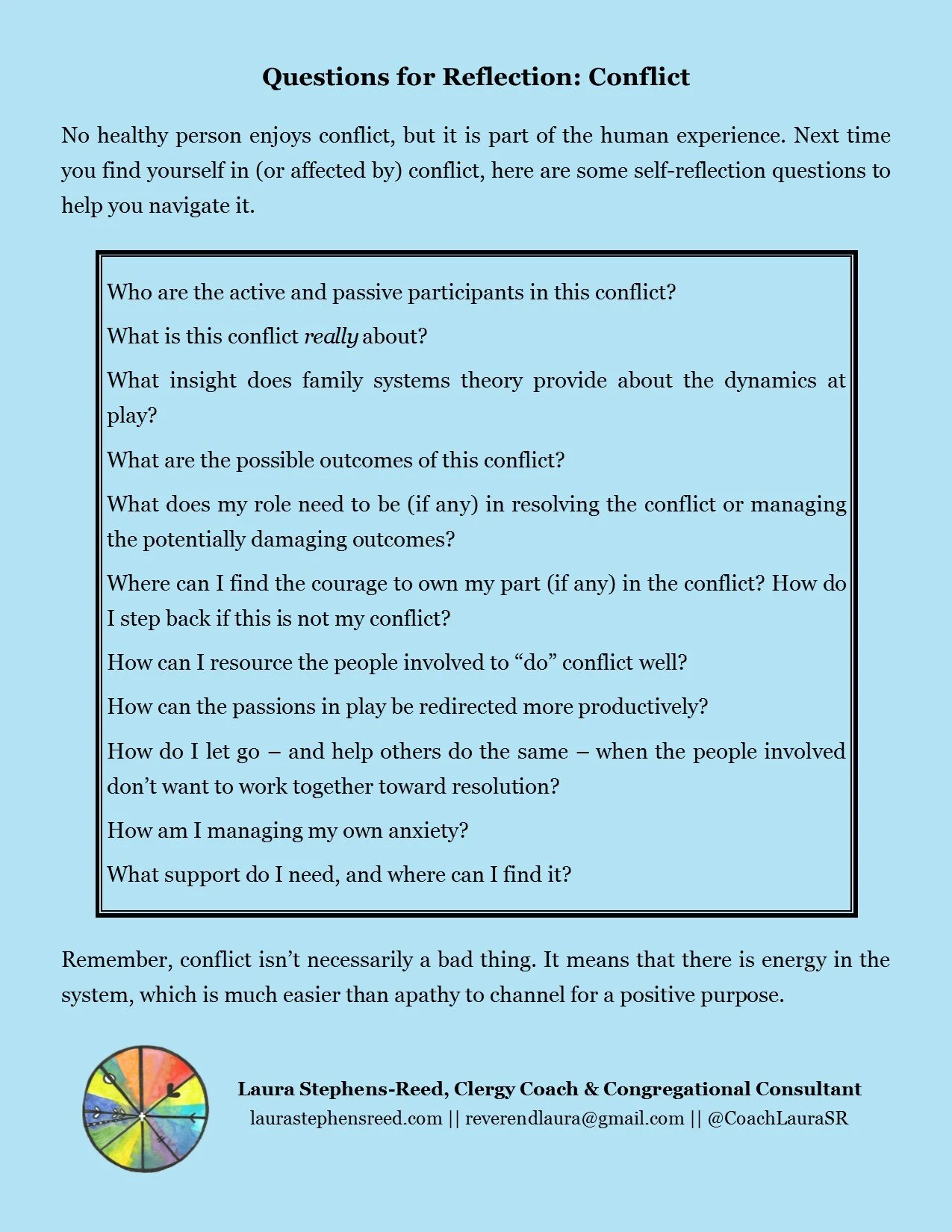
There are no rewind, pause, or fast forward functions available to us. We can only press play and allow life to unfold. For times such as these, I offer some questions for reflection. They are intended to help us gain new awareness, focus our commitments, and make action plans for leadership and for self-care. Intentionality is our friend when chaos is afoot.

You are welcome to share the image above and/or to print the PDF version available here.

questions for reflection conflict.jpg
Resource: questions for reflection during conflict

Time and again, questions about how to navigate conflict pop up in coaching. (I have some theories about why conflict management has become such a huge time and energy suck in vocational ministry, but those hypotheses are not the subject of this post.) Building upon an earlier article, I have put together a list of questions to mull when conflict arises. I hope you find them useful, and if you do, please share! A printable PDF is available here.

questions for reflection conflict.jpg
Here I raise mine Ebenezer

I ran across a great tool for intentional interim ministers leading congregations through the heritage focus point. My husband’s church is undergoing a visioning/renewal process, and the leadership team for this process was asked to create an Ebenezer.

Ebenezer literally means “stone of help,” and it refers to Samuel’s placement of a marker that witnessed to God’s faithfulness (I Samuel 7:12). It signified the Israelites’ recognition of God’s constant presence with them up until the Ebenezer’s dedication. It was a visual reminder that the Israelites were purposefully entering a new era in their relationship with God.

In the heritage focus point, a congregation in transition acknowledges, celebrates, and grieves its history up until the current moment. Churches cannot move forward without first looking backward, noting where God has been at work all along and bringing closure to old hurts. After an intentional interim minister and transition team lead the congregation through their exercises of choice to accomplish these goals, I can see where it would be healing and hopeful for everyone to work together on creating an Ebenezer. Such a visual would mark the move from hindsight to foresight, and it could be incorporated into liturgical design or placed in a high-traffic area of the church as a sign that the always-faithful God is about to do a new thing.

The power of yes

In improvisation the rule is always to say “yes, and” to your fellow actor. In other words, take what that person gives you, however bizarre, and build on it.

In our everyday, walking-around lives, there are occasions when we have to say “but” or “no.” We bracket our yesses when a toddler is about to lurch onto a busy street, for example, or when a perpetrator does unspeakable harm to a victim.

But I think that in general, the “yes, and” guideline is a helpful one. It notes an understanding of current circumstances and a willingness to move forward in light of them. It signifies that we can make choices and build relationships that add value to our lives and the lives of others.

Saying “yes” is inclusive. It calls for flexibility. It is hopeful without being naïve. It also forces us to consider how we might become more versatile, dancing in the moment, however messy that moment is.

The “and,” though, is the real key. It is the difference between mere people-pleasing and maintaining a non-anxious presence in the face of challenges. The “and” is a mark of creativity rather than reactivity.

May we focus on the yesses being offered to us in this complicated time, and may we then use our gifts and passions to influence the arc of humankind for the better.

Creating networks of support

At my denominational meeting last week, I co-led a workshop on creating networks of care. Below are some of the notes for my piece of the workshop, which focused on finding non-peer professional support. (Note that my section followed a discussion of the value of peer learning groups.)

What are the benefits of non-peer professional support?

  • Non-peer professionals come with particular expertise and credentials. They are also often able to be more objective about your situation and needs than peers.

  • Professionals are generally bound by confidentiality clauses in the professional-client covenant and in the ethical codes of their disciplines, thus creating a safe environment for you to share freely.

What are the biggest differences between a coach, spiritual director, and therapist/counselor?

  • Coach: Coaches concentrate on forward movement from the present, helping the coachee name particular action steps toward reaching goals. The coach believes that the coachee is the expert on his/her situation, and the coach asks focused questions to draw out inherent wisdom and new awareness in the coachee. The coachee sets the agenda, meaning the coach asks questions that help the coachee reach her/his stated goal.

  • Spiritual director: Spiritual directors help clients pay attention and respond to where God is at work, letting go of whatever is in God’s way. Spiritual direction’s main emphasis is growth in relationship with divine. The spiritual director’s primary tools are study, narrative, questions that prompt reflection on the spiritual life, and spiritual disciplines.

  • Therapist/counselor: Therapists assist clients in healing from past events and learning how to move forward in light of them. Therapy uses narrative, problem-solving, and various exercises to help the client find health.

Each of these fields has nuances, and many ministers engage more than one of them. The different approaches often complement one another.

Where would a minister look for one of these professionals?

  • Ask for referrals from ministerial colleagues and/or denominational staff.

  • Additionally, if you’re looking specifically for one of these professionals:

    • Coaches: Check with coach accrediting bodies, seminaries, and parachurch organizations.

    • Spiritual directors: Look for spiritual direction accrediting bodies and retreat centers.

    • Therapists/counselors: Contact nearby pastoral counselor centers, your insurance provider, or your physician.

How does a minister determine a good match with a professional?

  • Comfortable talking with the professional

  • Clear about nature and goals of relationship

  • Confident in professional’s skills, willingness to listen, and commitment to confidentiality

  • Sense support and/or progress in the issues raised

Don’t hesitate to end a relationship if you and the professional are not a good match!

How does a minister pay for this professional support?

  • Check on insurance coverage for counselors/therapists.

  • Use professional expenses as appropriate. (Check with your ministry setting or a tax professional if you have questions about appropriate uses of funds.)

Being a good teammate

As the NCAA tournament has played out the past few weeks, I’ve spent some time reflecting on what makes a good teammate. Ministry is a vocation that can lend itself to Lone Rangerdom, but it bears the longest-lasting fruit when it is done collaboratively. (Hey, even God needs three aspects working together to get the job done.) Whether you are part of a big staff or a solo pastor who recruits laypeople for some of the tasks covered by ordained ministers in larger churches, the following observations apply.

Good teammates:

Cooperate. This seems obvious, but it doesn’t always happen.

Coordinate. The most effective ministry requires some measure of advance planning – together – not just in our individual areas of responsibility.

Communicate. Learning teammates’ verbal and non-verbal cues cuts down on costly misunderstandings and allows the team to roll more easily with the unexpected.

Practice and play hard. The whole team looks good when everyone has prepared. On the other hand, one person’s lack of preparedness can make the whole team look like it hasn’t taken the task at hand seriously.

Share credit. Spread the word about how others contributed to a good outcome. Your teammates will become more deeply invested in your relationship and in your shared mission.

Encourage one another. We all get down. And when we get down, we rarely do our best ministry.

Know how and when to confront one another… Teams run into personality conflicts and differences of opinion. Don’t let them fester.

…but also maintain a unified front. Nothing tears a team apart faster than teammates talking behind one another’s backs.

Being a teammate is about working with others toward a common goal and making those around us better. And there are few things as exhilarating and productive as being part of a team that has really gelled.

My guiding image

Ah, the first semester of seminary. That magical time when I formed my still-strong circle of friends, I finally heard women preach (from the pulpit, and their messages were called sermons rather than “talks”), and people in authority really wanted me to ask my many questions about the Church and the Bible.

My world was rapidly expanding. And I was introduced to an image in my History of Christian Thought class that helped me make sense of it. This image still serves as the lens through which I interpret my ministry, politics, and personal relationships:

“Suppose we were to take a compass and insert the point and draw the outline of a circle. The center point is the same distance from any point on the circumference. Let us suppose that this circle is the world and that God himself is the center….To move toward God, then, human beings move from the circumference along the various radii of the circle to the center…The closer they are to God, the closer they become to one another; and the closer they are to one another, the closer they become to God.” (Sixth-century monk Dorotheos of Gaza, quoted on p. 25 of To Love As God Loves by Roberta Bondi)

As a visual person, I realized I needed an artistic representation of this picture in words both to tell other people what my ministry is about and to keep me inspired. There was no question where I would turn for this rendering – Silver Tree Art, a ministry provided by my friend Suzanne L. Vinson. Suzanne took the Dorotheos quote and used watercolors and ink to interpret it. I love her creation, which includes leaves, hearts, arrows, and an equal sign along the radii. I hope and trust you will appreciate it as well, because I will be using it every chance I get!

laura's logo.png
Call me...coach?

As a brainy, uncoordinated child I had little use for sports. In the sixth grade, though, my best friend introduced me to basketball, and it was love at first bounce. I played a year of rec ball, during which I had to shoot my free throws granny-style because my spindly arms weren’t used to such physical exertion. I played two years on my school team, improving my shooting and becoming a tenacious defender. I was an anxious ball-handler, though, and ball management is a big part of the job description when you’re 4’10.” I decided I was a better student of the game than player, and I spent my high school years keeping statistics for the team and filing the occasional scouting report about an upcoming opponent. I loved every moment in that role, and I set my sights on becoming a basketball coach. I read basketball theory and biographies of great coaches and used all of my tv time during the season to break down games. When I graduated from high school, my coach gave me the whiteboard he used to diagram plays for the team and his well wishes for my coaching journey.

Needless to say, this coaching journey took a turn. God got tired of whispering in my ear about a call to ministry and started yelling and banging pots and pans. I stored the whiteboard in the attic and turned my attention to scripture, history, polity, classical languages, and psychology. I went to seminary. I began ministering in congregations, hospitals, and domestic violence shelters. I was never sorry that Pat Summitt didn’t have to watch over her shoulder for me. But in 2010 I was introduced to the concept of ministry coaching and contracted with a seasoned minister who asked questions that brought out the best in me. I was soon more effective, more joyful, more confident as a minister. And when I was offered the opportunity to become a coach myself, I jumped at it.

Ministry coaching isn’t quite like basketball coaching. I do much more listening and asking than yelling and telling. But I love every moment in this role too, and it is a privilege to walk alongside coachees as they build on their fundamentals and discover their own tenacity.