Clergy & Congregational Coach
laurastephensreed logo2 (1).png

Blog

Helping clergy and congregations navigate transitions with faithfulness and curiosity

My blog has moved to Substack! You can find new articles weekly there.

Visit my Substack

Use the button below to search the blog archives on this website.

Search the blog
Soul vacation

This past week my family took a trip to the Gulf Coast. We played in the waves, took plenty of naps, and ate our share of seafood. It was a nice break after the intensity of moving this summer.

It turned out to be a different kind of vacation for me. Not because I haven’t spent much time at the beach, because I’ve been fortunate to feel the ocean lapping at my feet from the shorelines of several states. Not because my husband and I had our two-year-old in tow, though a toddler certainly changes the schedule and dynamics of time away. No, this trip was unique in my adult life because I truly enjoyed each moment. (Yes, I realize it’s sad that this is such an uncommon occurrence.) It didn’t take two days to decompress enough to kick back. I didn’t have any re-entry dread at the tail end, either.

I attribute this ability to focus on fun to the fact that I love and am energized by my work. I was glad to set it aside for a week, and I was just as happy to pick it back up yesterday.

What's on your playlist?

I once had to sit in my office, waiting for the members of my congregation’s personnel committee to invite me into what was sure to be a difficult discussion. A misunderstanding with the wrong person had quickly spiraled out of control, and I was finally going to have the opportunity to engage in a solution-focused conversation. I was excited and anxious and angry and terrified, and I couldn’t go into the room with all those emotions roiling just below the surface. So I made a playlist on my phone, which included “Freebird,” “I Will Survive,” the title song from the musical Rent, and other high-energy, tail-kicking songs. I sang them LOUDLY. I punched the air. The music gave me an emotional workout, after which the endorphins were pumping and my feelings were more defined.

As the mother of a preschooler, these days my playlist is mostly comprised of Daniel Tiger songs. But I have found Daniel’s short, simple ditties very helpful at times: “When you’re feeling frustrated, take a step back and ask for help.” “It’s ok to feel sad sometimes. Little by little, you’ll feel better again.” “When you feel so mad that you want to roar, take a step back and count to four.”

Music can be a powerful motivator, a calming agent, and an empathetic expression of our grief, not to mention a community facilitator and even a force for social change. What needs to be on your playlist when you’re headed into a dreaded meeting, when you’re having trouble focusing, when your heart is weighed down with sadness? How can music help you feel connected and prepared and alive?

Stewardship talk (sorrynotsorry)

Happy stewardship season!

[Collective groan.]

I get it. It’s incredibly awkward to preach about money, especially when the biggest chunk of most churches’ budgets goes to personnel – namely, your salary.

But please, for the love, do not approach stewardship messages with a “let’s just get through this” mentality. Do not make jokes about visitors choosing the wrong Sunday to try out your worship service for the first time. Do not blame your finance committee for making you talk about a significant spiritual issue. Preach that sermon as proudly as if you were riffing on Jesus’ two greatest commandments, because giving is one expression of loving God, loving others, and loving self.

Stretching to give more toward God’s work in the world is a spiritual discipline, an opportunity to grow closer to God and God’s children. In other words, you are not asking for charity in your stewardship messages. You are helping your people grow as disciples of Christ. (The flip side of asking people to stretch in their giving is making sure their money truly is being used to further God’s work in the world.)

Ok, rant over. Here are some tips to make sermons about money less antacid-requiring:

Explain how stewardship is a spiritual matter as well as a practical one. Many people don’t understand that a stewardship campaign is not just about keeping the lights on in the church.

Be honest about your own struggles/aspirations to give. Let your parishioners know that you’re preaching to yourself as much as to them.

Talk about your church budget as a ministry action plan. Make clear how every aspect of that plan helps the congregation fulfill its mission. (So it’s also important to have a current, carefully-discerned mission statement!)

Preach about stewardship throughout the year. This brings home its importance, and no one has to dread a drawn-out campaign in the fall.

May your stewardship season be inspiring and fruitful, and may your Tums supply remain untouched.

Shifting perspective

A few years ago I made a series of pastoral visits to a woman whose husband had died several months prior. Her grief repeatedly manifested as anger at her petite stature. Her husband had been a tall man and had always helped her reach the dishes and spices in her highest kitchen cabinets.

Recognizing these complaints for the expressions of anguish they were, I tried to empathize. I knew she was describing one way her relationship with her husband was symbiotic, and I did not want to discount her pain. But part of me was befuddled. This woman was an inch or two taller than me, yet rarely had I considered my height a handicap. (Perceptions of my age are another story.) When I need something that’s way above my eye line, I climb the shelves Spiderman-style, grab the item, and go on my way. In fact, I’ve found a number of outright advantages to being 4’10.” Most importantly to me right now, I can sit comfortably in children’s furniture, squeeze into playhouses, and ride playground equipment without worrying about size limits. Before my son was sure of foot, he got to do many more fun things (like go in bounce houses) because I could do them with him.

My visits with this parishioner prompted me to reflect on this flip side of my “short”coming. I wish I had more effectively returned the favor, asking her to tell me stories about how the height differential contributed to her happy marriage and getting her to think practically and proactively about the adjustments she would now need to make.

Shortcomings can be opportunities, if we embrace them as such. What muscles have we had to flex because of our quirks or circumstances? What specialized knowledge have we gained? To whom are we more connected? To what are we more sensitive? How are we more resolved?

It’s important to know our limits and own our pain. How can we then take hardship and use it not just for our own good, but also for others’?

Fleshing out underwritten characters

My newest pop culture obsession is the Gilmore Guys podcast, which features two men in their 20s discussing each episode of the now-defunct series Gilmore Girls. It is by turns hilarious (though I do need to slap a language warning on this endorsement) and deep with discussions about gender and race, entitlement and selflessness. The hosts, Kevin and Demi, are employed behind the scenes in the entertainment business, so they use some writing and production jargon.

At times Kevin and Demi have noted that some of the minor-but-recurring characters are “underwritten,” meaning the show’s creators missed an opportunity to give them a lot more dimension. That term caught my attention, and I began to wonder where the underwritten characters are in church life. Maybe they’re the folks we call on to help with one particular ministry, even though they have other gifts to share. Maybe they are our antagonists, the people we have trouble empathizing with because we haven’t grasped their deeper motives and backstory. Or maybe we as ministers seem underwritten to our parishioners because they can’t imagine us “out in the wild” (e.g., at a concert, or even in the grocery store).

How then do we flesh out our perceptions of underwritten characters, and how do we let the people in our care see our complexity?

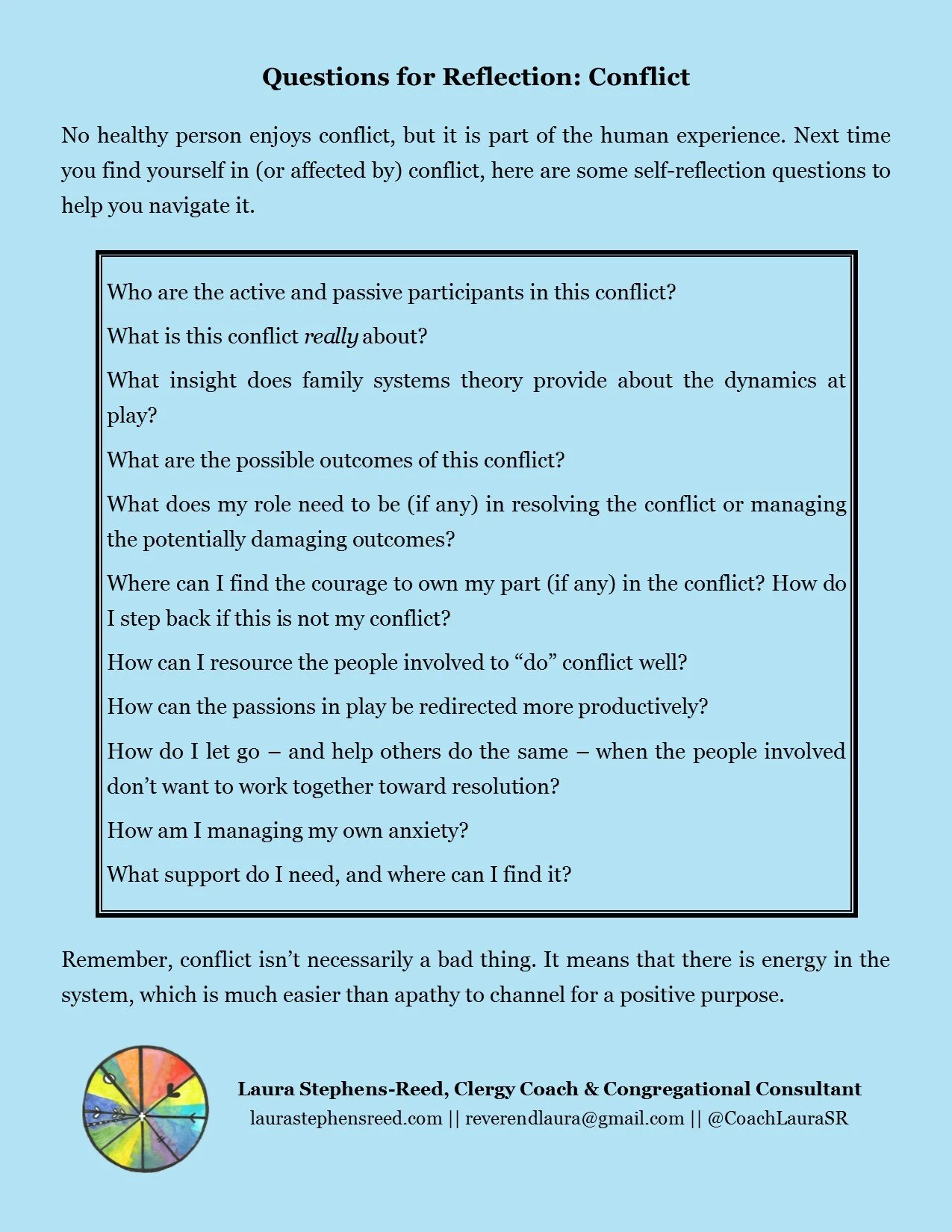
Questions for reflection in times of conflict

There are times when the future seems so murky – or so desolate – that we are utterly unsure what to do next. For many in the United States, this is one of those times.

There are no rewind, pause, or fast forward functions available to us. We can only press play and allow life to unfold. For times such as these, I offer some questions for reflection. They are intended to help us gain new awareness, focus our commitments, and make action plans for leadership and for self-care. Intentionality is our friend when chaos is afoot.

You are welcome to share the image above and/or to print the PDF version available here.

questions for reflection conflict.jpg
Resource: questions for reflection during conflict

Time and again, questions about how to navigate conflict pop up in coaching. (I have some theories about why conflict management has become such a huge time and energy suck in vocational ministry, but those hypotheses are not the subject of this post.) Building upon an earlier article, I have put together a list of questions to mull when conflict arises. I hope you find them useful, and if you do, please share! A printable PDF is available here.

questions for reflection conflict.jpg
A preacher's work is never done...or is it?

I suffer from the terrible scourge that is perfectionism. Until recently, this affliction meant that I’d still be editing my sermons until I stepped onto the chancel, no matter how long I’d been working on them.

Something has changed over the last couple of years, though. I’ve been able to stick a fork in my manuscripts and enjoy playing or even (gasp) just kicking back in the recliner on Saturdays. Maybe I’ve gained a smidge of insight about my process through experience and the passage of time. Maybe I have a different sense of priorities now that I sit across the breakfast table from 28 pounds of pure curiosity, cuteness, and mischief. Maybe I simply trust the Spirit more than I once did.

I don’t think the quality of my sermons has declined, but even if it has, God can hit the override and still speak through me. So if you are a long-suffering perfectionist preacher, here’s what I recommend:

Get an editor. I’m lucky to have one required by the marriage laws of our state (or something like that) to give feedback on my sermons, but in-town friends and online communities are great resources too.

Make plans for Saturday. This is counter-intuitive for many ministers, but it may provide the inspiration needed to finish writing early and set the manuscript aside.

Learn when to call it. Not every sermon will draw Barbara Brown Taylor comparisons. Know when to say, “I’ve worked hard, I’ve tried to be faithful to the text, and it’s up to the Spirit to do the rest.”

Ask for post-sermon feedback. Approach a cross-section of parishioners for their honest, constructive reactions. Knowing what they heard and where they engaged will help with the next week’s preparation.

Thankfully, while it is essential to approach homiletical work with all due reverence, the Word is proclaimed in so many ways – through music, communion, prayer, the passing of the peace, and so many other experiences of the divine. So preaching is not all about us as ministers, and it is certainly not all done by us!

Pruning programs, part 2

You and your leadership have decided it’s time to prune the list of ministries your congregation offers. Now it’s time for the fun (AHEM) part – actually killing what is sure to be an earnest, devoted church member’s pet project.

Sigh. So how do you rip off the Band-Aid with those for whom this will not be good news?

Listen deeply to stories about the ministry’s glory days. This conversation may be uncomfortable, but it is also an opportunity to learn more about the history and culture of the congregation and community.

Show sincere gratitude for the ministry’s impact and the time and energy put into it. There was a need for this ministry at some point, or else it never would have been launched.

Ask the church members whose claw marks are in the ministry what they want its/their legacy to be. What would best honor the people who have poured so much of themselves into this ministry – to end it with joy and intentionality or to let it limp along until it dies of natural causes?

Talk through the importance of letting the ministry go, acknowledging the grief involved. Help the ministry’s proponents come to their own realizations about the potential in reallocating money, time, and person power.

Decide together what elements of the ministry it is important to carry forward. One ministry pollinates another.

Publicly celebrate the ministry and the people who made it happen. This ministry has helped shape the church and its surroundings. Thanks be to God!

Pruning programs, part 1

In many (most?) churches, new ministries are added at a faster rate than dying ones are eulogized. Add to that the new standard for active membership – attending a couple of Sundays a month as opposed to three or four – and congregations are cruising for some big-time leadership fatigue.

It’s important, then, to evaluate ministries for their missional value versus energy expended. Here are some questions to ask staff and lay leaders on a regular basis:

Which ministries…

…embody the core values of our congregation as a whole

…help us share the love of Christ in ways that meet others’ needs, not just our own?

…are reaching people who would otherwise go underserved?

…allow room for initiative, creativity, and new participants/partners/leaders?

…meet the above criteria and are either going strong or have real potential to be re-energized?

Highlight these ministries and determine how to give more oomph to flagging but critical initiatives.

As for the ministries that don’t make this list, stay tuned for part II of this topic.

Picking the low-hanging fruit

At The Young Clergy Women Project conference this summer, keynote speaker Dr. Margaret Aymer taught participants how to design contextual Bible studies with a missional bent. Every discussion of scripture, she said, should conclude with a commitment to action: what small, immediately-doable step can we take in light of what we’ve learned together?

Dr. Aymer used a fruit tree metaphor for sorting possible action items. Low-hanging fruit can be gleaned without too much effort. As you reach for fruit further up the tree, you’ll need a taller stepladder, exert more energy, and take more risk. (You’ll also be able to pick fewer fruits at a time, since you’ll have to juggle your harvest and hold onto the ladder.)

I’ve found the fruit tree metaphor very useful the past few weeks:

What fruit is hanging within easy reach? What small course corrections can I make that will yield big results?

What low-hanging fruit do I need to leave hanging so that others can glean it? How can I be a Boaz and empower the Ruths around me?

When do I really need to break out the stepladder? Have I plucked all the fruit I can/should with both feet on solid ground? Or is the fruit that grows further up somehow more substantive?

How can I minimize the risk? Or, shifting perspective a bit, whom do I need to hold the ladder for me as I climb and to tell me how to reach fruit I can’t easily see?

May your theological discussions and the initiatives that come out of them be fruit-full.

Telling your origin story

During Conan O’Brien’s week of broadcasts from Comic Con, he shared a video about his origin story. (For those who are unfamiliar with the concept, an origin story is an accounting of the events that lead up to the rise of a superhero.) Aside from getting me laughing, the video also got me thinking.

Most Christians will be asked at some point to share their journey to professing faith in Jesus. I wonder how the origin story framework might shift the perspective a bit. Origin stories often begin before the superhero is born, connecting the hero to a larger narrative. They describe the acquisition of special powers, which generally come from a source beyond the hero. And these backstories often point the hero toward some sense of responsibility – a mission, if you will.

It seems to be that origin story thinking might help us widen our view of what people and events shaped us, what gifts have been ingrained in us, and how those gifts might serve the greater good (i.e., reign of God) than many accounts of our call to faith allow.

What, then, is your origin story?

Receiving constructive feedback

This past week I received feedback on a project. The person giving the feedback was straightforward – “this isn’t really what we’re looking for” – and offered some thoughts on how I might shift my perspective. Then he welcomed me to contact him with my revisions so that we could talk further.

What a gift.

No one really likes criticism, but it’s often necessary to get honest input in order to grow. And after so many Sundays of well-intended worshipers saying simply “Nice service” or “I enjoyed your message” at the sanctuary door, it was refreshing to get some pointers about specific growing edges.

Still, when someone gives that elusive constructive criticism, it can be hard to hear. Here are a few questions that might make it easier to take to heart:

Is this person right? Sometimes we know in the moment that our critic has hit the nail on the head.

Does this person have experience or expertise that makes their perspective valuable? It would be unwise to ignore valuable advice from someone in the know.

What stake does this person have in my success? If the critic is either completely objective or had to work up the courage to deliver a hard word, the criticism is worth considering.

What will I do with this feedback? If I choose to act on it, I need to think about what my first steps will be and what needs to be bracketed for later.

How will I stay engaged with my critic? If the feedback is helpful, the relationship is worth pursuing.

(For what it’s worth, I revised my project prospectus and got a green light.)

Make your own sabbatical

Ahhh, sabbatical. A time of rest, renewal, and reflection away from the usual pulls of congregational ministry. In many denominations and churches, clergy are eligible for multi-month sabbaticals after a certain period of service (usually five, seven, or ten years).

Some of us will never get there.

In my case, I’ll likely never serve in one place long enough to reach the sabbatical threshold. (Such is one of the downsides of a passion for interim ministry.) Even those who are serve in settled ministry are often called away before they hit the magic number of years, whether because other congregations match their gifts more closely or because conflict in the here and now has taken its toll. So what are the short-timers to do?

I suggest we make our own mini-sabbaticals.

There are a couple of ways to go about this. The more flexible route is to leave ample space between calls and be intentional about how that time is spent. This assumes, however, that the minister is in no hurry for a paycheck at the new gig. (I know, I know.)

The other way is to get creative with vacation and professional development allotments. The whole point of a sabbatical is to take more than the average week away so that the pastor can unplug from the congregation, reconnect with God, and recharge passion for ministry. So consider the setting, the tools, the companionship, and the time you’d need to meet these aims. Then ask colleagues and scour the web for recommendations about locations, mentors, and maybe even short-term courses that would fit the focus of your time away. Take a look at your personal and church budgets to see what financial resources are available to you. Then consult the calendar, identifying seasons when you could string together a few weeks of study leave, vacation, and maybe even a denominational gathering.

When a minister takes an official sabbatical, it’s a good idea for him/her to prepare the congregation a long time in advance, letting church folks know the purpose behind the time away, getting them excited about how your sabbatical will benefit them, and filling them in on the plan for pastoral coverage. You might consider doing the same for an unofficial mini-sabbatical. Obtaining the congregation’s support for your rest and renewal will ease your mind while you’re gone, help your members take ownership of ministry during the gap, and give them the sense that you care enough about them to do the things that cultivate longevity in your position.

Embracing the new normal

In seminary I searched for my denominational identity. I had always been a Baptist, but that label came with a lot of baggage. I tried on a few other denominations that first year, but none of them really fit. It was only when I attended a local congregation’s Bible study on Baptist distinctives that I realized I was – am – in fact a proud Baptist.

The struggle then was being a future-oriented Baptist in the south, where many of my progressive peers were expending a lot of energy mourning a pre-fundamentalist Southern Baptist Convention that I had never known. I tried to understand their pain, but it was tough. There was no pendulum swing coming in the SBC, and new networks were emerging for centrist and left-leaning Baptists. There was clearly a new normal at play, one that I was enthusiastic about.

I heard echoes of my experience in this blog post by a new(ish)comer to the Christian Church (Disciples of Christ), which gathered in Ohio last week. (Discipledom is my second home these days.) Sara Fisher writes this about the passion and faithfulness she witnessed at her first General Assembly, even as longtime Disciples grieved the shrinking attendance:

“As a new-ish Disciple, this IS normal….This is what I signed up for.

Yes, newbies need to be historically aware and sensitive to those who see demise where we see life. But as long as people are joining us and saying, this IS what I signed up for, the church has a future. May those with institutional memory allow the whippersnappers to infuse some energy into the system, and may we young’uns remember that the long-timers still have vast knowledge and needed leadership to offer.

Contextual Bible study

A couple of weeks ago I attended The Young Clergy Women Project conference in Austin, Texas. I have gone to seven TYCWP conferences primarily for the fellowship, but the content is invariably excellent as well. Led by Dr. Margaret Aymer, this year’s plenaries focused on how to design a Bible study that emerges from the questions of the community.

The first step in the process is to gather some of the community’s leaders and ask them to name the most pressing issues facing the community. This group then brainstorms some passages of scripture that could potentially speak to the selected issue and chooses one to study.

The Bible study facilitator then takes the passage and creates discussion questions about it with the issue in mind. The questions attempt to draw out and privilege the wisdom in the room. They address such angles as:

  • what the scripture passage is about

  • who’s in the passage and what they’re doing

  • what the context (historical, narrative, etc.) is in relation to the selected issue

  • how the passage speaks to the issue and the community’s context

The Bible study is not just an academic exercise, however. It ends by asking, “Now what are we going to do about the issue at hand, given our discussion of this passage?” The students name possible actions and choose an easily doable one to tackle.

The contextual Bible study would be an effective approach in any situation, but I believe it would be especially helpful in situations of conflict and/or transition. If you’d like a fuller explanation of this method, the Ujamaa Centre for Community Development and Research has a manual here.

The calendar is my frenemy

Have you ever started a day or week with a short to-do list, only to find that you are soon swallowed up by requests and minutiae?

Time abhors a vacuum.

So, what’s a minister to do when so much of her work is about being available to others and taking care of those details that no one else knows about but that make the ministry run smoothly?

Make the calendar your friend. Schedule blocks for sermon prep, curriculum writing, big picture planning, visitation, open office hours, and even self-care (afternoon Dunkin Donuts run, anyone?) just like you do for committee meetings. And just like with committee meetings, you can push your plans aside if a truly pressing pastoral need arises. Otherwise, feel free to say, “I’m sorry, I can’t do such-and-such right now. I have an appointment.” Because you do.

If we don’t block out time for visioning and self-care, those two things are almost always first on the to-do list chopping block. Yet those are perhaps the two most critical pieces of longevity in ministry.

Happy calendaring!

Determining agency

There are times when every minister feels stuck, helpless, or ineffective in his/her ministry setting, particularly if that setting is experiencing unhealth. One of the keys to regaining hope and refocusing on the ministry at hand is to determine what kinds of power or agency you do in fact have. Hint: there may be some types that aren’t immediately obvious!

Relationships/partnerships (inside and outside setting)

  • Position/roles (formal and informal)

  • Talents/expertise (ministry-related and not)

  • Assets (budget, facilities, other tangible resources)

  • Teaching tools (curricula and other springboards for discussion/study)

  • Other

Once you have named the avenues of agency you have, how will you utilize them? What power do others who share your vision for ministry have, and how can you leverage this combined power for forward movement?

Here I raise mine Ebenezer

I ran across a great tool for intentional interim ministers leading congregations through the heritage focus point. My husband’s church is undergoing a visioning/renewal process, and the leadership team for this process was asked to create an Ebenezer.

Ebenezer literally means “stone of help,” and it refers to Samuel’s placement of a marker that witnessed to God’s faithfulness (I Samuel 7:12). It signified the Israelites’ recognition of God’s constant presence with them up until the Ebenezer’s dedication. It was a visual reminder that the Israelites were purposefully entering a new era in their relationship with God.

In the heritage focus point, a congregation in transition acknowledges, celebrates, and grieves its history up until the current moment. Churches cannot move forward without first looking backward, noting where God has been at work all along and bringing closure to old hurts. After an intentional interim minister and transition team lead the congregation through their exercises of choice to accomplish these goals, I can see where it would be healing and hopeful for everyone to work together on creating an Ebenezer. Such a visual would mark the move from hindsight to foresight, and it could be incorporated into liturgical design or placed in a high-traffic area of the church as a sign that the always-faithful God is about to do a new thing.

The power of yes

In improvisation the rule is always to say “yes, and” to your fellow actor. In other words, take what that person gives you, however bizarre, and build on it.

In our everyday, walking-around lives, there are occasions when we have to say “but” or “no.” We bracket our yesses when a toddler is about to lurch onto a busy street, for example, or when a perpetrator does unspeakable harm to a victim.

But I think that in general, the “yes, and” guideline is a helpful one. It notes an understanding of current circumstances and a willingness to move forward in light of them. It signifies that we can make choices and build relationships that add value to our lives and the lives of others.

Saying “yes” is inclusive. It calls for flexibility. It is hopeful without being naïve. It also forces us to consider how we might become more versatile, dancing in the moment, however messy that moment is.

The “and,” though, is the real key. It is the difference between mere people-pleasing and maintaining a non-anxious presence in the face of challenges. The “and” is a mark of creativity rather than reactivity.

May we focus on the yesses being offered to us in this complicated time, and may we then use our gifts and passions to influence the arc of humankind for the better.