Clergy & Congregational Coach
laurastephensreed logo2 (1).png

Blog

Helping clergy and congregations navigate transitions with faithfulness and curiosity

My blog has moved to Substack! You can find new articles weekly there.

Visit my Substack

Use the button below to search the blog archives on this website.

Search the blog
A pastoral prayer for these days

God of all creation,

you made the world we know out of a dark and formless void.

Before your breath swept across the face of the waters,

there was no light.

No sky.

No land.

No way of marking time.

No vegetation.

No animals.

No humans.

You made everything out of nothing, out of chaos.

And it was all good.

On behalf of everyone whose life feels out of control this morning,

who wonders how anything good could come out of such mess,

we pray to you this morning.

Where there is fear, let there be courage.

Where there is discord, let there be unity.

Where there is sickness, let there be healing.

Where there is oppression, let there be liberation.

Where there is loneliness, let there be connection.

Where there is worry, let there be peace.

Where there is want, let there be enough.

Use us, your people, to bring about all of this good,

because in your blueprint,

you bestowed upon humankind responsibility for all living things.

Prompt each one of us,

whether we are the leader of the free world

or have no formal position of power,

to use the skills and influence you have given us

in ways that make your world a place that is more just

more interdependent

more joyful

more beautiful

more sustainable.


These things we ask in the name of Jesus,

who came to redeem the brokenness in all that you made,

and by the power of the Spirit, which recreates us on a daily basis. Amen.

10 ways to strengthen relationships in the new year

It’s a strange world we live in. In some ways, our relationships are stronger than ever, thanks in large part to technology. In other ways, we are more disconnected from each other than we’ve ever been (at least partially due, ironically, to the ways we use technology).

Whatever the state of our relationships, it never hurts to reinforce them. After all, they are the primary means for creating circles of care, affecting change, and ushering joy into the world. I’ve developed a list of ten ways to strengthen relationships in this still-young year. They can be applied to individual bonds, teamwork, and our walk with God.

Deepen trust. Without authentic trust, relationships will always stay at a surface level. What small risk are you willing to take to show the real you? How might you invite others to do the same?

Add a layer of communication. We generally believe we’ve been heard better than we actually have been. How can you relay important information in an additional, different way so that everyone is operating from a shared understanding?

Share stories. Narrative is the root and food of knowing and being known. It prompts people to laugh, mourn, and plot together. What anecdote or arc speaks to where you are or how you’re feeling today? Who needs to hear it? Whose stories do you want to seek out?

Reflect on the relationship. Ok, it’s awkward, but it never hurts to ask for feedback on how the relationship is going. What’s working (and not) for him/her? For you? Disconnects can’t be repaired if they aren’t identified.

Embrace conflict. Conflict is simply a difference of opinion. It doesn’t have to come with all the baggage we tend to load onto it. Being forthright – in respectful ways – about our disagreements allows us to learn, and our openness to one another in moments of dissent breeds trust.

Help one another be fully engaged in the relationship. Everyone’s personality is different. As an extreme introvert, for example, I need lots of alone time to be fully present with people. Know and own your quirks, and support others in theirs.

Examen each day. Engage in some sort of reflection at the end of each day. How was I a good friend? How did I fall short? Utilizing the spiritual practice of examen opens up the possibilities even more. Where did I notice God at work today? How did I aid in or hinder the in-breaking of God’s peace?

Increase your curiosity. Instead of imagining someone’s beliefs or motives, ask: tell me what you were thinking when… What did you hope to accomplish by…? We usually default to assuming the worst, and often the truth is better (or at least more complex) than what we thought.

Start from common values or vision. Consider what all parties can affirm. Even if there are differing ideas about how to approach problems, there can be shared commitments underlying them. That’s a much more promising starting point for connection and for change.

Affirm one another. Name what you appreciate in one another. Be specific, and focus on attitudes and actions rather than appearance. Not only does a genuine compliment provide a serotonin boost, it also helps people identify and navigate from their strengths.

Which of these ideas could you begin implementing today? What would you add to this list?

What you get when you call a clergywoman

Recently the Lewis Center for Church Leadership published a fantastic article about how congregations can welcome and support their female ministers. The piece speaks to some of the fears that search committees have when considering a woman for a ministry position. It also raises awareness about  the small but significant ways that clergywomen are treated differently than clergymen. In doing so, the post names and dispels many of the assumptions about women in ministry. With that slate clear, what can churches expect from their female clergy?

Clergywomen love Jesus. We are not in ministry for the money (most of us are paid less than our male counterparts) or the notoriety (the stained glass ceiling is real). And we definitely have not pursued this vocation because it is the path of least resistance. We’re here because we are drawn to the message and model of Christ.

Clergywomen know their scripture. For many of us, Paul’s epistles have long been used as a barricade to the pulpit. That means we’ve had to steep ourselves in the Bible, studying its words, arcs, and historical/cultural context so that we can be confident we’ve discerned correctly and so that we can be faithful in forming others.

Clergywomen have been vetted, then vetted some more. At every level of examination, someone is looking for a reason not just to exclude each one of us as individuals, but also to use our personal shortcomings (real or imagined) as grounds not to grant pastoral authority to any woman. If we clear these hurdles, you’d better believe we are capable.

Clergywomen have had their mettle tested. Women in ministry are criticized for our hair, age, fashion choices, voice, family situation, and many other variables that are irrelevant to ministry – and that men are rarely evaluated on. And the “acceptable” leadership style for a woman (in any professional field, really) falls in a miniscule range between too soft and too assertive. Experienced in dealing with discouragements around these matters on a regular basis, we are not easily scared off from the legitimate difficulties of church work.

Clergywomen have a deep, DEEP sense of call. Women have their calls to ministry questioned all the time. Sometimes it happens in plain talk (e.g., “I believe women should never teach men”), and on other occasions it manifests by such means as second-guessing, talking to a female pastor as if she is the speaker’s daughter or granddaughter, asking where the “real” pastor is, or using diminutive terms (Miss Laura, Pastorette). As a result, clergywomen check in with God about their calls on a regular basis, asking for guidance and courage to live toward the purpose we’ve been given.

Clergywomen are endlessly creative. When there are so many hurdles not just to serving faithfully, but also finding a place to serve to begin with, women have to call upon all our gifts. We can think beyond our assumed constraints because we must – and the church and her people are the beneficiaries of our innovation.

Many clergywomen are backed by a fierce tribe, which provides its members with wisdom and support. When a congregation calls a female minister, it gets the bonus of a magnificently insightful hive mind. (Note: if you are a woman in ministry who has not yet found her tribe, look for it! Here are two places to start. And as a coach I would be thrilled to be your encourager and thought partner via a coaching relationship.)

Imagine your congregation could find all of these qualities in a minister, plus the particular skills and graces of a ministerial candidate. What great things for God could you do together?

My guiding words for 2017

Sometimes inspiration comes from unexpected places. Recently it ambushed me by way of an interview that entertainer/faux (?) journalist Samantha Bee conducted with pundit Glenn Beck. (If you click on the link, be prepared for strong language.) In it Bee and Beck, who inhabit opposite ends of the political spectrum, acknowledged that they have more in common than it seems. They celebrated their fledgling friendship by sharing a strange bedfellows cake.

That liberals and conservatives can work together on issues affecting us all was no surprise to me. What did catch me off guard was Glenn Beck’s warning that Samantha Bee was in danger of becoming – like him – a “catastrophist,” someone who reads the worst into every headline. As the earth has shifted beneath my feet the past couple of months, I’ve had to refocus myself continually on hope, courage, and justice. In those many moments when I’ve been less than successful at this, I too have been tiptoeing into catastrophist territory. (Vigilance and action are warranted in such a time as this. Catastrophism, however, consumes physical, mental, and spiritual energy that could be used more constructively.)

Surprised by this self-knowledge, three adjectives popped to mind, and they will serve as my touchstones for the year. I aim to be:

Curious. What’s really happening in this situation? What do I not yet understand? What’s going on inside of me? Denial and assumptions rarely lead to the best course of action.

Present. Who is around me? What do they need from me? What do I need so that I can stay engaged, insofar as it is productive? Insulating ourselves from the hopes and fears of others has led to a fractured church and a deeply-divided country.

Resilient. How will I stoke my resolve to be kind when kindness is not returned? To be brave when I am scared? To see things as they are, but still move forward in the confidence that this bad thing is not the last thing? 2017 promises many setbacks to the commitments I hold dear, but as matters of faith and integrity, I must keep showing up.

This is my mindset as we begin the new year. What word(s), phrase, quote, or song is guiding you? Let’s support and hold one another accountable.

It's resolution time!

As 2016 becomes 2017, many folks will be making resolutions for the new year. Good intentions can quickly give way to frustration and guilt, though, if ample thought isn’t put into creating these goals. And who wants to start the year with frustration and guilt, especially considering the 12-month dumpster fire we’ve just collectively endured?

Here, then, are a few ideas for setting goals for 2017:

Consider the “why” behind the “what.” What are the reasons you want to read a novel per month, take on additional responsibility at work, or expand your circle of friends? If you’re sensing a nudge from the Spirit, tapping into an abiding desire, or coming up against a make-or-break moment (e.g., major health risk, request from a supervisor), you’ll have a better chance of succeeding than if you’re operating out of a sense of “should.”

Focus on what you can control. Want to lose 10 pounds? For some, that goal is attainable in a month. For others, it could be a year-long aim. There’s only so much we can do about our body’s chemistry and various environmental factors. We have much more control, however, over our actions. It could be more helpful, then, to frame goals accordingly: I will eat two more servings of vegetables per day, I will take 30 minutes of my lunchtime each day to walk around my workplace.

Note that there’s a step between doing differently and being different. Change usually begins with an alteration in routine. But for the change to stick, there must eventually be a shift to seeing things differently – not just “I teach,” for example, but “I am a teacher.” This new perspective is the midway point between trying something new and becoming a wholly new person.

Set sub-goals and celebrate when you achieve them. It’s easy to get discouraged when you set a big goal – even if it’s one that comes from deep within – and seem to be making only slight progress, or even taking two steps forward and one step back. Bite-size your resolution. If you’re a novice athlete who wants to run a 5K, first make a plan to run two minutes without stopping, then work up to five minutes, and so on. And reward yourself when you hit those smaller marks!

Build in support. Ask someone you trust to cheerlead and check in with you. If you’re concerned that this is requesting too much from a loved one, partner with someone who has a similar resolution, trade accountability and encouragement with a friend who has set a different goal, or hire a professional to help you stay on track.

Focus outward as well as inward. Don’t just consider resolutions focused on self-improvement. Think about ways you can make the world around you better with the achievement of your goals. We need these kinds of efforts now more than ever.

As you make plans for the coming year, consider how a coach might help you address challenges and meet goals.

May your 2017 start out with hope, and may your resolutions be a means for stoking that hope in the months to come.

Being awake to - and beyond - Advent

Ah, fall. The crisp air cuts summer’s sweltering heat. The changing leaves make the world beyond our window look like a Bob Ross painting. Apple cider and pumpkinspiceeverything reawaken our salivary glands. Fall is, without question, the season when I feel most alive.

Fall holds just as much promise in the church world. The new program year begins. Children and youth promote. Offerings and attendance pick back up after the summer slump. And then…budget and stewardship season hit. Planning for the new liturgical year begins in earnest. And Thanksgiving (for many of us) brings complicated and exhausting gatherings with loved ones who understand neither our profession nor our politics. Our energy bottoms out just in time for the start of Advent, which for clergy is an all-consuming effort to see the baby Jesus into the manger. It’s no wonder we want to hibernate from Christmas Day through Ash Wednesday (which, mercifully, holds off until March in 2017).

It doesn’t have to be this way, though. We can be present to our congregations and our loved ones throughout the holidays, take a hard-earned break afterward, and still function fully in January and February. Here are a few ideas toward that end:

  • Get some vitamin D. The daylight hours during December are fewer than at any other time of year, and lack of sun exposure can have a big impact on mood and motivation. Try leaving the building at lunch or at least working by a window.

  • Go home. Studies show that productivity tails off after a certain number of hours worked, so you could be working longer hours but getting less done. (Horrors!) This season calls for some extra weekends and evenings, so grab some flex time elsewhere.

  • Look at each week through the lens of the Advent wreath theme. Ask yourself each day this week where you witness or contribute to hope, for example. Here are some questions to help you focus your thoughts.

  • Honor the scriptural narrative by trusting some of the season’s heavy lifting to unlikely people. Remember that Mary, a young, unmarried woman, would never have been so bold as to volunteer to birth and raise the savior of the world. Who in your congregation is capable of taking on responsibility, if you will only ask and trust them to do so?

  • Make time for people you love. Few people will remember you didn’t get all the readers for Lessons & Carols. Your family and friends will remember if they don’t get the pleasure of your company and the honor of your attention. Drink hot chocolate together, hop in the car to look at lights, and gather around Santa for a picture.

  • Remember that Jesus will be born whatever you do – or don’t do. God can work through our errors of commission and omission as much as through our gifts and passions.

  • Ease your way back in after Epiphany. Some things can’t wait, like new leader training. But consider what other pieces you can experiment with, delegate, or let lie fallow.

May your Advent be more full of wonder than of stress and exhaustion.

Feeling the pinch

I’d had pretty much the same hairstyle for twenty years. Somewhere between chin and shoulders in length, with long layers. This look suited me well enough, I guess. There was no complicated styling involved. I didn’t have to buy any product. I could throw my hair in a ponytail when I wanted. Still, I was craving something different.

I researched short hairstyles, asking friends with cute hair to send me pictures and details on what it took to get their coiffures to look that way. I set aside some money for a cut in a real! salon! because it seemed too risky to make a big change for $7.99 at Great Clips. I asked around for stylist recommendations. I was ready…or was I? I kept putting off making the appointment. No time for a haircut this week…I don’t want to still be figuring out how to tame my new ‘do when X event rolls around…I remember being confused when I was in preschool and my mom made a drastic hair change, and I don’t want to do that to my son.

And then said son began protesting whenever I pulled my hair back into a ponytail, which was most of my at-home hours. “No! Take it out!” He even became quite adept at pulling out my ponytail holder before I even realized what was happening. It was time for the haircut.

So I did it. I went to the grown-up salon and had all the hair that had been weighing me down whacked off. I had been wanting and plotting for a while, but I had to feel a pinch to get myself in gear.

This is the state that many of our churches find themselves in. They want to follow their evolving call from God. Often they already have the resources and have even made some concrete plans for how to move forward. Something, however, is holding them back. Maybe it’s fear. Maybe it’s comfort. These congregations need to feel the pinch before they’re willing to make the leap.  

Sometimes the pinch happens naturally. A staff transition necessitates re-evaluation of leadership needs. The property next to the church goes up for sale. A local service agency invites the congregation into a partnership that would benefit both entities and the community as a whole. A shrinking budget prompts discussion about the best use of resources.

Sometimes, however, leaders who have latched onto God’s dream for the congregation need to help their constituents feel the pinch. How might you help the people you minister alongside discover both the opportunity in and urgency for potential change?

Today is the day

It’s election day in the United States. The whole country has been counting down to this moment since, well, the 2012 general election, given our never-ending campaign cycle. And this has been a political season for the history books. First female presidential candidate put forth by a major party. First presidential candidate who has hosted his own reality tv show. The first time a former President and a former First Spouse could end up swapping roles.

All of these firsts have been overshadowed by the unprecedented rancor that has characterized this election. Each party believes the other’s candidate is a harbinger of the end times. There’s no space for real dialogue about differences in policy when the rhetoric is accusatory if not downright abusive. And there’s little reason to hope for a change in tone when the candidates won’t even shake hands after their debates.

By tomorrow morning, the election will have been decided unless we have a replay of 2000 or the vote gets kicked to the House. And we’ll all have to find a way forward – together. We cannot stay in our red and blue and whatever-color-third-parties-are camps. But I’m not gonna lie, because of the mistrust bred (deepened?) by this political cycle, it will be hard to unify under this President-elect. But unify we must. Not only does the future of our republic depend on it, so does our ability to call ourselves people whose life source is Love.

Here are the best ways to start, so far as I know:

Care for one another. Start simple by doing something nice for someone who believes differently from you. Drop off some brownies. Loan out your favorite novel. Blow the leaves off your neighbor’s driveway while you’re clearing off yours.

Seek out and listen to one another’s stories. We’ve got to acknowledge the humanity in each other again. The narrative you share doesn’t have to be from the depths of your soul, at least not at first. Swap anecdotes from your week.

Focus on our common interests and challenges. Democrats and Republicans and people of other parties have different ideas about how to get things done. But we share many of the same ideals. If we can identify those points of intersection and work together from there – instead of leaping ahead to contrast our proposed solutions – we might just spark some creativity and new understanding in one another.

We’ve got a lot of work ahead. We can – we must – do it. May God equip and embolden us to be agents of connection in a world that so desperately needs our hope and our outstretched hands.

Resource: Advent reflections

Growing up Southern Baptist, I did not observe liturgical seasons. (To be fair, I did not know such seasons existed, at least in the Protestant world.) When I was introduced to them in seminary, corporate worship and my personal devotional life became more layered and more nourishing to me than when my high holy days had consisted only of Christmas Day, Easter Sunday, Homecoming, and the Fourth of July.

I particularly love Advent, with its emphasis on waiting and on faithfulness in the face of great risk. The candles in the Advent wreath illuminate our way to the manger, guiding us to consider love, hope, joy, and peace in the midst of our current circumstances. Each of these themes is so rich that it deserves attention for more than one hour per week. For this reason I have created a calendar of daily reflection questions to prompt deeper engagement with these foundations of faith. The calendar is available as a copier-friendly PDF, a more colorful PDF, and a JPG (click below to download). Feel free to share it on social media, print and distribute it, or use it as your next newsletter article.

advent 2016 - color.jpg
Retconning

When I was in seminary, I became moderately obsessed with re-runs of the 80s tv show St. Elsewhere, a medical drama set in a run-down Boston hospital. My devotion made sense. It was fun to see current celebrities in their earlier iterations. I was fascinated by the ways medical and social issues, such as the beginning of the AIDS epidemic, were handled by the writers. And since an episode aired every day, the show was my nightly reward for plowing through my class assignments.

The series finale of St. Elsewhere is still – 28 years later! – one of the most polarizing in tv history. In it viewers find out that the entire run of the show has taken place in the head of one of the characters, a boy with autism. (For the record, I’m in the camp that thinks this is a genius wrap-up.) This is what folks in the comic book world call retroactive continuity, or retconning for short. It’s re-visioning the whole arc of the story in light of previously unknown facts. Via retconning writers can:

  • add details, filling in important tidbits that explain how the characters got where they are,

  • alter details, often through a narrative device (as in St. Elsewhere’s finale),

  • or subtract details, basically ignoring elements that no longer work with the current direction of the story.

Does this kind of literary math strike you as familiar? While I’ve never heard the term “reconning” used in the church world, we do it all the time. Congregations are masters of revisionist history. Retconning can be a means of improving collective health. Dragging long-buried secrets into the light of day can allow churches to trace reactive patterns and to have honest dialogue about what’s keeping them from living toward God’s call. Re-interpreting tightly-held narratives can open up possibilities for growth where progress had previously been stunted. Retconning can also be a means of denial and disease. Ignoring unpleasant truths causes them to simmer, making them highly combustible.

As you consider the arc of your congregation’s story, where might a bit of retcon work move your people toward more authentic community and deeper discipleship? What retcons are holding your church back and need to be named and revised?

Rejoicing in God's saints

Sometimes I wish All Saints’ Day could be more than, well, one day. Our lives are shaped by so many people who have gone before, whether we knew them personally or not. I think we could all benefit from reflecting on their influence and considering what parts of their legacies to carry forward.

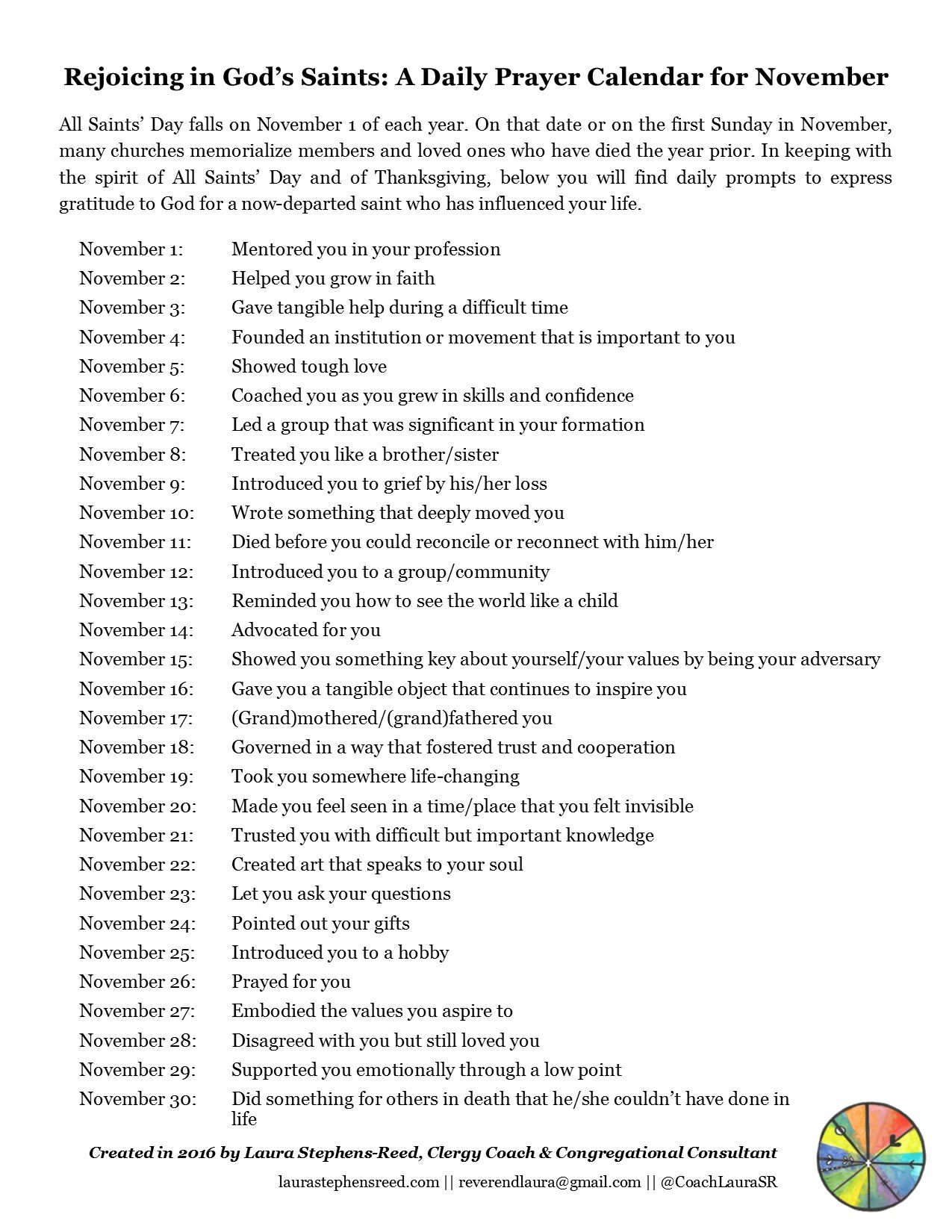
Since All Saints’ Day is November 1, and since we are already inclined toward thanks-living during November, I have put together a month-long prayer calendar with daily prompts to remember a departed saint whose impact has been significant. This calendar is available as a copier-friendly PDF and as a Canva PDF. Feel free to share the calendar on social media, print it for your church members or yourself, or use it as your November newsletter article.

rejoicing in gods saints.jpg
On "bullies"

Lately I’ve seen several articles about church bullies making the rounds on Facebook. They tend to point out the characteristics of a bully and offer some helpful strategies for dealing with – or working around – antagonists. A quick internet search brings up pages of similar posts.

Bullying in the church is real. I have been both a witness to it and a target of it. If you have too, then you know it is soul-sucking. It is exhausting. It affects our ability to minister to healthy people. We sometimes end up taking our pain out on the people closest to us. We may even question not just our calling, but also our faith. Maybe those doing the bullying don’t know how deep their impact is. Maybe they do.

My coaching clients often want to talk about their “bully” or “antagonist.” That verbiage is a shorthand. If I’ve met with the client before, those keywords tap into previous conversations so that we can move more quickly toward designing actions. Those words also give me clues to the client’s state of mind, though I must be careful not to assume too much or project my own experiences. So the label “bully” can be helpful in some contexts.

But I believe the term’s usefulness is limited. If we almost exclusively refer to a person as our bully or antagonist, it becomes difficult to see them any other way. We begin to interpret everything that person says or does through that identity. The hints of humanity get sifted out. Saying that someone bullies rather than that someone is a bully reminds us that the sinner is not his/her sin. Language matters.

I’m convinced that there are pastoral care needs behind every act of bullying. We might have been so wounded by the one bullying that we are unable to provide that care. We might need to set strong boundaries with that person to limit the damage s/he can inflict on us or on others. But as followers of a God who loves even the hardest heart, we must continue to look for – or at least believe in – the image of that God within those who hurt us. Because if we do not, then God’s image within us becomes more deeply buried.

Bullying is real, evil, and potent. But our power lies in grace. Not a cheap grace that makes any and all behavior acceptable, but in a grace that moves us toward wholeness for all.

My hope for you

My family and I just got back from a week at the beach. Thanks to our early-rising human alarm – for some reason my 3-year-old seems to think the day must start before 6:30 am – we took full advantage of the waves, a large pool, and a balcony that was great for picnics and reading and people-watching. We ate great seafood. We took naps. On the day it rained, we jumped until we were sore at a trampoline park.

I am very lucky in that going to the beach is nothing new. I have always lived within an eight-hour drive of one shore or another. When I was young, my parents took my brother and me to the Atlantic coast or the Gulf at least every other year. In nearly thirteen years of marriage, my husband and I have gotten away to the beach several times. That’s including the last three falls, now that we have a child who loves to be manhandled by the tide.

Yet something was different about this trip. I anticipated it. I enjoyed nearly every moment of it. And when it was over, I was happy to be coming home to my bed, my routine, my work. There was no dread about what awaited me. I didn’t open my email yesterday with one eye shut. I didn’t groan about the stacks of papers and books on my desk.

In other words, I needed – and had – a break, not an escape.

Too many times I’ve gone out of town in total denial about what I’d have to deal with when I got back. Church members gone wild. Staff conflict. Events that had to be pulled off, whether there was support and enthusiasm for them or not. I’ve dreamed about what it would look like just to stay gone.

Many of you have been there too. You survive until vacation, then your time away is not nearly enough to recover from the exhaustion and the discouragement. And sometimes all the quiet does is amplify the voice in your head that keeps asking if what you do makes any difference to anyone. (Spoiler alert: it does.)

So my hope for you is that your personal and vocational lives nourish you as much as they drain you so that, when you take that hard-earned time away, you just need a break instead of a full-on escape.

Celebrate the moments of your life

For four days in a row last week, my three-year-old caught me off guard with new things he said or did. He swam a few strokes completely submerged. He adopted perfect shooting form – without instruction – on his Little Tykes basketball goal and started sinking long balls. He looked me in the eye and recited my cell phone number, which I had been planning to teach him but hadn’t gotten around to yet. And he brought a leaf to me and told me it was from a Japanese Maple. (Ok, he was wrong on this last one, but I had no idea until my husband looked up a picture on the internet. I didn’t even know that was a kind of tree.)

I was delighted by and grateful for each of these moments, which were simultaneously ordinary and extraordinary. I replayed them in my head several times. My husband and I talked about them. We made sure our son knew that we had noticed his new feats and knowledge. It was family time worth savoring.

These mini celebrations made me think about the hidden lives of congregations, which are families of sorts. In a church ordinary-yet-extraordinary things happen all the time. Are we marking them? Delighting in them? Giving due thanks for them? Hopefully we are commissioning new leaders, consecrating pledges, and drawing on the gifts of the liturgical calendar. But what about a person’s first time taking communion, speaking in front of the congregation, or inviting a friend to church? Do we “graduate” participants of intensive Bible studies? Do we properly thank outgoing committee chairs and youth sponsors? These milestones are worth noting too. Calling attention to them is a way of saying that God is present among us, that God is pulling us forward in barely-perceptible ways, that we worship a God who offers us joy.

Many of the snapshots in the gospels are of ordinary-yet-extraordinary situations: temple services, conversations among friends, annual festivals. They take place in ordinary-yet-extraordinary places such as around dinner tables, on dusty roads, and in upper rooms. Jesus himself is ordinary-yet-extraordinary, completely one of us, yet completely not. If he is worthy of worship, then these small but significant moments in our corporate lives are surely worth celebrating.

What do you need to delight in this week as an act of worship? May you seek joy, and in doing so, find nurture for your soul and renewed strength for your leadership.

Impostor syndrome: the struggle is real

A couple of weeks ago I was interviewed for a Baptist News Global article titled “Clarify those expectations, experts tell pastor search committees.” Two people were quoted in the piece: Craig Janney, the reference and referral guru for the Cooperative Baptist Fellowship, and me. Craig is a bona fide expert. Churches and clergy from all over the country call him for help with ministerial searches. But the title said experts – plural – and the article included several statements from me that expounded on the headline.

I just got a promotion, I slowly realized.

In my shock, here were my inclinations:

Duck and cover my head with my hands, as if someone was about to throw something at me. (I actually did this.)

Make a snarky comment on social media about how much credibility the article had if it counted me as an expert. (It took all my willpower not to do this.)

Email Craig and apologize not only for the number of my quotes in the piece but also for the appearance of my photo above his. (I did not do this, as Craig is a humble and generous person who referred the reporter to me in the first place.)

I was suffering from an acute case of impostor syndrome.

After a few deep breaths, I started to think it through. I was on my first search committee as a junior in high school. I have been in the search process with more churches than I care to count in fourteen years of ministry. I have observed searches from the perspectives of an interim minister and of a coach working with clergy in transition. I have consulted with search teams. And the Louisville Institute saw fit to award me a grant to come up with a better-resourced, more spiritually-grounded approach to search & call.

In other words, I have done some things. OK, I can claim them. But what will it take for me to wear the clothes of someone with some expertise – and not feel like I’m swimming in them like the tween Josh at the very end of the movie Big? Time will tell.

In what roles do you have some growing room? Which roles are too tight? And what roles fit you just right? When you wear these clothes, give yourself a double thumbs-up in the mirror and a big ol’ Fonzie “heyyyyy!”

"I did a thing!"

“I helped with…”

“I was part of a team that…”

“I collaborated on…”

The ability to cooperate with others toward a shared goal is an essential – and sometimes underrated and underutilized – skill in a leader. Without it, we’re all a bunch of free agents who don’t have anyone to refine our ideas, pool our resources with, or tame our wild hairs. And humility, the underlying trait that makes cooperation possible, is a mark of a Christ-like life.

But. When we have done a thing, when we have created or supervised or equipped or stabilized or trained or written or founded, we must be able to own it. Not brag about it, but lay claim to it. And here’s why:

  • It’s the truth. Truth leads to trust among the parties involved, and trust leads to optimal individual and collective functioning.

  • We set others up for failure when we don’t acknowledge our role. If we don’t take proper credit, chances are that someone else will actively seek or passively receive it. Then those folks are given more authority and more responsibility – without the experience and know-how to draw upon.

  • We’ve got to practice presenting ourselves accurately to people who have power over our vocations. We must show that we can play well with others. But if we completely blend our leadership identity with that of the people we work with, search teams, judicatory leaders, and those who have the clout to recommend us for positions are left to wonder and assume about our personal capabilities. We miss out on opportunities, and others miss out on our leadership.

  • Our self-esteem suffers when we downplay our role. I believe that many people – especially we womenfolk – are generous with success but selfish with failure. By that I mean that if something goes well, it’s because of all of us. If something goes wrong, it’s because of me alone. When we fall short, we should take our lumps but also examine the larger context. When we triumph, we can reflect on how we contributed to the success as a means of grasping and building on our strengths.

  • It honors our God-given abilities and calling. We are each fearfully and wonderfully made to be certain people and do certain things. Because of how God equipped me, I was able to do a thing! Acknowledging our role, then, is testimony.

What, then, have you done this week, this month, this year? Make a list, then tuck it away for the next time you have an evaluation, need to fill out a profile, or feel down about your abilities. Pull it out and remember that “I did a thing!”

Prophet and priest

When I was in high school and college, I fancied myself a prophet. I was a young woman discerning a call to ministry in a Southern Baptist context, and I knew in every wrinkle in my brain, beat of my heart, and conviction of my soul both that God calls women to be pastors and that we are up to the challenge. And I wasn’t hesitant to tell anyone exactly what I thought.

I might have said a prophetic word here and there about egalitarianism, but some of my bra-burning rants were more about pushing others’ buttons or reacting when they pushed mine. Fourteen years into ordained ministry I understand something that I didn’t back then: that there’s more to being prophetic than simply saying something edgy.

Sometimes God taps us to say hard things to people who won’t be eager to hear them. But there’s a second task in the prophet’s job description: we have to prepare our intended audience to listen to what we’re saying. Too often we expend our energy yelling into the void because we haven’t cultivated the relationships that prompt our hearers to pay attention, to give credence to our impassioned points. All the wordsmithing and protesting in the world won’t make up for neglecting this responsibility.

In congregational ministry we tend to believe being a pastor gives us, well, a pulpit for our positions. To some extent it does. Our title and role provide some level of authority. But to be truly, effectively prophetic (read: prompting people to real action based on beliefs they hold themselves), we must first prove ourselves to be our constituents’ priest. We must get to know them, care for them, learn from them, minister alongside them, share our own stories with them, be a trustworthy presence for them, and show our ministerial abilities to them. (Even as public figures we must prove ourselves relatable to hearers we might never meet by finding ways to listen to their concerns and by living with integrity, compassion, competence, and appropriate self-revelation.) Only then will the soil be well-fertilized for the prophecies we share with them to take deep root.

Taking the time to relate to our people is as important – more important? – than ever. In an election cycle that is turning out to be like no other and in a Church that is often held captive by anxieties and outdated expectations, prophets are much needed. And without real bonds, the only people who will care about our messages are the ones who already agree with us. Not only will few hearts and minds be changed, we’ll continue to speak past each other (or worse, talk at one another). So may God equip us in this critical time not just with the words, but also with the courage, empathy, persistence that give the words lasting impact.

Trust thyself

“I will leave work today by 5:00, whether I’ve crossed everything off my to-do list or not!”

“I need to be more assertive the next time someone makes an inappropriate comment about my [insert object of unwelcome observations here].”

“I’m going to start having a date night with my significant other at least once a month.”

“This year I will finally learn how to [insert dreamed-of hobby here].”

It’s good to make promises to ourselves. It’s perhaps more important to keep them. (I confess, I’m particularly guilty of fudging on #1.) But why? Other than me, who suffers when I break a commitment pledged only to myself?

Actually, it matters a lot that we can trust ourselves, and not just in terms of “I’m going to report all my wonky ministry income to the IRS” or “I’m going to visit that shut-in like I planned to whether anyone else knows about it or not.” If we don’t follow through on what we say we’ll do for ourselves, we cannot build self-trust. And according to Stephen M. R. Covey, we must learn to trust ourselves before we’re fully ready to trust or be trusted by others. Considering that the whole of ministry – the whole of communal life, really – is rooted in trust, self-trust is thus a big deal.

Covey says that when we don’t come through for ourselves, “Not only do we lose trust in our ability to make and keep commitments, we fail to project the personal strength of character that inspires trust. We may try to borrow strength from position or association. But it’s not real” (The Speed of Trust, p. 45). Instead, when we do keep promises to ourselves, we lay the groundwork for what Covey calls the four cores of credibility. We demonstrate congruence between what we say and how we act. We show that our stated motives are real, not just lip service. We prove that we have the ability to carry out the tasks themselves. And we have the track record to prove we are trustworthy.

This emphasis on self-trust puts a whole new spin on self-care, an area in which many ministers struggle. We want and need rest and replenishment, but we feel guilty laying claim to them. So we make plans and then push them aside when one more person needs one more thing from us. We treat our commitments to ourselves as fluid, and in doing so we violate the four cores of self-trust, making it harder for trust to flow between us and others.

How then does our inability to trust ourselves impact our ministry? Our relationships with family and friends? And if trust – faith – is the heart of our belief system, how does a lack of self-trust affect our own spirituality? There’s much more at stake than meets the eye when we don’t keep promises to ourselves. May we be encouraged to follow through on our personal plans so that we can be not only rejuvenated for ministry but also credible in our leadership.

Death and life

My birthday was last Thursday. July 28 is always a mixed bag of emotions for me, but not for the standard reason. I don’t really have a fear of growing older, partly because I have always wanted to look older (or at least my age), and partly because life seems to get more flavorful as the years add up. No, my birthday celebrations seem off-key because they share a date with my Nanna’s death, now eighteen years ago.

Nanna was one of the strongest, most generous people I have ever known. She was a stout woman with a hearty laugh and a hug that was so tight it made you squeak. She worked hard as a breadwinner and as the caretaker for my grandfather, who was paralyzed on one side for all the years his life overlapped with mine. She anchored a pew every Sunday and anonymously slipped money – not that she had much to spare – to people in need. She cooked for her extended family many Sundays (lunch wasn’t ready until the forgotten bread was burned!) and she delighted in hosting her grandchildren for sleepovers and playing whiffle ball with us in the yard.

Nanna earned her retirement after decades in sales. She buried my grandfather and great-grandmother. At last unfettered by the many responsibilities she’d shouldered for so long with little complaining, she really began to enjoy herself. She took bus trips. She got into trouble with her friend Mrs. Hannah. And then, without warning – she’d been to the doctor that day, in fact – she died.

I wish my Nanna could have met my husband. She would have loved his big heart and lack of filter. She would have adored our songbird of a son. She would have been proud of my ministry. But while she is gone, she isn’t. I have been and continue to be shaped by her in many ways, and three are especially significant.

Nanna gave me the best gift I’ve ever received. At Christmas one year, I opened a cardboard box to find craft sticks, macaroni, glue, pipe cleaners, fabric, glitter, and countless other art items. And, perhaps most significantly, no instructions. The box was a boundary-less invitation to create, and it unlocked a part of my brain that has been essential to my vocation and my personal life.

Nanna helped pay for my wedding, supplies for my son before his birth, and ongoing education for ministry, even though she wasn’t alive for any of these milestones. Every year she and my PaPaw gave each of their grandchildren a small savings bond. At the time, I was the typically ungrateful child: I’d rather have had a gift card to Waldenbooks <<nerdy flashback alert>>. But as expenses come up, I carefully consider whether Nanna would want to contribute by way of a bond, now worth at least twice as much as the purchase price. I trust my choices make her proud.

And Nanna supported my ministry. When I first discerned my call, she was unsure, though she never said as much to me. (She was, after all, a lifelong Southern Baptist.) But she secretly recruited a friend whose scripture savvy she trusted, and she asked him to walk her through texts about women in leadership. By the end of their study, she was able to trust what she already knew in her gut, that God could and does call women to ministry. Her desire to support me and her commitment to faith continue to encourage and guide me.

My Nanna loved butterflies. A few years ago I officiated a wedding at her church, and I was waiting in the narthex with the groom before the service. I glanced down and saw an abandoned butterfly pin on the floor. I tucked it into my Bible, as sure a sign as any that the dead are yet among the living, and that in the love of God, we are never lost to each other.

Laura Stephens-Reed
Outputs or outcomes?

I took several gems of insight away from the keynote sessions at the recent Young Clergy Women Project conference. One in particular helped me articulate a conviction I have held for a long time but have had trouble putting into words, at least in a concise way.

In the world of church, we are too often focused on outputs instead of outcomes.

Outputs are the measurement of the business world. They are easily captured in spreadsheets. In congregations, outputs are the nickels and noses: what money came in this month through the offering plate vs. how much went out for bills and payroll, how many people attended worship this week (and how many of these folks were first-time visitors), what new ministries were added this year.

Now, I’m not saying that outputs are unimportant. Being fiscally attentive is essential to good stewardship. Noting attendance patterns lets us know when we need to re-evaluate our approach and points us to potential pastoral care issues. And taking stock of new ministries gives us some sense of the energy, commitment, and needs among our constituents. (I use the word “constituents” here because it is more inclusive both of visitors to our campus and of the neighbors we work with in the community.)

Outputs, however, are not the best indicators of faithfulness and fruitfulness. Outcomes are. Outcomes are harder to get our arms around than numbers, and that’s why we fall back on our beloved spreadsheets. But which church is growing, in the spiritual sense? The one with a budget built solely on last year’s giving patterns and this year’s pledges, or the one that takes calculated risks rooted in a vision of what the congregation could be and do with God’s help? The one that has ten new members every week, many of whom never connect with a small group or find their niche within the congregation’s mission, or the one that rarely gains new people but is regularly finding ways to share God’s love with the surrounding area? The one that adds new Sunday School classes all the time using boilerplate curriculum, or the one that intentionally teaches and practices disciplines that open participants to the counsel of the Holy Spirit?

Outputs can be useful, but let’s not confuse them with outcomes. They are (some of the) benchmarks, not the goals in and of themselves. Where, then, have the two been unwittingly married in your context, and what separation/redefinition needs to occur for the people in your care to grow in discipleship and service?