Clergy & Congregational Coach
laurastephensreed logo2 (1).png

Blog

Helping clergy and congregations navigate transitions with faithfulness and curiosity

My blog has moved to Substack! You can find new articles weekly there.

Visit my Substack

Use the button below to search the blog archives on this website.

Search the blog
Politics, polarization, and the Coronavirus

In his book The Righteous Mind: Why Good People Are Divided by Politics and Religion, social psychologist Jonathan Haidt covers a range of themes about which liberals and conservatives disagree. One is the care/harm theme in which the two polarities differently attribute definitions and causes of hurt and assign the responsibilities of society toward those who are vulnerable. In another, the polarities take varying stances toward people with power.

Our relationships toward these two themes are running beneath the surface of many COVID-19 conversations. Who is to blame for the spread of the virus? Who is supposed to do what about it? How well are our leaders serving us in this crisis? Who is the boss of me and my comings and goings as recommendations for ever more stringent social distancing guidelines are urged?

Right now these questions are only helpful insofar as they reduce the spread of disease. Beyond that, they are ingredients for introducing even more anxiety into a system that is already highly reactive. Still, the questions aren't going away.

For leaders, then, the need to self-differentiate is more important (and difficult) than ever. If we can be with our people rather than react to to them, we'll model ways to manage self and begin to infuse the system with more stability.

What does self-differentiating in a pandemic mean? Here are some thoughts:

Listen deeply to others. When people feel heard, seen, and valued, the tension in a conversation drops.

Stay curious. Seek to understand, whether or not you agree.

Don't try to change minds. Be clear about what you believe, but prioritize the relationship over the position.

Neither under- nor overfunction. This helps distribute responsibility throughout the system, evening out the emotions.

Balance thinking and feeling. You need both, but too much of one or the other will make it hard to keep connected with people.

Stay present with people. If you can be grounded where you are, there is always the potential for care and respect.

Take care of yourself. Self-differentiation is hard work. Shore up your support system as needed.

Your leadership matters. While others panic, blame, or scoff, your self-management is helping make it possible for those in your care not just to cope, but to assign meaning to this unprecedented experience.

Gen X clergywomen and the Coronavirus

I recently finished reading Ada Calhoun's book Why We Can't Sleep: Women's New Midlife Crisis. It was pretty on-the-nose about how I feel these days - stretched thin, anxious, and simmering with low-grade rage most of the time. Calhoun points out the myriad reasons why many women of my generation feel this way. Among them are having so many more career possibilities (expectations, even) without much additional support for parenting and managing a household, coming of age professionally during financial crises that ultimately let to fewer and lower-paying job opportunities, being dismissed by much of the medical community around peri/menopause symptoms, and caring for young kids and aging parents simultaneously.

And yet, as many memes have been reminding me lately, Gen Xers are uniquely qualified to manage in a pandemic. Our expectations are low, partly because we're used to being invisible to others. We're able to entertain and take care of ourselves. We've partaken of our fair share of dystopian films and novels, so not much surprises us.

I think that Gen X clergywomen in particular are suited to this moment in time. No, the pressures common to our generation have not lifted. But we have the Gen X survival skills paired with the grit, wisdom, faithfulness, and creativity that come from having to make our own way in the church world. (Yes, we owe much to the clergywomen who came before for blazing the path. We have the benefit/challenge, though, of figuring out how to lead and be valued in ways authentic to us, not just imitating the guys like our forebears had to do.)

And so I would remind you that you are likely crushing it, even when you don't feel like it, and urge you to tend to the three steps Ada Calhoun recommends:

Get support. Don't go it alone. Lean on your laypeople to share the congregational care load and seek out clergy with whom you can vent and share best practices.

Reframe the situation. What's another narrative you can lift out of the current crisis, for yourself and others? What expectations do you need to lower since we're all feeling our way along?

Wait. The pandemic won't last forever, just like middle age won't. Life will be different on the other side.

If I can support, resource, or encourage you in this time - of pandemic, of season of life - please drop me a line. 

Scarcity, abundance, and COVID-19

On the best of days, many churches have long spent too much energy on what they do not have, usually a balanced budget and pews bursting at the end caps. The COVID-19 crisis has ramped up that fear about scarcity. Not only do we not have an offering plate to pass or full sanctuaries, we cannot safely gather in person at all. We do not even have the incarnational comfort of physical proximity.

Ok. All of that is true. All of that is hard. And, it is not the only story. Abundance still exists. You might just have to look a little harder or get more creative to find it. But once you do, you can build on it in ways that will benefit your congregation far beyond the passing of this immediate crisis. Here, then, are some places where you might take stock:

Tech savvy. Who are the people in your church who know how to connect others or disseminate information in a variety of ways by technology? What platforms or equipment might they have access to that your church could use to gather constituents virtually at various times?

Connections to denominational partners. Your denomination (including publishing houses, benefits boards, and more) or middle judicatory has probably sent information out to churches. What resources are on offer? What resources might you ask about, such as mini grants to set up online platforms?

Time. Some of your church members are extra busy right now as they work from home (and possibly try to homeschool their kids simultaneously). Those who are home and cannot/do not telecommute, though, might have availability that they might not otherwise. How might they use that time to serve others, perhaps by calling or texting individuals or hosting virtual gathering?

Individual connections. Who do the people in your church know, whether from school, work, volunteer efforts, professional networks, clubs, or businesses they frequent? How might those connections be leveraged remotely to help those in need, whether within your congregation or beyond?

Individual talents. What are the people in your church good at - whether those are life skills or for pure enjoyment - and that they might teach others to do by phone or video? What can they make and share (with proper precautions) with others, such as poetry or meals or activity kits for kids?

This is not an exhaustive list, but it does provide examples of ways to think more deeply about strengths your church can leverage in a greatly changed context. Getting creative about ways to connect has the added advantage of moving your congregation forward into an increasingly digital world - pandemic or not. And it further trains us to notice where God is at work among us, a habit that is spiritually transformative.

Church in the time of Coronavirus

Let’s not mince words. This whole COVID-19 business sucks.

That suckage covers a big range, too. At one extreme, there’s the physical danger to immunosuppressed people and to those living in poverty, who might have difficulty feeding themselves as schools close and shelves empty at food banks and at stores that take government benefits. At the other extreme, people lament the (hopefully very short-term) loss of all that makes life enjoyable, such as birthday parties and trips and worship services and the NCAA basketball tournament. And these are only the immediate impacts.

So we’re all feeling the pinch in some way. The mortal danger is, of course, the exponentially greater concern. That’s why institutions of all kids are taking precautions and recommending safety guidelines to leaders and individuals – including pastors and church members. Talk about the things they didn’t teach you in seminary: many a minister is struggling to tend both to concerns about vulnerable people and frustrations about closures in a context that is now changing hourly.

Fully acknowledging how much the situation stinks, there are a couple of opportunities to keep in mind.

First, the church is not the building where your congregation is used to meeting. The church I attended in seminary had (and probably still has) a sign that said, “Oakhurst Baptist meets here.” It was a way of separating the congregation from the physical location. Many a church struggles to do that. After all, how many conversations about sanctuary carpet or the color the youth want to paint the walls of their meeting space become seemingly all-consuming, to the detriment of actual ministry? With many churches canceling in-person gathering for at least the next few weeks, there can begin to be more daylight between the people and the place.

With that in mind, how can you help your congregation members see in new ways that church is about relationships, not a facility? How will you equip and encourage your people to tend to those connections in the absence of a physical gathering place?

Second, the church as it was has been dying for some time. Many pastors know that, yet it can be hard to imagine what a new iteration of church might look like. And even if we can visualize it, how in the world can we inspire our people to be courageous enough to attempt it? Well, this pandemic offers a laboratory for that. We can’t conduct business as usual. We thus have unprecedented permission to discern new ways of connecting to one another as we seek to grow in our relationships with God.

So what expressions of the scattered church have you wanted to play with but heretofore haven’t dared? If you’re not sure what you’d like to experiment with, how can those who are accustomed to relating to people who aren’t physically present (e.g. youth ministers, digital natives, tech professionals) show us the way?

I am praying for you, pastors, and I am confident in your faithfulness, compassion, and ability to innovate. Lean into those strengths – you might be surprised by what emerges. And as you attempt new things, give yourself permission not to have all the answers immediately. We’re all feeling our way along in this brave new world.

Interim ministry as pastoral care

I have the joy of leading two cohorts of clergy either serving in interim ministry or contemplating making that plunge. At one of our online gatherings last week, the participants were considering the questions of what makes interim ministry distinct from settled ministry and why we find transitional work so engaging. One cohort member shared that he considers churches in pastoral transitions vulnerable in ways that congregations with installed clergy are not. He considers it a privilege to minister to churches experiencing that vulnerability, helping them feel their way to hope.

That word - “vulnerable” - put a descriptor to the privilege of being with churches in their liminal spaces. I’ve had three units of Clinical Pastoral Education, which is intensive training for pastoral care. I can make an adequate visit to a homebound church member. I can show up in a hospital room and pray. But care for an entire congregation moving through the grief and anxiety of losing a pastor is where I do some of my best work. I am moved by hearing churches talk about what their former minister meant to them, which almost always covers the full range of emotions. I get excited about crafting worship experiences and conversations that help church members re-connect with God now that the person who was often their conduit has departed. I love helping congregations, especially small or shrinking ones, acknowledge that they are loved and gifted by God. And I revel in accompanying churches as they discern their way into the next season of ministry.

If your congregation has had a long-tenured, beloved, AND/OR controversial pastor, please allow an interim minister to journey with you when that person leaves. You deserve to be cared for, and your well-being will only benefit the pastor search process, the clergyperson who is eventually called to your setting, and the mission you offer in service to God out of healing rather than hurt.

Workshop: managing impostor syndrome

At the height of Michael Jordan's NBA career, Gatorade launched the "Be like Mike" campaign. If we replenished our electrolytes with the same sports beverage as Jordan, then we could hope to lead our teams to NBA titles, be named the NBA's MVP, and take home multiple NBA scoring and slam-dunk championships.

It's important to have role models, people who broaden our imaginations about what's possible. At some point there becomes a danger, though, of feeling like a fraud if we compare ourselves to those role models - or even to those who don't seem to be putting in the work yet reap the rewards of their positions - and judge ourselves as coming up short. There aren't enough gallons of Gatorade to make up for gaps in privilege or charisma or opportunity or raw talent.

Even in 2020, many clergywomen are treated as if we are "playing at" pastoring, as if we don't deserve to live into the fullness of God's call on our lives and aren't capable to exercise the fullness of God's equipping for our vocations. While we often feel like we are treading water, toiling for our authority every day, we see others gaining bigger platforms.

Enter impostor syndrome: what am I doing here? Is someone going to realize I don't belong and call me on it? Does my effort even matter, since I might never be the Michael Jordan of ministry? (Spoiler alert: YES.) Impostor syndrome is widespread and insidious. It makes us feel like our gifts and ministries aren't valuable to God or God's people. It urges us to lead in ways that are not authentic to us, which means we don't leverage our God-given strengths as faithfully as we could. It causes us to doubt our decisions instead of using outcomes - whatever they might be - as fodder for ongoing discernment. It causes us to compare ourselves to others, which prompts discouragement that can eventually lead to our departure from ministry altogether.

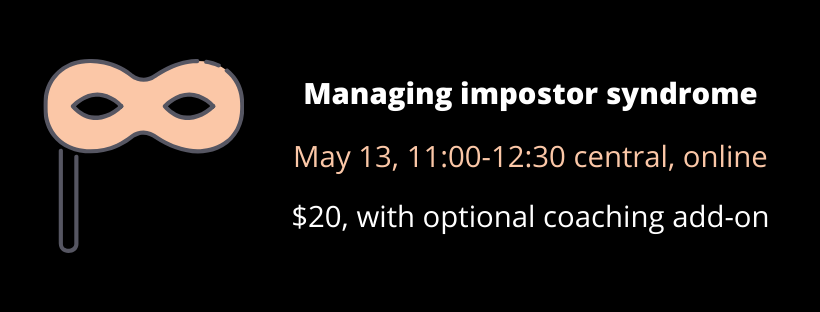
From 11:00 am -12:30 pm central time on May 13 I will be offering an interactive workshop for clergywomen on managing impostor syndrome. Within a theological framing, we'll name what impostors are. As counterpoints, we'll discuss how we came to be where we are, what our impact is on our ministry settings, how we can remember our worth, and how we can develop mutual support networks to bolster one another when symptoms of impostor syndrome emerge. Participants will take away awareness and practices they can put in place to live out of God's call on their lives and God's love for God's people rather than out of the (sometimes internalized) expectations of others.

The cost for this workshop, which will take place via the Zoom online platform, is $20. There will be an option to add on three 1-hour coaching sessions, at a discounted rate of $225 (total for all three sessions), to help you apply what you learn. Click here to sign up.

The difficulty of discernment

Discernment is reallllly hard.

Discernment is also reallllly important.

Here is a link to the audio of a sermon I preached two Sundays ago about the why and the how of discernment. I was in the pulpit at First Baptist Church in Memphis, Tennessee, which is between settled pastors. In my role as the FBC’s transition facilitator, I was speaking directly to the challenge and the gift of discerning along the way to calling a new minister. The sermon also applies anytime we as clergy or congregations feel the internal or external pressure just to get on with it.

Understanding conflict

There is more than one way to assess the dynamics at play in conflict. We have the intrapersonal elements: what is going on within each person? Internal struggles are sometimes good fodder for conversation with a therapist or counselor, a professional who helps individuals understand how their current reactions are shaped by past experiences. Once that awareness emerges, healing becomes possible.

In conflict there are also the interpersonal aspects: what is happening among people? I don’t know of an approach that offers more insight into relationships than family systems theory, which explains how different emotional units interact in healthy and unhealthy ways.

To be certain, the intra- and interpersonal overlap when conflict threatens to boil over, and a basic grasp of both is essential to pastoral care at multiple layers. But I think an additional filter is helpful when we’re dealing with issues at the congregational level. Otherwise we can quickly get into the weeds, analyzing who is where in the system or what each person’s triggers are, so that it’s hard to zoom back out to the big picture. Meetings grind to a halt and initiatives die because we’re so focused on managing problems at the micro level.

In my mind, then, congregations live on an x-y axis. Individuals are points on the plane. Family systems theory orients us along the horizontal axis, helping us see how one person relates to the next. The vertical axis can in turn offer us a deeper though perhaps simpler way in to focusing what’s going on by taking us from symptoms at the surface to underlying issues.

At the outset we deal with logic. What are the arguments the involved parties are making? What are the counterpoints? If conflict is not resolved through reason, through adding up pros and cons and taking the most apparently advantageous path, then something else is going on.

The next level down to probe, then, is emotion. Who is feeling what and why? How might those feelings need tending? Whose heart or relationship needs mending?

If conflict remains after working with logic and feelings, then there is a struggle for power, whether or not it’s acknowledged as such. Who has control in certain situations? How did they get it, and how do they maintain it? What would it look like to give some of it up, and who would benefit? What would it take to convince the powerholders to cede some of their stake?

This approach, adapted from Sarah Drummond’s book Dynamic Discernment, provides a more streamlined on-the-spot assessment and offers a way to think about what it would take truly to get conversations and plans moving in a helpful direction. So the next time you’re blindsided in a conversation or banging your head on the conference table during a stalled-out meeting, travel the vertical axis of reason-emotion-power, taking care as you have breadth to tend to the pastoral care needs of individuals and emotional units.

Re-imagining ministry and re-inventing yourself

Many clergywomen find themselves in the position of needing to re-invent themselves at some point. There are many reasons why. We are geographically limited. Or congregational ministry positions are drying up as church budgets shrink. Or we have small children or aging parents who need more of our attention than full-time congregational ministry allows. Or we’ve been scarred by church work. Or we have yet to find a venue that fully utilizes our gifts. Or God is at work in us, shaping a vision of what we’ve been made for. 

And so we dream about – or are forced to consider – what an out-of-the-box ministry could look like. Let me say (as someone who has been there) that I am in your corner. I’d offer these steps to you as you mull and plan.

Define your purpose in ministry. What is it that God is nudging you to do? The specific tasks aren’t as important at this point as what your overall aim is. “I create spaces for people to grow their relationships with God and one another.” “I help churches navigate change with clarity and hope.”

Free yourself up to think broadly about ministry. Many seminaries are geared to drive students toward traditional congregational ministry positions. There’s more than one way, though, to live out your purpose in ministry. What way(s) suit you and your strengths?

Consider the environment you need. What kind of space does your ministry require? Do you work best with people or on your own? What supports and/or accountability will allow you to make the most of your gifts? What equipment or resources can undergird your efforts? How important is location to your success?

Think about your financial requirements. Creating your own ministry often means leaving the world of steady pay and benefits. How much fluctuation in income can you tolerate, at least in the short term? How will you secure health insurance? Remember too that business expenses will now likely come out of your gross income, and be sure to figure that in to your projections.

Identify to whom your ministry would be good news. If God is inviting you to consider a new venture, your efforts will be valuable to others as well. Find those people, tell them what you’re mulling, and listen deeply to the feedback as you gauge their level of excitement.

Pray on it. After you’ve done all of the above, turn your data and your shoulds and coulds over to God: that would you have me do? This is a time for discernment, not decision-making.

Promote yourself. “Noooo…” you might be thinking. “I don’t want to do that. I can’t do that.” But remember those people you talked to who saw great potential in what you were thinking about. Letting those who need your ministry know that your help is available is a service to – not a burden on – them.

Set attainable targets for yourself. You have very little control over whether you net a certain number of new clients per month, so a goal like this is a recipe for frustration. You can absolutely make so many new contacts or spend X number of hours per week working on a particular project, though. These kinds of mileposts keep you moving forward.

Celebrate the flexibility you have when times are lean. Hustling is hard. It requires tenacity. You will wonder many times if you heard God correctly when you stepped out on this limb. And, you will be so glad when you don’t have to plan time away, whether it’s to attend an event your child’s school or to get away for a few days, around a million other concerns.

Find colleagues. Even if you work well alone, don’t allow yourself always to be alone. Look for people with whom you can provide mutual encouragement, space to vent, and brainstorming time.

Keep learning and growing. There’s a lot of trial and error in starting up a new venture. Instead of letting the errors discourage you, use them for further discernment. What about this particular try helped me be faithful to my purpose? What distracted me from it? Use those reflections to refine your ministry.

Be patient with yourself. You are brave. You are wise. You are innovative. You have much to offer. And, it will take time to build your ministry. Release yourself from the expectation – and the pressure that comes with it – of going from 0 to 60 in a few months.

I have found great joy in reimagining what ministry looks like for me. That does not mean it’s always been easy. It took a long time to build toward sustainability, but I can now confidently say it was worth the effort. So all the best to you in your new season of ministry. Know that I am here to help if you need it.

Thriving = relationships

I am part of the teaching team for the Thriving in Ministry program co-sponsored by Wake Forest School of Divinity and the Center for Congregational Health and funded by the Lilly Endowment. Last week program participants gathered for the first time to mull what it means to thrive (and why it matters for that clergyperson, the congregation, and the world). Much of thriving boils down to relationships. We merely survive, at best, when our ties to others are tenuous. Here, then are some ways you can set up your incoming - or settled! - minister to thrive:

Pray for your pastor(s). Pray for them not just as leaders, but as human beings. Let your minister(s) know that they are part of your spiritual practice in this way.

Pitch in on ministries. The clergyperson is not there to do everything. Your pastor is with you to encourage you in your discipleship. Make it clear that you see your minister as a partner in service and worship, not a hired hand to do all the things.

Encourage connections within the community. Ministers are at their best when they have colleagues to learn with and vent to. Urge your pastor to join a clergy group, meet the minister down the road, or become involved with an organization, then be supportive when your pastor is away from the office for these reasons.

Encourage engagement with the wider church. Pastors need interaction with other leaders in the denomination, and that often means going out of town to be a camp chaplain or serve on a denominational committee. Building these relationships within bigger circles gives your minister a broader support network to draw on and connects your congregation to more resources.

Protect the minister’s time with loved ones. This one is so hard - and so necessary. Pastors know what they've signed up for when they accept a call to congregational ministry. And yet, they don’t need to miss games and plays at their kids’ schools, special lunches at their spouse’s place of work, and birthday celebrations with best friends. These bonds will last them long after the relationship with your church is dissolved, so they must prioritize them. They are also a clergyperson’s best daily protection against loneliness, which has not only emotional but physical health effects.

Thriving ministers help congregations answer God’s invitations to show love in a world so desperate for it. If relationships can make all of that happen, why wouldn’t we make sure our pastors are making life-enriching, life-saving connections?

Understanding how people arrive at different beliefs

Have you ever wondered how someone in a similar life station can experience the world or believe so differently from you?

Or have you ever been in a conversation that seemed benign until the other party exploded, leaving you to think, “Well that escalated quickly.”

An organizational psychologist named Chris Argyris developed a model called the ladder of inference that might be helpful for understanding what’s happening in scenarios like these.

Basically, each of us filters the world around us in a different way. We select among observable data, often without thinking much about it. We add meaning to that slice of data according to our personal experiences or cultural background. Those assigned meanings lead us to make assumptions, and we then make conclusions accordingly. As conclusions pile up over time, they solidify into beliefs. We act based on those beliefs.

The ladder of inference explains how even in a congregation that averages 100 in attendance – or in a discussion between two people – the parties can end up having very divergent perspectives. It can also help us learn to explore situations through others’ eyes. How might differences at each rung of the ladder lead to ranges of beliefs and actions? Where are potential points at which further discussion might result in understanding and collaboration?

The ladder of inference could be a useful tool for committees or teams that are having trouble coming to agreement. Start at the bottom and work your way up. What are each person’s observations? What data do they choose to work with? Keep going up. Note where there are divergences. Hearing from one another is the starting point for real collaboration.

ladder of inference.png
Who - or what - controls your time?

I have had a number of conversations lately with coachees who feel overwhelmed by their workloads. Some have even expressed shame that they can’t seem to get their arms around all they need – or at least think they need – to do.

Here are my responses to that:

You are not alone. Not by a long shot. Most ministers are generalists, which makes your work big and amorphous.

If you feel overwhelmed, it’s because you care. You love your calling and your people. That’s a good thing!

It is ok to reclaim your time. There are some things that only you can do or that you are specifically called to do. You are allowed to prioritize those tasks.

There are strategies that can help you toward that end. Some of the following suggestions will work better than others for you based on your work style and personality type, but you might consider:

Developing a work flow. Think about tasks that recur weekly or monthly and schedule standing blocks of time for them. These don’t have to be big chunks, but blocking time creates touchstones that reduce anxiety and the number of decisions you have to make in a day.

Postponing and/or limiting time spent on email. If you open your email as soon as you sit down at your desk, you have ceded control of your day to whatever awaits you in those messages. Get some of your important tasks done before you check your inbox. A related strategy is to dg into email only at a couple of designated times each day. (Rest assured that real emergencies will get through to you by other means.)

Thinking in longer arcs. Take time at the beginning of each month or season to set goals, plan sermon trajectories, or create outlines for Bible studies. That will offer continuity to your work and make sure your best ideas don’t get shelved.

Breaking big projects into smaller tasks. Projects on the whole can feel too overwhelming to start, but they are made up of mini projects and shorter deadlines that are much more manageable.

Working somewhere else when needed. It’s ok to set up shop from time to time somewhere that you won’t be interrupted every five minutes. Let your admin or lay leaders know where you are for accountability and how your deep work during these windows benefits the church.

Getting curious. Ask yourself questions such as, “Why am I doing this?” or “Who could do this better or with more enthusiasm than me?”

Empowering others. Ministry is about equipping people to follow Jesus. What opportunities to use God-given strengths and to share the love of Christ can others take on and free you up for other responsibilities in the process?

Loving the people in your care is not the same as responding to their every expectation, real or imagined. I encourage you to be proactive about your use of time and to notice how your ministry and your stress level change as a result.

Pastor search teams, personnel committees, and pastoral relations committees

If your church is like most, it has a lot of committees. (It might even have - GASP - more than it needs!) So why would a congregation expend valuable member energy on a pastor search team AND a personnel committee AND a pastoral relations committee?

Simply put, these three bodies fulfill different but complementary functions:

A pastor search team (or pastor nominating committee for our PCUSA friends) does what its name suggests. It designs and implements the steps required to call a clergyperson to the congregation. Search teams are ad hoc and disbanded once the incoming minister has settled in. (The exception would be when the new pastor asks the search team to morph into a pastoral relations committee. See below.)

At their best, personnel committees help staff members live fully into their roles. (Note that in some churches and denominations pastors answer to personnel committees, but in others personnel committees oversee non-pastoral staff while the clergy primarily relate to another group of leaders.) They clarify expectations of staff both for employees and for the congregation and establish constructive feedback loops. They help staff work through challenges and provide them with the resources needed to do so.

Pastoral relations committees are support teams for the minister. This body is made up of people with whom the clergyperson feels comfortable sharing more sensitive information such as personal conflicts and family or medical issues. (This is why incoming ministers sometimes ask their search teams to serve as their first PRCs. The clergyperson has grown comfortable with the search team through the search process and does not yet have relationships with other church members.) PRCs offer feedback and encouragement and occasionally advocate for the pastor to the appropriate body, but they do not review or oversee the minister.

Search teams will want high-functioning personnel and pastoral relations committees because they carry forward the work the search team begins. The most thorough, faithful search can result in a crash-and-burn if the personnel committee is stocked with people bringing an agenda or if there’s no PRC to support the pastor. With that in mind, what changes does your church need to make and what practices does it need to implement?

Avoiding clergy burnout

According to many studies done over the past couple of decades, clergy burnout is epidemic. At least half of all pastors leave vocational ministry for good after five years of service. (Some surveys put the number closer to 85%.) Fewer than 1/10 of clergy make it to retirement. These are sobering numbers.

Symptoms of burnout cover the range from relationship problems to poor physical health to feelings of isolation from God to anxiety and depression. But what is the root cause of this burnout? According to Sarah Drummond in Discerning Dynamics: Reason, Power, and Emotion in Change Leadership, “A leader becomes burned out not from long hours, but from working under unrealistic expectations set by others or themselves. When responsibility and power are insufficiently proximate in the work environment, burnout is possible.” This means that clergy who are tasked with making congregational shifts (or keeping a lot of people with disparate hopes happy) but who are not given the resources and authority to put changes in place are most at risk.

What can pastors do, then, to avoid burnout?

Get clear. Use every avenue available to you to find out what the stated and unstated expectations of the pastor are. Read old newsletters. Paw through meeting minutes the previous minister left behind. Know what is in legal documents. Information itself is power.

Get curious. Talk with formal leaders, informal influencers, and people who have a long history with the congregation (including those beyond the church, such as judicatory leaders and other clergy in the community). Whenever a weird dynamic pops up, probe what’s going on beneath the surface. Illuminating unhelpful norms is the first step in reshaping them.

Communicate, then communicate some more. Let everyone – especially your core leaders – know what you’re doing. Use the newsletter, the pulpit, and social media. Make your pastor’s reports available to everyone when appropriate. The role of minister is shrouded in mystery for some folks, leading them to believe you only work a few hours a week. That can prompt them to lay on the pressure even as they grab tasks. Sharing what you’re doing can reshape unrealistic expectations.

Create constructive feedback loops. Advertise when and how you hear questions and concerns best (e.g., a Monday morning email instead of a pre-worship ambush). State what kind of feedback is off limits, such as your parenting approach or hairstyle. Say how you handle anonymous notes. Setting boundaries allows you to claim – appropriately – your power.

Build support for new initiatives. Before you take any big steps, identify the people who will be most affected and get backing from them, particularly from those with the most clout. In other words, pool your power for positive purposes.

Say what you need. Could you use more time away for rest and renewal and professional development? An increase to a line item in the budget? Introductions to potential community partners? More layperson power for a particular ministry? It’s ok to ask, no matter what the response is. In fact, it’s an opportunity to share your thinking and to give folks a peek into what happens in ministry.

All of these approaches work toward more alignment between responsibility and power.

The church needs you and all your gifts for the long haul. So while the onus isn’t – or at least shouldn’t be – all on you to match expectations and authority, it’s well worth your effort to gain new awareness for yourself, shift others’  understanding, and seek more resources.

Speaking the truth about power

You have been working with ministry leaders for months on a new initiative. In the process you and your team have carefully gathered input, communicated decisions out in a variety of ways, and provided pastoral care to people for whom proposed changes to the way things are currently done might spark anger or grief.

When implementation time comes, however, the initiative dies on the vine. Why? Well, you’ve attended to reason and emotion, two key aspects of transformation, but it’s possible you and your team overlooked the most potent one: power. According to UCC minister and seminary dean Sarah Drummond in her book Dynamic Discernment, all three areas must be addressed for lasting organizational change to occur.

That makes sense, doesn’t it? You’ve got to have the investment of influencers for anything new to have a shot at succeeding. But here’s the thing, says Drummond: people with power often deny that they have it: “Oh, as board chair my voice is just one among many.” “I haven’t held any [formal] leadership roles for a long time.” “It’s not my fault that others look to me for my opinions.” That’s because those who acknowledge that they have power for whatever reason (position, wealth, gender, sexual orientation, race, age, length of membership, etc.) might be asked to give up some of that advantage, which even well-meaning people are reluctant to do.

Ministers must have a clear-eyed understanding of power dynamics in order to help their congregations live into hope and inhabit new realities. And they have to be able to help others see the forces at work, own where they have clout so that they can leverage it for healthy purposes, and willingly share some of their authority so that new voices can be heard.

As in many matters, curiosity is key, whether you wonder to yourself, “What is really going on here?” or if you ask others to tell you more about people, roles, and expectations to heighten their awareness as well as your own. This questioning not only illuminates previously hidden systems but also makes it possible to note what Drummond calls “pockets of possibility” where established power and grassroots energy could converge.

Who, then, holds the power in your setting? If you don’t know, how will you find out? And how will you then use that information in wise and compassionate ways to affect changes so that your church can be creative and faithful?

It's a new year, but the world doesn't need a whole new you

You see, you’re already pretty great.

First of all, you are a beloved child of God, made in the divine image. That means you glimmer with God’s imagination and care. Wow.

Second, you are tenacious. After all, you’ve had bad days and Really Bad Days in among the good. And the world sometimes feels like it’s crumbling around us. Yet here you are, keeping on keeping on. Great work!

Third, you do really valuable ministry.  I feel confident saying that you are not just smart but also wise. That you are resourceful and innovative. That you are compassionate. Otherwise, you wouldn’t have the role and the responsibilities that you tend so faithfully. I’m grateful for who you are and what you do.

So the world doesn’t need you to become a whole new you in 2020, despite what the weight loss commercials might tell you. The world does need you to become the best you, though, because you have unique ways of seeing and being in and moving through all that is wonderful and terrible. And we need this particularity from you, from each other.

Coaching can help you embrace this best self. In this new year, I’d love to help you discover:

  • what your hard-won and God-given aspects of greatness look like,

  • how to channel that greatness for more impact,

  • how to remove obstacles to that greatness, and

  • how to share (and enlist others to share) the good news of that greatness with others.

Are you ready to explore the fullness of who you are and what you can do in 2020? If so, let’s talk. Click here to schedule a free discovery call.

Mortality and middle age

It didn’t happen when I turned 30 or 40, like I expected.

It happened this year, my 42nd. I began to wrestle with my mortality in more than an academic sense.

It started with the unexplained illness and eventual death of Rachel Held Evans, which hit me hard. I felt a heaviness in my body and soul that was new for me. I can’t explain exactly why. I admired her work, but I did not know her personally. I think my reaction was a soup of knowing that she was putting so much good out into the world, and yet she was physically gone. That she was younger than me. That she left behind a baby and a preschooler who will have to learn about their mom through others’ memories.

Around the same time that Rachel Held Evans contracted her illness, a high school classmate of mine lost her toddler suddenly, also without a clear medical diagnosis. Every day my classmate posts a picture or video of her curious, rosy-cheeked daughter on social media. Every day I look and I “like” what she has shared. I’m sure this child would have been – likely already was – smart and feisty like her mama. I am grateful to my classmate for inviting her friends into her grief process, and it socks me in the gut daily.

And then, in August, I walked that thin line myself between being here among the living or being a (hopefully) blessed memory. I was run over by an SUV while crossing a busy downtown street on foot. I was pretty gruesome to look at, and I had a couple of internal injuries as well. A few inches in one direction or another, and I would have been on the other side of that thin line. For weeks I fought off the absurd notion that I was living in an alternate dimension and that in another, I had been those few inches forward or backward. Four months later, I still think nightly about my first month home from the hospital – about how every movement took effort, about how I couldn’t find a position to sleep in because I had on open wound on my face and a goose egg on the back of my head, about how I had to cull stories about car accidents or death from my podcast playlist because they were so triggering.

2019 slopped a healthy dollop of reality onto my plate. And yet, facing my mortality through others’ experiences and my own has strengthened my resolve. I want to put as much good out into the world as I can. I want to notice all that is life-giving. I want to be here, really here, while I yet breathe.

I hope you’ll join me.

Laura Stephens-Reed
Women helping women

I know a lot of clergywomen. I run in different networks designed for them. I coach them. I am one myself. And I cannot think of a single one that is not creative, smart, and committed. Why, then, aren’t more clergywomen serving as senior pastors in big pulpits or leading middle judicatories or denominations?

Some of the reasons  are cultural and structural. Women, socialized for humility, are more likely to be shamed (by men and women) for assertively sharing their successes and ideas. Women’s contributions are sometimes co-opted by men, who repeat and get credit for what women have said, sometimes just moments before. Women often have smaller spheres of influence because of the ministry roles to which they are called, giving them less exposure for big steeple pastor searches and elections to leadership on a larger platform. That’s why I piloted a cohort called Trinit-A this fall to help the participants become more comfortable and confident sharing their successes and innovations, celebrate each other’s gifts and accomplishments in ways that encourage continued growth, and go to bat for one another and themselves in spaces dominated by male voices.

During the first session, I asked the members of the cohort what their personal hopes for our time together would be. The group named a desire to share what we learned with others. One of our chosen methods was a blog post. And so, with the cohort’s blessing, I would like to name some of the themes that emerged from our conversations.

Affirm specifics. The group members noted that often they hear their male counterparts celebrated for specific talents and tasks, while they are generally – even generically – referred to as “great,” “sweet,” or “wonderful.” They encouraged affirming in others and in ourselves particular gifts or accomplishments. That makes it more likely that the clergywoman in question will stick in hearers’/observers’ minds and will stand out more in search processes.

Re-write your bio. When we guest preach or speak or lead a retreat, we are inevitably asked for a bio to put in the bulletin and other marketing pieces. Look at yours. In what ways have you undersold your credentials? (If you’re unsure, consult with one of your biggest cheerleaders.) Then take another run at a bio that captures the fullness of your track record and abilities.

Take your rightful seat at the table. Sometimes we’re invited to the table. More often we have to invite ourselves. Either way, it’s important to show up to leadership conversations, reframing, questioning, challenging, and offering our insight on our own behalf and others.’

Network to connect others. For some, networking is still a dirty word. For others it’s not, but it feels awkward. Networking, done right, is intended to benefit both parties. But there’s a way to make it not just win-win, but win-win-win as Michael Scott would say. Consider how you can use your relationships to introduce people who would be of interest to one another but might not meet without your help. Then those people (and the ones they serve) have benefitted, and you lodge in others’ brains as someone who is connected and generous and wise about potential collaborations.

Link hands across denominational lines. Some denominations have more women in ministry than others. Regardless if you’re a pioneer or a third wave clergywoman, though, it helps to have relationships and sounding boards among female clergy in other denominations. These spaces offer perspective, a greater pool of support, and opportunities to share more honestly than is sometimes possible in small denominational worlds. They also lay the groundwork for multi-denominational collaboration.

Highlight positive voices. This fall a certain (male) evangelical leader made a big hubbub about telling a certain (female) author, speaker, and Bible teacher to return to her domicile, among other offensive statements. That incident got a lot of play on my Twitter and Facebook feeds, but it didn’t do much for women other than accentuate how entrenched the patriarchy remains. Instead of giving men who belittle women a bigger platform, the cohort advocated for pushing the voices of women and their allies. It’s just as easy to click share or retweet if you see a clergywoman doing something good or saying something insightful as it is to pass along outrageous content.

Keep track of all you do. The cohort was built on the participants’ willingness to announce recent accomplishments. There were long pauses on the first couple of calls, though, as the members scrolled through their days to remember something worth sharing. After a couple of weeks, one of the women suggested keeping a running list between calls. That shifted the conversation. Responses included, “I didn’t realize how much I do!” and “I thought this was something everyone did. It never occurred to me before now that it is a legit accomplishment.” We’re better prepared to talk about ourselves when we acknowledge all that we do.

Know that your success is my success, and vice versa. We’ve probably all heard a congregation say, “Well, we tried having a woman pastor, and it just didn’t work.” It might be decades before that church is willing to call a woman again, even though the issue was likely not the minister herself but the fit or the church’s lack of support. On the other hand, you might have also heard, “We had a woman pastor, and she was amazing. Let’s call another one.” When one of us succeeds, we broaden the path for all our colleagues.

If we announce our accomplishments and affirm and amplify each other, our whispers of giftedness and faithfulness become shouts that skeptics can’t ignore.

Thank you to this pilot cohort of Trinit-A. I enjoyed being with and learning from you so much.

If you are interested in a future Trinit-A cohort, contact me.

Book recommendation: How to Lead When You Don't Know Where You're Going

Surprise! The old ways of doing church are no longer leading to the outcomes we’ve been conditioned to expect. Instead, numbers in most congregations have dipped (well, at least the ones that are easiest to measure). Churches are so desperate to stop the skid that they often tell God to take a backseat and lean on strategies more suited for the corporate world. The result is that congregations no longer feel so much like sacred centers but frantic, fractured gatherings of people who’ll do anything to avoid looking mortality – the congregation’s and their own – in the eyes.

There’s no denying that the “Big C” Church and many congregations are at a crossroads, or what seasoned consultant Susan Beaumont calls a “liminal space.” The old is in the rearview, and the new is not yet in sight. There is no easy path forward. This is not a situation that churches can strategically plan their way out of or pour more resources into until the trend rights itself. Instead, this season calls for a new kind of leadership, one that lets go of attachment to outcomes, tends the soul of the gathered body, and notices what emerges.

What this transition time requires, in other words, is true spiritual leadership. In her book How to Lead When You Don’t Know Where You’re Going: Leading in a Liminal Season, Beaumont lines out what this leadership looks like. It requires the ability to live with discomfort. Every congregation wants to know now what the future will look like now, and that simply isn’t possible without experimentation and discovery. Humans in a world geared toward instant gratification will buck against this purposeful not-knowing, and the leader must point toward the faithfulness of this stance and the opportunities in it. Liminal leadership also necessitates the willingness and capacity to tune into who the congregation is at its roots, what God is up to, and what the Spirit is nudging it to do and be. It invites the church as a whole to join in this untangling of its DNA, this discernment, this identification of purpose. In the process, dependence on God’s timing and attentiveness to God’s presence bring about spiritual transformation for those who engage in this challenging work.

Beaumont’s book offers as much of a guide as we have available for how to navigate this weird, wild time. It outlines the postures a liminal leader must take. It points to where the soul of each congregation reveals itself. It teaches the spiritual practices that add up to discernment. It helps leaders detect and elevate new, more helpful narratives about their churches. It highlights what congregations do (e.g., core values) and don’t (e.g., a 10-year plan) need to move ahead with faithful purpose. And it reassures and emboldens leaders and their churches by emphasizing that it is good and right to stand in wonder rather than on certainty.

I recommend this book to pastors and lay leaders who are stymied about how to put one foot in front of the other. It offers a balance of spiritual and practical, realism and hope that I believe can move churches from liminal languishing to empowered, impassioned purpose.

Celebration: I have leveled up!

Last week I received word that my application for the next level of coaching credential was approved by the International Coach Federation. Formerly an Associate Certified Coach, I am now a Professional Certified Coach. Logistically, this means I have more than 125 coach training hours and 500+ coaching hours, have been mentored by my own coach for no fewer than 10 hours since my ACC credential was awarded, have passed a Coach Knowledge Assessment, and have demonstrated PCC-level coaching (assessed according to increasingly rigorous standards) in two recorded coaching sessions. In a bigger sense, though, this designation means that I have committed myself to a higher standard of coaching and to continual growth as a coach.

I would like to thank:

my first coach, Melissa Clodfelter, who showed me what a difference coaching could make,

the Cooperative Baptist Fellowship for inviting me to consider becoming a coach and then getting me started down that path,

all of my coach trainers over the years,

my mentor coaches in the process of attaining the Certified Christian Leadership Coach and ACC designations (Eddie Hammett, Brian Miller, and Bill Copper),

my mentor coach who got me ready to apply for the PCC credential, Janice Lee Fitzgerald,

and my family and friends who have encouraged me over the past 6.5 years of growing into this joy-filled ministry niche.

Above all, though, I am grateful to every person who has trusted me as a coach. I am excited to go to my office each day to find out about the good you are doing and to work with you on increasing the impact of your faithfulness, giftedness, wisdom, and experience. What a privilege!

Here’s to many more years of our journey together.

Laura Stephens-Reed