Clergy & Congregational Coach
laurastephensreed logo2 (1).png

Blog

Helping clergy and congregations navigate transitions with faithfulness and curiosity

My blog has moved to Substack! You can find new articles weekly there.

Visit my Substack

Use the button below to search the blog archives on this website.

Search the blog
Posts in clergy
Resource: Advent reflections

Growing up Southern Baptist, I did not observe liturgical seasons. (To be fair, I did not know such seasons existed, at least in the Protestant world.) When I was introduced to them in seminary, corporate worship and my personal devotional life became more layered and more nourishing to me than when my high holy days had consisted only of Christmas Day, Easter Sunday, Homecoming, and the Fourth of July.

I particularly love Advent, with its emphasis on waiting and on faithfulness in the face of great risk. The candles in the Advent wreath illuminate our way to the manger, guiding us to consider love, hope, joy, and peace in the midst of our current circumstances. Each of these themes is so rich that it deserves attention for more than one hour per week. For this reason I have created a calendar of daily reflection questions to prompt deeper engagement with these foundations of faith. The calendar is available as a copier-friendly PDF, a more colorful PDF, and a JPG (click below to download). Feel free to share it on social media, print and distribute it, or use it as your next newsletter article.

advent 2016 - color.jpg
Retconning

When I was in seminary, I became moderately obsessed with re-runs of the 80s tv show St. Elsewhere, a medical drama set in a run-down Boston hospital. My devotion made sense. It was fun to see current celebrities in their earlier iterations. I was fascinated by the ways medical and social issues, such as the beginning of the AIDS epidemic, were handled by the writers. And since an episode aired every day, the show was my nightly reward for plowing through my class assignments.

The series finale of St. Elsewhere is still – 28 years later! – one of the most polarizing in tv history. In it viewers find out that the entire run of the show has taken place in the head of one of the characters, a boy with autism. (For the record, I’m in the camp that thinks this is a genius wrap-up.) This is what folks in the comic book world call retroactive continuity, or retconning for short. It’s re-visioning the whole arc of the story in light of previously unknown facts. Via retconning writers can:

  • add details, filling in important tidbits that explain how the characters got where they are,

  • alter details, often through a narrative device (as in St. Elsewhere’s finale),

  • or subtract details, basically ignoring elements that no longer work with the current direction of the story.

Does this kind of literary math strike you as familiar? While I’ve never heard the term “reconning” used in the church world, we do it all the time. Congregations are masters of revisionist history. Retconning can be a means of improving collective health. Dragging long-buried secrets into the light of day can allow churches to trace reactive patterns and to have honest dialogue about what’s keeping them from living toward God’s call. Re-interpreting tightly-held narratives can open up possibilities for growth where progress had previously been stunted. Retconning can also be a means of denial and disease. Ignoring unpleasant truths causes them to simmer, making them highly combustible.

As you consider the arc of your congregation’s story, where might a bit of retcon work move your people toward more authentic community and deeper discipleship? What retcons are holding your church back and need to be named and revised?

Rejoicing in God's saints

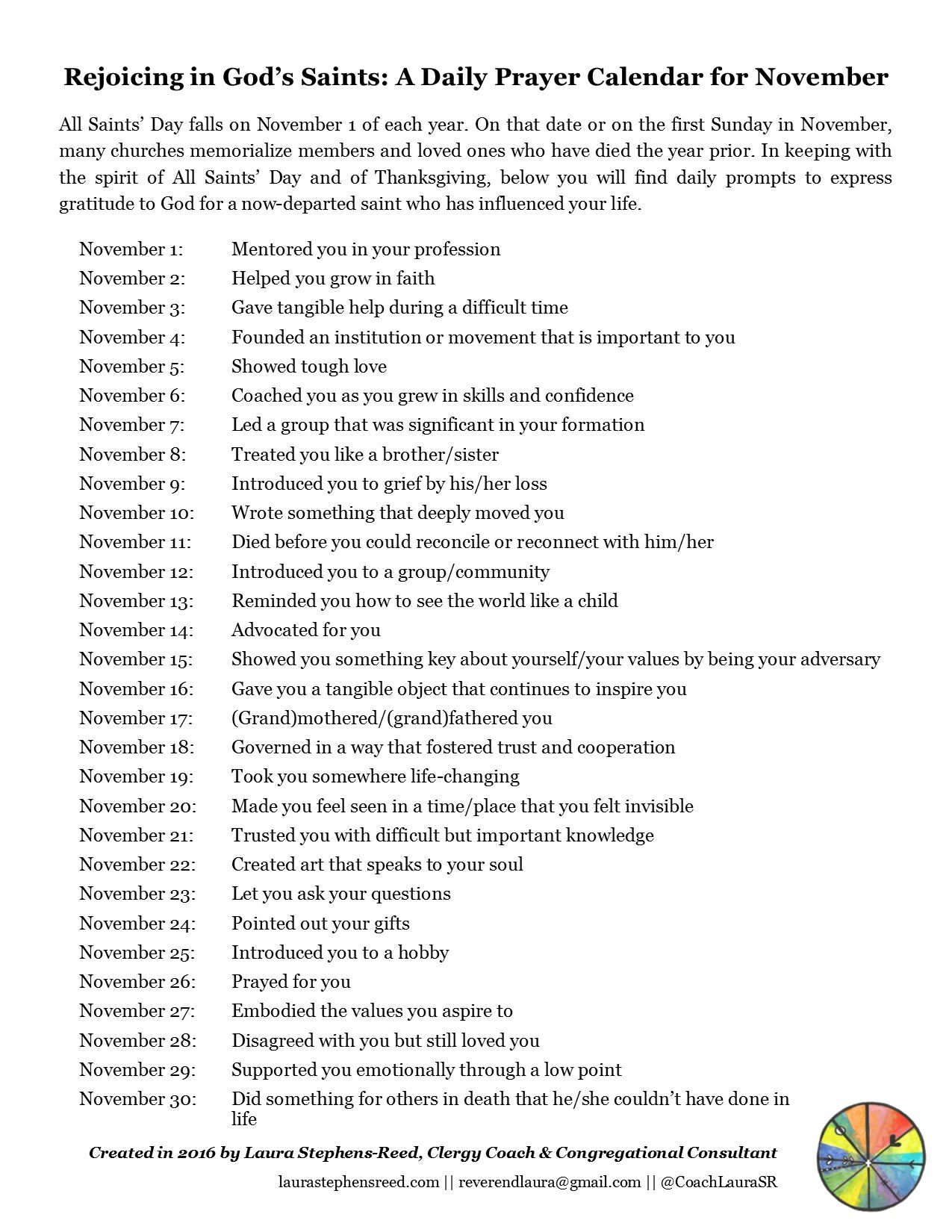
Sometimes I wish All Saints’ Day could be more than, well, one day. Our lives are shaped by so many people who have gone before, whether we knew them personally or not. I think we could all benefit from reflecting on their influence and considering what parts of their legacies to carry forward.

Since All Saints’ Day is November 1, and since we are already inclined toward thanks-living during November, I have put together a month-long prayer calendar with daily prompts to remember a departed saint whose impact has been significant. This calendar is available as a copier-friendly PDF and as a Canva PDF. Feel free to share the calendar on social media, print it for your church members or yourself, or use it as your November newsletter article.

rejoicing in gods saints.jpg
On "bullies"

Lately I’ve seen several articles about church bullies making the rounds on Facebook. They tend to point out the characteristics of a bully and offer some helpful strategies for dealing with – or working around – antagonists. A quick internet search brings up pages of similar posts.

Bullying in the church is real. I have been both a witness to it and a target of it. If you have too, then you know it is soul-sucking. It is exhausting. It affects our ability to minister to healthy people. We sometimes end up taking our pain out on the people closest to us. We may even question not just our calling, but also our faith. Maybe those doing the bullying don’t know how deep their impact is. Maybe they do.

My coaching clients often want to talk about their “bully” or “antagonist.” That verbiage is a shorthand. If I’ve met with the client before, those keywords tap into previous conversations so that we can move more quickly toward designing actions. Those words also give me clues to the client’s state of mind, though I must be careful not to assume too much or project my own experiences. So the label “bully” can be helpful in some contexts.

But I believe the term’s usefulness is limited. If we almost exclusively refer to a person as our bully or antagonist, it becomes difficult to see them any other way. We begin to interpret everything that person says or does through that identity. The hints of humanity get sifted out. Saying that someone bullies rather than that someone is a bully reminds us that the sinner is not his/her sin. Language matters.

I’m convinced that there are pastoral care needs behind every act of bullying. We might have been so wounded by the one bullying that we are unable to provide that care. We might need to set strong boundaries with that person to limit the damage s/he can inflict on us or on others. But as followers of a God who loves even the hardest heart, we must continue to look for – or at least believe in – the image of that God within those who hurt us. Because if we do not, then God’s image within us becomes more deeply buried.

Bullying is real, evil, and potent. But our power lies in grace. Not a cheap grace that makes any and all behavior acceptable, but in a grace that moves us toward wholeness for all.

My hope for you

My family and I just got back from a week at the beach. Thanks to our early-rising human alarm – for some reason my 3-year-old seems to think the day must start before 6:30 am – we took full advantage of the waves, a large pool, and a balcony that was great for picnics and reading and people-watching. We ate great seafood. We took naps. On the day it rained, we jumped until we were sore at a trampoline park.

I am very lucky in that going to the beach is nothing new. I have always lived within an eight-hour drive of one shore or another. When I was young, my parents took my brother and me to the Atlantic coast or the Gulf at least every other year. In nearly thirteen years of marriage, my husband and I have gotten away to the beach several times. That’s including the last three falls, now that we have a child who loves to be manhandled by the tide.

Yet something was different about this trip. I anticipated it. I enjoyed nearly every moment of it. And when it was over, I was happy to be coming home to my bed, my routine, my work. There was no dread about what awaited me. I didn’t open my email yesterday with one eye shut. I didn’t groan about the stacks of papers and books on my desk.

In other words, I needed – and had – a break, not an escape.

Too many times I’ve gone out of town in total denial about what I’d have to deal with when I got back. Church members gone wild. Staff conflict. Events that had to be pulled off, whether there was support and enthusiasm for them or not. I’ve dreamed about what it would look like just to stay gone.

Many of you have been there too. You survive until vacation, then your time away is not nearly enough to recover from the exhaustion and the discouragement. And sometimes all the quiet does is amplify the voice in your head that keeps asking if what you do makes any difference to anyone. (Spoiler alert: it does.)

So my hope for you is that your personal and vocational lives nourish you as much as they drain you so that, when you take that hard-earned time away, you just need a break instead of a full-on escape.

Celebrate the moments of your life

For four days in a row last week, my three-year-old caught me off guard with new things he said or did. He swam a few strokes completely submerged. He adopted perfect shooting form – without instruction – on his Little Tykes basketball goal and started sinking long balls. He looked me in the eye and recited my cell phone number, which I had been planning to teach him but hadn’t gotten around to yet. And he brought a leaf to me and told me it was from a Japanese Maple. (Ok, he was wrong on this last one, but I had no idea until my husband looked up a picture on the internet. I didn’t even know that was a kind of tree.)

I was delighted by and grateful for each of these moments, which were simultaneously ordinary and extraordinary. I replayed them in my head several times. My husband and I talked about them. We made sure our son knew that we had noticed his new feats and knowledge. It was family time worth savoring.

These mini celebrations made me think about the hidden lives of congregations, which are families of sorts. In a church ordinary-yet-extraordinary things happen all the time. Are we marking them? Delighting in them? Giving due thanks for them? Hopefully we are commissioning new leaders, consecrating pledges, and drawing on the gifts of the liturgical calendar. But what about a person’s first time taking communion, speaking in front of the congregation, or inviting a friend to church? Do we “graduate” participants of intensive Bible studies? Do we properly thank outgoing committee chairs and youth sponsors? These milestones are worth noting too. Calling attention to them is a way of saying that God is present among us, that God is pulling us forward in barely-perceptible ways, that we worship a God who offers us joy.

Many of the snapshots in the gospels are of ordinary-yet-extraordinary situations: temple services, conversations among friends, annual festivals. They take place in ordinary-yet-extraordinary places such as around dinner tables, on dusty roads, and in upper rooms. Jesus himself is ordinary-yet-extraordinary, completely one of us, yet completely not. If he is worthy of worship, then these small but significant moments in our corporate lives are surely worth celebrating.

What do you need to delight in this week as an act of worship? May you seek joy, and in doing so, find nurture for your soul and renewed strength for your leadership.

Impostor syndrome: the struggle is real

A couple of weeks ago I was interviewed for a Baptist News Global article titled “Clarify those expectations, experts tell pastor search committees.” Two people were quoted in the piece: Craig Janney, the reference and referral guru for the Cooperative Baptist Fellowship, and me. Craig is a bona fide expert. Churches and clergy from all over the country call him for help with ministerial searches. But the title said experts – plural – and the article included several statements from me that expounded on the headline.

I just got a promotion, I slowly realized.

In my shock, here were my inclinations:

Duck and cover my head with my hands, as if someone was about to throw something at me. (I actually did this.)

Make a snarky comment on social media about how much credibility the article had if it counted me as an expert. (It took all my willpower not to do this.)

Email Craig and apologize not only for the number of my quotes in the piece but also for the appearance of my photo above his. (I did not do this, as Craig is a humble and generous person who referred the reporter to me in the first place.)

I was suffering from an acute case of impostor syndrome.

After a few deep breaths, I started to think it through. I was on my first search committee as a junior in high school. I have been in the search process with more churches than I care to count in fourteen years of ministry. I have observed searches from the perspectives of an interim minister and of a coach working with clergy in transition. I have consulted with search teams. And the Louisville Institute saw fit to award me a grant to come up with a better-resourced, more spiritually-grounded approach to search & call.

In other words, I have done some things. OK, I can claim them. But what will it take for me to wear the clothes of someone with some expertise – and not feel like I’m swimming in them like the tween Josh at the very end of the movie Big? Time will tell.

In what roles do you have some growing room? Which roles are too tight? And what roles fit you just right? When you wear these clothes, give yourself a double thumbs-up in the mirror and a big ol’ Fonzie “heyyyyy!”

"I did a thing!"

“I helped with…”

“I was part of a team that…”

“I collaborated on…”

The ability to cooperate with others toward a shared goal is an essential – and sometimes underrated and underutilized – skill in a leader. Without it, we’re all a bunch of free agents who don’t have anyone to refine our ideas, pool our resources with, or tame our wild hairs. And humility, the underlying trait that makes cooperation possible, is a mark of a Christ-like life.

But. When we have done a thing, when we have created or supervised or equipped or stabilized or trained or written or founded, we must be able to own it. Not brag about it, but lay claim to it. And here’s why:

  • It’s the truth. Truth leads to trust among the parties involved, and trust leads to optimal individual and collective functioning.

  • We set others up for failure when we don’t acknowledge our role. If we don’t take proper credit, chances are that someone else will actively seek or passively receive it. Then those folks are given more authority and more responsibility – without the experience and know-how to draw upon.

  • We’ve got to practice presenting ourselves accurately to people who have power over our vocations. We must show that we can play well with others. But if we completely blend our leadership identity with that of the people we work with, search teams, judicatory leaders, and those who have the clout to recommend us for positions are left to wonder and assume about our personal capabilities. We miss out on opportunities, and others miss out on our leadership.

  • Our self-esteem suffers when we downplay our role. I believe that many people – especially we womenfolk – are generous with success but selfish with failure. By that I mean that if something goes well, it’s because of all of us. If something goes wrong, it’s because of me alone. When we fall short, we should take our lumps but also examine the larger context. When we triumph, we can reflect on how we contributed to the success as a means of grasping and building on our strengths.

  • It honors our God-given abilities and calling. We are each fearfully and wonderfully made to be certain people and do certain things. Because of how God equipped me, I was able to do a thing! Acknowledging our role, then, is testimony.

What, then, have you done this week, this month, this year? Make a list, then tuck it away for the next time you have an evaluation, need to fill out a profile, or feel down about your abilities. Pull it out and remember that “I did a thing!”

Prophet and priest

When I was in high school and college, I fancied myself a prophet. I was a young woman discerning a call to ministry in a Southern Baptist context, and I knew in every wrinkle in my brain, beat of my heart, and conviction of my soul both that God calls women to be pastors and that we are up to the challenge. And I wasn’t hesitant to tell anyone exactly what I thought.

I might have said a prophetic word here and there about egalitarianism, but some of my bra-burning rants were more about pushing others’ buttons or reacting when they pushed mine. Fourteen years into ordained ministry I understand something that I didn’t back then: that there’s more to being prophetic than simply saying something edgy.

Sometimes God taps us to say hard things to people who won’t be eager to hear them. But there’s a second task in the prophet’s job description: we have to prepare our intended audience to listen to what we’re saying. Too often we expend our energy yelling into the void because we haven’t cultivated the relationships that prompt our hearers to pay attention, to give credence to our impassioned points. All the wordsmithing and protesting in the world won’t make up for neglecting this responsibility.

In congregational ministry we tend to believe being a pastor gives us, well, a pulpit for our positions. To some extent it does. Our title and role provide some level of authority. But to be truly, effectively prophetic (read: prompting people to real action based on beliefs they hold themselves), we must first prove ourselves to be our constituents’ priest. We must get to know them, care for them, learn from them, minister alongside them, share our own stories with them, be a trustworthy presence for them, and show our ministerial abilities to them. (Even as public figures we must prove ourselves relatable to hearers we might never meet by finding ways to listen to their concerns and by living with integrity, compassion, competence, and appropriate self-revelation.) Only then will the soil be well-fertilized for the prophecies we share with them to take deep root.

Taking the time to relate to our people is as important – more important? – than ever. In an election cycle that is turning out to be like no other and in a Church that is often held captive by anxieties and outdated expectations, prophets are much needed. And without real bonds, the only people who will care about our messages are the ones who already agree with us. Not only will few hearts and minds be changed, we’ll continue to speak past each other (or worse, talk at one another). So may God equip us in this critical time not just with the words, but also with the courage, empathy, persistence that give the words lasting impact.

Trust thyself

“I will leave work today by 5:00, whether I’ve crossed everything off my to-do list or not!”

“I need to be more assertive the next time someone makes an inappropriate comment about my [insert object of unwelcome observations here].”

“I’m going to start having a date night with my significant other at least once a month.”

“This year I will finally learn how to [insert dreamed-of hobby here].”

It’s good to make promises to ourselves. It’s perhaps more important to keep them. (I confess, I’m particularly guilty of fudging on #1.) But why? Other than me, who suffers when I break a commitment pledged only to myself?

Actually, it matters a lot that we can trust ourselves, and not just in terms of “I’m going to report all my wonky ministry income to the IRS” or “I’m going to visit that shut-in like I planned to whether anyone else knows about it or not.” If we don’t follow through on what we say we’ll do for ourselves, we cannot build self-trust. And according to Stephen M. R. Covey, we must learn to trust ourselves before we’re fully ready to trust or be trusted by others. Considering that the whole of ministry – the whole of communal life, really – is rooted in trust, self-trust is thus a big deal.

Covey says that when we don’t come through for ourselves, “Not only do we lose trust in our ability to make and keep commitments, we fail to project the personal strength of character that inspires trust. We may try to borrow strength from position or association. But it’s not real” (The Speed of Trust, p. 45). Instead, when we do keep promises to ourselves, we lay the groundwork for what Covey calls the four cores of credibility. We demonstrate congruence between what we say and how we act. We show that our stated motives are real, not just lip service. We prove that we have the ability to carry out the tasks themselves. And we have the track record to prove we are trustworthy.

This emphasis on self-trust puts a whole new spin on self-care, an area in which many ministers struggle. We want and need rest and replenishment, but we feel guilty laying claim to them. So we make plans and then push them aside when one more person needs one more thing from us. We treat our commitments to ourselves as fluid, and in doing so we violate the four cores of self-trust, making it harder for trust to flow between us and others.

How then does our inability to trust ourselves impact our ministry? Our relationships with family and friends? And if trust – faith – is the heart of our belief system, how does a lack of self-trust affect our own spirituality? There’s much more at stake than meets the eye when we don’t keep promises to ourselves. May we be encouraged to follow through on our personal plans so that we can be not only rejuvenated for ministry but also credible in our leadership.

Outputs or outcomes?

I took several gems of insight away from the keynote sessions at the recent Young Clergy Women Project conference. One in particular helped me articulate a conviction I have held for a long time but have had trouble putting into words, at least in a concise way.

In the world of church, we are too often focused on outputs instead of outcomes.

Outputs are the measurement of the business world. They are easily captured in spreadsheets. In congregations, outputs are the nickels and noses: what money came in this month through the offering plate vs. how much went out for bills and payroll, how many people attended worship this week (and how many of these folks were first-time visitors), what new ministries were added this year.

Now, I’m not saying that outputs are unimportant. Being fiscally attentive is essential to good stewardship. Noting attendance patterns lets us know when we need to re-evaluate our approach and points us to potential pastoral care issues. And taking stock of new ministries gives us some sense of the energy, commitment, and needs among our constituents. (I use the word “constituents” here because it is more inclusive both of visitors to our campus and of the neighbors we work with in the community.)

Outputs, however, are not the best indicators of faithfulness and fruitfulness. Outcomes are. Outcomes are harder to get our arms around than numbers, and that’s why we fall back on our beloved spreadsheets. But which church is growing, in the spiritual sense? The one with a budget built solely on last year’s giving patterns and this year’s pledges, or the one that takes calculated risks rooted in a vision of what the congregation could be and do with God’s help? The one that has ten new members every week, many of whom never connect with a small group or find their niche within the congregation’s mission, or the one that rarely gains new people but is regularly finding ways to share God’s love with the surrounding area? The one that adds new Sunday School classes all the time using boilerplate curriculum, or the one that intentionally teaches and practices disciplines that open participants to the counsel of the Holy Spirit?

Outputs can be useful, but let’s not confuse them with outcomes. They are (some of the) benchmarks, not the goals in and of themselves. Where, then, have the two been unwittingly married in your context, and what separation/redefinition needs to occur for the people in your care to grow in discipleship and service?

Event debrief form

You’ve spent months planning a ministry or one-off event. When the time comes for implementation, your heart is excited (and maybe a little nervous) and your brain is fried. Once this all-consuming project is in the rearview, your body is ready to hibernate. You stick all your post-its in a folder and dump all your virtual outlines in your Dropbox and ask, “What’s next?”

[Record scratch.]

How do you know what’s next if you haven’t taken the opportunity to consider what you’ve just done?

When fatigue sets in, it’s tough to name our criteria for assessing the fruitfulness of ministry. Yet, as CPE taught us, action-reflection-action is what keeps us growing as clergy and prevents us from offering a random assortment of programs that don’t build on one another.

I offer to you, then, this downloadable event debrief form. (It’s in Word format so you can keep digital copies of your responses.) It is designed to help you capture essential details and think theologically about how the event served your congregation’s mission. Please use it, share it, and let me know what tweaks to it you would recommend.

Building effective teams

Committee 1 gathers monthly – more or less – to maintain one of the church’s ministries. It has a dedicated core group, plus some other participants that drift in and out. The meetings tend to be needlessly long and rehash a lot of the same issues each time. Action items are unevenly distributed, and implementation is hit-or-miss.

Committee 2 gathers monthly to carry out one of the church’s ministries. The members are clear on their task and have spent time agreeing on how to accomplish it. Before beginning their work each time, they revisit the covenant they created that guides how they interact with one another. Sometimes there are differences of opinion during discussion times, but each committee member makes an effort to understand where others are coming from. At the end of each meeting, the chair ensures everyone is on the same page about the action items, point people, and timelines they’ve agreed on.

What’s the difference between the two committees? Committee 1 is a group, a loose collection of individuals who share an orbital pattern. Committee 2, by contrast, is a team. In teams the members share a purpose, a grasp on the process for accomplishing it, and responsibility for seeing it through. Someone has taken up the mantle of leadership (which may be passed among the members) and someone has given this group the authority to move on their plans. There is a cohesiveness among the members that allows them to build on one another’s strengths and hold each other accountable.

There’s nothing wrong with being a group, if that’s what the situation calls for. The people gathered for a class or training, for example, co-exist well as a group. They’re all there for the learning, but there’s no project to require interdependence. However, church leadership teams will be much more effective if they embrace a team identity with all it entails.

To start making the move from being a collection of individuals to a true team, build mutual understanding by discussing together these four questions:

What is our shared purpose?

What is our process for living toward that purpose?

Who will be responsible for which pieces of the process?

How will we know we can trust one another throughout the process?

These aren’t the only considerations for team-building, but they’re a good start.

What groups in your purview need to evolve into teams – or be disbanded and re-formed as teams from the start?

Two levels of trust

A friend talks about you behind your back. Your significant other makes decisions that impact you both without your input. Your supposed advocate throws you under the bus to protect her own reputation, position, or livelihood. We’ve all had our trust broken at one time or another. And put simply, if inelegantly: it sucks.

That’s why it is so tempting to frame trust as predictability. When we can anticipate the actions of others, we can exhale. I can let my guard down a bit at a green light because the Department of Transportation has promised me that crossways traffic will be halted by a red light. If I know what you’re going to do, I can trust you.

But is predictability the full measure of trust? Some of the most relationship-deepening moments I’ve experienced were the result of surprise. Unexpected words of affirmation or acts of care. Sharing a hidden piece of one’s soul. Defending another at great risk to self. Anticipated? No. Trust-building? You’d better believe it.

I may trust that oncoming cars will obey the law, but I’m still going to drive defensively. (I hope others will do the same!) But in the world of relationships, people will know and be known only at a surface level if we stay on our side of the double yellow line. The more foundational level of trust, then, involves risk-taking. Being vulnerable and creating space for others to do the same.

What relationships, either with individuals or groups, need to grow roots down into that lower layer of trust? How can you take the first step by sharing something about yourself that lets the other know it’s safe to return in kind?

Benefits of coaching: dealing with conflict

I sighed deeply, knowing a difficult conversation with a parent was in my near future. A children’s worship leader – one with extraordinary patience and skill in managing rambunctious behavior – had just expressed her concerns about a second grader’s ongoing disruptive and defiant actions during Godly Play.

I needed – I really wanted – to work with the parent on making children’s worship a sacred space for all of the kids, including her son. But I had experienced this mom as not very solution-focused on several occasions. So I tapped my go-to resource: I called my coach.

My coach asked me questions that surfaced my hoped-for outcomes. Her queries prepared me to ask the mother for a meeting in a non-threatening way, have the right people in the room for the conversation itself, voice the interests shared by all involved, name the point at which we’d made as much headway as we were going to, and communicate the results to those who needed to be in the loop. It was a hard meeting, but it went as well as it could because of all that pre-work.

Conflict is inevitable in ministry. And while the word “conflict” may strike terror in many hearts, conflict is actually value-neutral. It is simply a difference of opinion. Conflict done well can build trust and buy-in. Bungled conflict can lead to…well, we all have our horror stories.

I have found coaching invaluable when I’ve stared down the confusion, vulnerability, and fear that come with conflict, and I believe it can help you too. Specifically, a coach can help you:

  • define the conflict and see its potential value

  • separate conflicting ideas from the people who hold them

  • explore the dynamics of the situation and sort out your role (if any)

  • take a step back and see the issue or pastoral care need behind the issue

  • pinpoint what you don’t yet know but need to find out about the conflict

  • prompt you to name and assess options for taking action

  • strategize specific conversations

  • think about resources and partners available to you

  • empower you to say or do difficult but necessary things

  • build in some accountability for following through with your action plan

If you recognize value in these conversation points for your own ministry, let’s talk.

Benefits of coaching: dealing with conflict

I sighed deeply, knowing a difficult conversation with a parent was in my near future. A children’s worship leader – one with extraordinary patience and skill in managing rambunctious behavior – had just expressed her concerns about a second grader’s ongoing disruptive and defiant actions during Godly Play.

I needed – I really wanted – to work with the parent on making children’s worship a sacred space for all of the kids, including her son. But I had experienced this mom as not very solution-focused on several occasions. So I tapped my go-to resource: I called my coach.

My coach asked me questions that surfaced my hoped-for outcomes. Her queries prepared me to ask the mother for a meeting in a non-threatening way, have the right people in the room for the conversation itself, voice the interests shared by all involved, name the point at which we’d made as much headway as we were going to, and communicate the results to those who needed to be in the loop. It was a hard meeting, but it went as well as it could because of all that pre-work.

Conflict is inevitable in ministry. And while the word “conflict” may strike terror in many hearts, conflict is actually value-neutral. It is simply a difference of opinion. Conflict done well can build trust and buy-in. Bungled conflict can lead to…well, we all have our horror stories.

I have found coaching invaluable when I’ve stared down the confusion, vulnerability, and fear that come with conflict, and I believe it can help you too. Specifically, a coach can help you:

  • define the conflict and see its potential value

  • separate conflicting ideas from the people who hold them

  • explore the dynamics of the situation and sort out your role (if any)

  • take a step back and see the issue or pastoral care need behind the issue

  • pinpoint what you don’t yet know but need to find out about the conflict

  • prompt you to name and assess options for taking action

  • strategize specific conversations

  • think about resources and partners available to you

  • empower you to say or do difficult but necessary things

  • build in some accountability for following through with your action plan

If you recognize value in these conversation points for your own ministry, let’s talk.

Self-care bingo

Most self-care is pretty fun. (I don’t know about you, but saddling up in the stirrups at the OBGYN’s office and trying to answer the dental hygienist’s questions while she stabs my gums aren’t really my idea of thrill rides.) Talking about self-care isn’t always that pleasant, though, because we can begin to realize how much we’ve been neglecting our health or our relationships and we often start stressing about what our church members will say if we leave the office at 3:00 on the Thursday of a 55-hour work week. That kind of thinking can sap some of the excitement over a night out with friends. (Kind of defeats the purpose of self-care, eh?)

I want to make reflecting about our self-care practices enjoyable! To that end I give you self-care bingo. Ten different PDF bingo cards are available for download here. Use them however you like, but here are a few suggestions:

  • Play a traditional game of bingo at a clergy gathering. Cut up one of the grids into 25 cards, shuffle the cards, and have a caller shout out one self-care action at a time. Offer a prize to the first person to get a BINGO.

  • Use the bingo cards for a get-to-know-you activity. If you’re at a gathering of ministers who don’t know each other well, give each person a bingo card and a pen. Ask people to mingle and find someone who has completed one of the self-care actions in the last week. Have the person initial that square and tell a brief story related to the self-care action.

  • Create an ongoing self-care challenge. Distribute the bingo cards among your peers, then go about your week. See who can get a bingo first by completing five adjacent self-care actions.

Comment to let me know how you used this resource…er, game!

self care bingo 1.jpg
What clergy health looks like

Healthy churches are much more likely to have healthy ministers. There’s a chicken-or-egg question involved, but the influence likely goes both ways. Here, then, are some thoughts on what clergy health looks like.

Taking care of self:

  • Tends to own discipleship/relationship with God. A spiritual leader must continue to be formed by and connected to God.

  • Knows when to call it a day/week. There is always more ministry to be done.

  • Takes all vacation/professional development time. Those who can’t go on vacations take staycations. Those who can’t attend conferences plan their own reading or planning weeks.

  • Attends to physical and mental health. Sometimes being healthy means tending to literal health by getting regular checkups, seeing a counselor as needed, and taking the advice (and the medicine!) prescribed by healthcare professionals.

  • Asks for personal and professional help as needed. Requesting help is a sign of self-awareness and strength, not shortcoming.

  • Asks for what he/she needs materially to be able to focus on ministry. Just wages offer freedom from the resentment and financial panic that distract from ministry.

  • Has a peer support network. Isolation in ministry is the shortest path to burnout.

  • Has a pastor. Many ministers who worry about gossip and politics look outside their denominations for a pastor.

  • Has a life outside of church. All work and no play make for a tired, frustrated, dull minister. Make a friend. Find a hobby. Become a regular somewhere.

  • Protects his/her family from the fishbowl effect. A less anxious family makes for a happier home.

Leading well: 

  • Continues to feel called. Ministry isn’t just a job and a paycheck.

  • Enjoys the challenge of ministry, even though not all ministry situations are pleasant. It’s a great feeling when gifts are being well-utilized.

  • Doesn’t own issues/initiatives that shouldn’t belong to him/her. The triangle is my least favorite shape.

  • Addresses conflict in a timely fashion. Conflict that isn’t addressed festers and then explodes.

  • Sees the pastoral needs behind conflict. When people are behaving badly, they are usually acting out of their hurt.

  • Identifies the line between being someone’s pastor and being someone’s friend. It’s very hard – if not impossible – to be both.

  • Is transparent. Vulnerability breeds trust.

  • Knows and owns strengths and weaknesses. Weaknesses can’t always be shored up, but strengths can always be built upon.

  • Keeps learning and growing. The church is evolving, and so must her ministers.

  • Is able to see when good ministry has been done. Even at the end of a hard or seemingly unproductive stretch, it’s helpful to reflect on where God was at work.

  • Mentors, supports, and thanks leaders. Ministry is not done in a vacuum.

  • Acknowledges when it’s time to move on. An appropriate level of challenge breeds effectiveness.

What would you add or remove from this list? What specific commitments do you need to make to your own health?

Benefits of coaching: leading processes

The church, like the culture around it, is evolving quickly. This means that strategic plans have a very short shelf life and that ministers are called upon to lead visioning-type processes more frequently.

But where do you begin? The thought of not just structuring the process but also inviting helpful participation and managing congregational anxiety around change can be so daunting.

I have worked with several coachees who were leading their churches to discern what God is calling them to be and to do – in this time and place. Coaching offers space for ministers to consider both the big picture and the tasks that will move the congregation toward realizing it. In our conversations we talk through interpreting the work theologically, making space for the Spirit to speak, involving various parties in healthy ways, naming available assets, sparking creativity, troubleshooting obstacles, managing polarities, and taking concrete steps.

Coachees are able to lead change processes with increased boldness and sensitivity when they feel more equipped. If your church is stuck in a rut, or if you’re already knee-deep in a visioning time and not sure what to do next, let’s talk.

To-done list

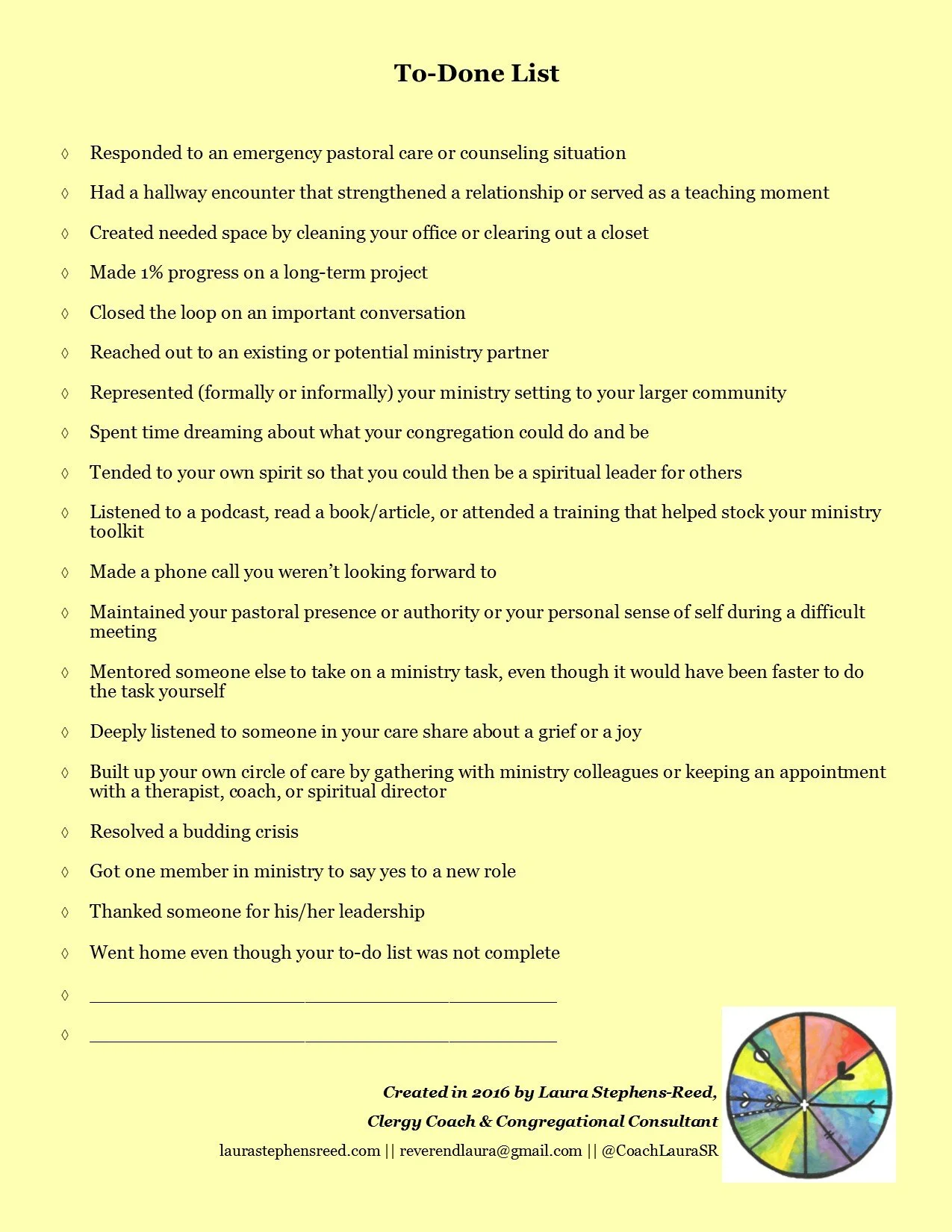
I love lists. I always have. And there are few things that make me as giddy as crossing a task off my to-do list. Ministry, however, rarely lends itself to an agenda made up of bite-sized, easily quantifiable jobs. For us listlovers, then, it can be discouraging to get to the end of the day and see so few strikethroughs. It’s easy to wonder if we did anything worthwhile.

Enter the to-done list. When your day has looked nothing like what you’d planned – such is ministry! – or when intangibles have dominated your focus, cross out some items on this list and know that your day has been well-spent. Feel free to use and share. (Downloadable PDF version here.)

to done list.jpg