Clergy & Congregational Coach
laurastephensreed logo2 (1).png

Blog

Helping clergy and congregations navigate transitions with faithfulness and curiosity

My blog has moved to Substack! You can find new articles weekly there.

Visit my Substack

Use the button below to search the blog archives on this website.

Search the blog
Posts in congregations
10 ways to strengthen relationships in the new year

It’s a strange world we live in. In some ways, our relationships are stronger than ever, thanks in large part to technology. In other ways, we are more disconnected from each other than we’ve ever been (at least partially due, ironically, to the ways we use technology).

Whatever the state of our relationships, it never hurts to reinforce them. After all, they are the primary means for creating circles of care, affecting change, and ushering joy into the world. I’ve developed a list of ten ways to strengthen relationships in this still-young year. They can be applied to individual bonds, teamwork, and our walk with God.

Deepen trust. Without authentic trust, relationships will always stay at a surface level. What small risk are you willing to take to show the real you? How might you invite others to do the same?

Add a layer of communication. We generally believe we’ve been heard better than we actually have been. How can you relay important information in an additional, different way so that everyone is operating from a shared understanding?

Share stories. Narrative is the root and food of knowing and being known. It prompts people to laugh, mourn, and plot together. What anecdote or arc speaks to where you are or how you’re feeling today? Who needs to hear it? Whose stories do you want to seek out?

Reflect on the relationship. Ok, it’s awkward, but it never hurts to ask for feedback on how the relationship is going. What’s working (and not) for him/her? For you? Disconnects can’t be repaired if they aren’t identified.

Embrace conflict. Conflict is simply a difference of opinion. It doesn’t have to come with all the baggage we tend to load onto it. Being forthright – in respectful ways – about our disagreements allows us to learn, and our openness to one another in moments of dissent breeds trust.

Help one another be fully engaged in the relationship. Everyone’s personality is different. As an extreme introvert, for example, I need lots of alone time to be fully present with people. Know and own your quirks, and support others in theirs.

Examen each day. Engage in some sort of reflection at the end of each day. How was I a good friend? How did I fall short? Utilizing the spiritual practice of examen opens up the possibilities even more. Where did I notice God at work today? How did I aid in or hinder the in-breaking of God’s peace?

Increase your curiosity. Instead of imagining someone’s beliefs or motives, ask: tell me what you were thinking when… What did you hope to accomplish by…? We usually default to assuming the worst, and often the truth is better (or at least more complex) than what we thought.

Start from common values or vision. Consider what all parties can affirm. Even if there are differing ideas about how to approach problems, there can be shared commitments underlying them. That’s a much more promising starting point for connection and for change.

Affirm one another. Name what you appreciate in one another. Be specific, and focus on attitudes and actions rather than appearance. Not only does a genuine compliment provide a serotonin boost, it also helps people identify and navigate from their strengths.

Which of these ideas could you begin implementing today? What would you add to this list?

What you get when you call a clergywoman

Recently the Lewis Center for Church Leadership published a fantastic article about how congregations can welcome and support their female ministers. The piece speaks to some of the fears that search committees have when considering a woman for a ministry position. It also raises awareness about  the small but significant ways that clergywomen are treated differently than clergymen. In doing so, the post names and dispels many of the assumptions about women in ministry. With that slate clear, what can churches expect from their female clergy?

Clergywomen love Jesus. We are not in ministry for the money (most of us are paid less than our male counterparts) or the notoriety (the stained glass ceiling is real). And we definitely have not pursued this vocation because it is the path of least resistance. We’re here because we are drawn to the message and model of Christ.

Clergywomen know their scripture. For many of us, Paul’s epistles have long been used as a barricade to the pulpit. That means we’ve had to steep ourselves in the Bible, studying its words, arcs, and historical/cultural context so that we can be confident we’ve discerned correctly and so that we can be faithful in forming others.

Clergywomen have been vetted, then vetted some more. At every level of examination, someone is looking for a reason not just to exclude each one of us as individuals, but also to use our personal shortcomings (real or imagined) as grounds not to grant pastoral authority to any woman. If we clear these hurdles, you’d better believe we are capable.

Clergywomen have had their mettle tested. Women in ministry are criticized for our hair, age, fashion choices, voice, family situation, and many other variables that are irrelevant to ministry – and that men are rarely evaluated on. And the “acceptable” leadership style for a woman (in any professional field, really) falls in a miniscule range between too soft and too assertive. Experienced in dealing with discouragements around these matters on a regular basis, we are not easily scared off from the legitimate difficulties of church work.

Clergywomen have a deep, DEEP sense of call. Women have their calls to ministry questioned all the time. Sometimes it happens in plain talk (e.g., “I believe women should never teach men”), and on other occasions it manifests by such means as second-guessing, talking to a female pastor as if she is the speaker’s daughter or granddaughter, asking where the “real” pastor is, or using diminutive terms (Miss Laura, Pastorette). As a result, clergywomen check in with God about their calls on a regular basis, asking for guidance and courage to live toward the purpose we’ve been given.

Clergywomen are endlessly creative. When there are so many hurdles not just to serving faithfully, but also finding a place to serve to begin with, women have to call upon all our gifts. We can think beyond our assumed constraints because we must – and the church and her people are the beneficiaries of our innovation.

Many clergywomen are backed by a fierce tribe, which provides its members with wisdom and support. When a congregation calls a female minister, it gets the bonus of a magnificently insightful hive mind. (Note: if you are a woman in ministry who has not yet found her tribe, look for it! Here are two places to start. And as a coach I would be thrilled to be your encourager and thought partner via a coaching relationship.)

Imagine your congregation could find all of these qualities in a minister, plus the particular skills and graces of a ministerial candidate. What great things for God could you do together?

My guiding words for 2017

Sometimes inspiration comes from unexpected places. Recently it ambushed me by way of an interview that entertainer/faux (?) journalist Samantha Bee conducted with pundit Glenn Beck. (If you click on the link, be prepared for strong language.) In it Bee and Beck, who inhabit opposite ends of the political spectrum, acknowledged that they have more in common than it seems. They celebrated their fledgling friendship by sharing a strange bedfellows cake.

That liberals and conservatives can work together on issues affecting us all was no surprise to me. What did catch me off guard was Glenn Beck’s warning that Samantha Bee was in danger of becoming – like him – a “catastrophist,” someone who reads the worst into every headline. As the earth has shifted beneath my feet the past couple of months, I’ve had to refocus myself continually on hope, courage, and justice. In those many moments when I’ve been less than successful at this, I too have been tiptoeing into catastrophist territory. (Vigilance and action are warranted in such a time as this. Catastrophism, however, consumes physical, mental, and spiritual energy that could be used more constructively.)

Surprised by this self-knowledge, three adjectives popped to mind, and they will serve as my touchstones for the year. I aim to be:

Curious. What’s really happening in this situation? What do I not yet understand? What’s going on inside of me? Denial and assumptions rarely lead to the best course of action.

Present. Who is around me? What do they need from me? What do I need so that I can stay engaged, insofar as it is productive? Insulating ourselves from the hopes and fears of others has led to a fractured church and a deeply-divided country.

Resilient. How will I stoke my resolve to be kind when kindness is not returned? To be brave when I am scared? To see things as they are, but still move forward in the confidence that this bad thing is not the last thing? 2017 promises many setbacks to the commitments I hold dear, but as matters of faith and integrity, I must keep showing up.

This is my mindset as we begin the new year. What word(s), phrase, quote, or song is guiding you? Let’s support and hold one another accountable.

Feeling the pinch

I’d had pretty much the same hairstyle for twenty years. Somewhere between chin and shoulders in length, with long layers. This look suited me well enough, I guess. There was no complicated styling involved. I didn’t have to buy any product. I could throw my hair in a ponytail when I wanted. Still, I was craving something different.

I researched short hairstyles, asking friends with cute hair to send me pictures and details on what it took to get their coiffures to look that way. I set aside some money for a cut in a real! salon! because it seemed too risky to make a big change for $7.99 at Great Clips. I asked around for stylist recommendations. I was ready…or was I? I kept putting off making the appointment. No time for a haircut this week…I don’t want to still be figuring out how to tame my new ‘do when X event rolls around…I remember being confused when I was in preschool and my mom made a drastic hair change, and I don’t want to do that to my son.

And then said son began protesting whenever I pulled my hair back into a ponytail, which was most of my at-home hours. “No! Take it out!” He even became quite adept at pulling out my ponytail holder before I even realized what was happening. It was time for the haircut.

So I did it. I went to the grown-up salon and had all the hair that had been weighing me down whacked off. I had been wanting and plotting for a while, but I had to feel a pinch to get myself in gear.

This is the state that many of our churches find themselves in. They want to follow their evolving call from God. Often they already have the resources and have even made some concrete plans for how to move forward. Something, however, is holding them back. Maybe it’s fear. Maybe it’s comfort. These congregations need to feel the pinch before they’re willing to make the leap.  

Sometimes the pinch happens naturally. A staff transition necessitates re-evaluation of leadership needs. The property next to the church goes up for sale. A local service agency invites the congregation into a partnership that would benefit both entities and the community as a whole. A shrinking budget prompts discussion about the best use of resources.

Sometimes, however, leaders who have latched onto God’s dream for the congregation need to help their constituents feel the pinch. How might you help the people you minister alongside discover both the opportunity in and urgency for potential change?

Today is the day

It’s election day in the United States. The whole country has been counting down to this moment since, well, the 2012 general election, given our never-ending campaign cycle. And this has been a political season for the history books. First female presidential candidate put forth by a major party. First presidential candidate who has hosted his own reality tv show. The first time a former President and a former First Spouse could end up swapping roles.

All of these firsts have been overshadowed by the unprecedented rancor that has characterized this election. Each party believes the other’s candidate is a harbinger of the end times. There’s no space for real dialogue about differences in policy when the rhetoric is accusatory if not downright abusive. And there’s little reason to hope for a change in tone when the candidates won’t even shake hands after their debates.

By tomorrow morning, the election will have been decided unless we have a replay of 2000 or the vote gets kicked to the House. And we’ll all have to find a way forward – together. We cannot stay in our red and blue and whatever-color-third-parties-are camps. But I’m not gonna lie, because of the mistrust bred (deepened?) by this political cycle, it will be hard to unify under this President-elect. But unify we must. Not only does the future of our republic depend on it, so does our ability to call ourselves people whose life source is Love.

Here are the best ways to start, so far as I know:

Care for one another. Start simple by doing something nice for someone who believes differently from you. Drop off some brownies. Loan out your favorite novel. Blow the leaves off your neighbor’s driveway while you’re clearing off yours.

Seek out and listen to one another’s stories. We’ve got to acknowledge the humanity in each other again. The narrative you share doesn’t have to be from the depths of your soul, at least not at first. Swap anecdotes from your week.

Focus on our common interests and challenges. Democrats and Republicans and people of other parties have different ideas about how to get things done. But we share many of the same ideals. If we can identify those points of intersection and work together from there – instead of leaping ahead to contrast our proposed solutions – we might just spark some creativity and new understanding in one another.

We’ve got a lot of work ahead. We can – we must – do it. May God equip and embolden us to be agents of connection in a world that so desperately needs our hope and our outstretched hands.

Resource: Advent reflections

Growing up Southern Baptist, I did not observe liturgical seasons. (To be fair, I did not know such seasons existed, at least in the Protestant world.) When I was introduced to them in seminary, corporate worship and my personal devotional life became more layered and more nourishing to me than when my high holy days had consisted only of Christmas Day, Easter Sunday, Homecoming, and the Fourth of July.

I particularly love Advent, with its emphasis on waiting and on faithfulness in the face of great risk. The candles in the Advent wreath illuminate our way to the manger, guiding us to consider love, hope, joy, and peace in the midst of our current circumstances. Each of these themes is so rich that it deserves attention for more than one hour per week. For this reason I have created a calendar of daily reflection questions to prompt deeper engagement with these foundations of faith. The calendar is available as a copier-friendly PDF, a more colorful PDF, and a JPG (click below to download). Feel free to share it on social media, print and distribute it, or use it as your next newsletter article.

advent 2016 - color.jpg
Retconning

When I was in seminary, I became moderately obsessed with re-runs of the 80s tv show St. Elsewhere, a medical drama set in a run-down Boston hospital. My devotion made sense. It was fun to see current celebrities in their earlier iterations. I was fascinated by the ways medical and social issues, such as the beginning of the AIDS epidemic, were handled by the writers. And since an episode aired every day, the show was my nightly reward for plowing through my class assignments.

The series finale of St. Elsewhere is still – 28 years later! – one of the most polarizing in tv history. In it viewers find out that the entire run of the show has taken place in the head of one of the characters, a boy with autism. (For the record, I’m in the camp that thinks this is a genius wrap-up.) This is what folks in the comic book world call retroactive continuity, or retconning for short. It’s re-visioning the whole arc of the story in light of previously unknown facts. Via retconning writers can:

  • add details, filling in important tidbits that explain how the characters got where they are,

  • alter details, often through a narrative device (as in St. Elsewhere’s finale),

  • or subtract details, basically ignoring elements that no longer work with the current direction of the story.

Does this kind of literary math strike you as familiar? While I’ve never heard the term “reconning” used in the church world, we do it all the time. Congregations are masters of revisionist history. Retconning can be a means of improving collective health. Dragging long-buried secrets into the light of day can allow churches to trace reactive patterns and to have honest dialogue about what’s keeping them from living toward God’s call. Re-interpreting tightly-held narratives can open up possibilities for growth where progress had previously been stunted. Retconning can also be a means of denial and disease. Ignoring unpleasant truths causes them to simmer, making them highly combustible.

As you consider the arc of your congregation’s story, where might a bit of retcon work move your people toward more authentic community and deeper discipleship? What retcons are holding your church back and need to be named and revised?

Rejoicing in God's saints

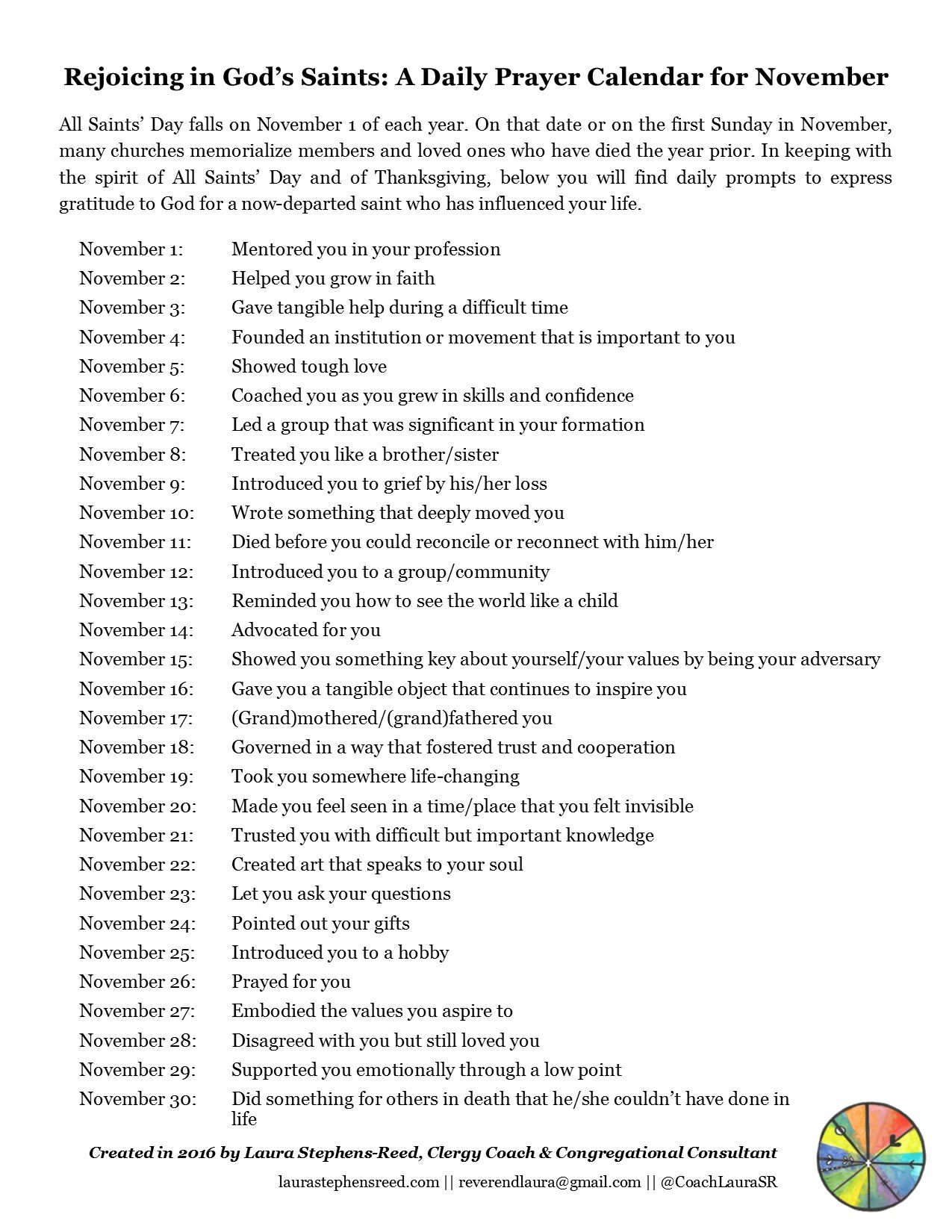
Sometimes I wish All Saints’ Day could be more than, well, one day. Our lives are shaped by so many people who have gone before, whether we knew them personally or not. I think we could all benefit from reflecting on their influence and considering what parts of their legacies to carry forward.

Since All Saints’ Day is November 1, and since we are already inclined toward thanks-living during November, I have put together a month-long prayer calendar with daily prompts to remember a departed saint whose impact has been significant. This calendar is available as a copier-friendly PDF and as a Canva PDF. Feel free to share the calendar on social media, print it for your church members or yourself, or use it as your November newsletter article.

rejoicing in gods saints.jpg
On "bullies"

Lately I’ve seen several articles about church bullies making the rounds on Facebook. They tend to point out the characteristics of a bully and offer some helpful strategies for dealing with – or working around – antagonists. A quick internet search brings up pages of similar posts.

Bullying in the church is real. I have been both a witness to it and a target of it. If you have too, then you know it is soul-sucking. It is exhausting. It affects our ability to minister to healthy people. We sometimes end up taking our pain out on the people closest to us. We may even question not just our calling, but also our faith. Maybe those doing the bullying don’t know how deep their impact is. Maybe they do.

My coaching clients often want to talk about their “bully” or “antagonist.” That verbiage is a shorthand. If I’ve met with the client before, those keywords tap into previous conversations so that we can move more quickly toward designing actions. Those words also give me clues to the client’s state of mind, though I must be careful not to assume too much or project my own experiences. So the label “bully” can be helpful in some contexts.

But I believe the term’s usefulness is limited. If we almost exclusively refer to a person as our bully or antagonist, it becomes difficult to see them any other way. We begin to interpret everything that person says or does through that identity. The hints of humanity get sifted out. Saying that someone bullies rather than that someone is a bully reminds us that the sinner is not his/her sin. Language matters.

I’m convinced that there are pastoral care needs behind every act of bullying. We might have been so wounded by the one bullying that we are unable to provide that care. We might need to set strong boundaries with that person to limit the damage s/he can inflict on us or on others. But as followers of a God who loves even the hardest heart, we must continue to look for – or at least believe in – the image of that God within those who hurt us. Because if we do not, then God’s image within us becomes more deeply buried.

Bullying is real, evil, and potent. But our power lies in grace. Not a cheap grace that makes any and all behavior acceptable, but in a grace that moves us toward wholeness for all.

Celebrate the moments of your life

For four days in a row last week, my three-year-old caught me off guard with new things he said or did. He swam a few strokes completely submerged. He adopted perfect shooting form – without instruction – on his Little Tykes basketball goal and started sinking long balls. He looked me in the eye and recited my cell phone number, which I had been planning to teach him but hadn’t gotten around to yet. And he brought a leaf to me and told me it was from a Japanese Maple. (Ok, he was wrong on this last one, but I had no idea until my husband looked up a picture on the internet. I didn’t even know that was a kind of tree.)

I was delighted by and grateful for each of these moments, which were simultaneously ordinary and extraordinary. I replayed them in my head several times. My husband and I talked about them. We made sure our son knew that we had noticed his new feats and knowledge. It was family time worth savoring.

These mini celebrations made me think about the hidden lives of congregations, which are families of sorts. In a church ordinary-yet-extraordinary things happen all the time. Are we marking them? Delighting in them? Giving due thanks for them? Hopefully we are commissioning new leaders, consecrating pledges, and drawing on the gifts of the liturgical calendar. But what about a person’s first time taking communion, speaking in front of the congregation, or inviting a friend to church? Do we “graduate” participants of intensive Bible studies? Do we properly thank outgoing committee chairs and youth sponsors? These milestones are worth noting too. Calling attention to them is a way of saying that God is present among us, that God is pulling us forward in barely-perceptible ways, that we worship a God who offers us joy.

Many of the snapshots in the gospels are of ordinary-yet-extraordinary situations: temple services, conversations among friends, annual festivals. They take place in ordinary-yet-extraordinary places such as around dinner tables, on dusty roads, and in upper rooms. Jesus himself is ordinary-yet-extraordinary, completely one of us, yet completely not. If he is worthy of worship, then these small but significant moments in our corporate lives are surely worth celebrating.

What do you need to delight in this week as an act of worship? May you seek joy, and in doing so, find nurture for your soul and renewed strength for your leadership.

Outputs or outcomes?

I took several gems of insight away from the keynote sessions at the recent Young Clergy Women Project conference. One in particular helped me articulate a conviction I have held for a long time but have had trouble putting into words, at least in a concise way.

In the world of church, we are too often focused on outputs instead of outcomes.

Outputs are the measurement of the business world. They are easily captured in spreadsheets. In congregations, outputs are the nickels and noses: what money came in this month through the offering plate vs. how much went out for bills and payroll, how many people attended worship this week (and how many of these folks were first-time visitors), what new ministries were added this year.

Now, I’m not saying that outputs are unimportant. Being fiscally attentive is essential to good stewardship. Noting attendance patterns lets us know when we need to re-evaluate our approach and points us to potential pastoral care issues. And taking stock of new ministries gives us some sense of the energy, commitment, and needs among our constituents. (I use the word “constituents” here because it is more inclusive both of visitors to our campus and of the neighbors we work with in the community.)

Outputs, however, are not the best indicators of faithfulness and fruitfulness. Outcomes are. Outcomes are harder to get our arms around than numbers, and that’s why we fall back on our beloved spreadsheets. But which church is growing, in the spiritual sense? The one with a budget built solely on last year’s giving patterns and this year’s pledges, or the one that takes calculated risks rooted in a vision of what the congregation could be and do with God’s help? The one that has ten new members every week, many of whom never connect with a small group or find their niche within the congregation’s mission, or the one that rarely gains new people but is regularly finding ways to share God’s love with the surrounding area? The one that adds new Sunday School classes all the time using boilerplate curriculum, or the one that intentionally teaches and practices disciplines that open participants to the counsel of the Holy Spirit?

Outputs can be useful, but let’s not confuse them with outcomes. They are (some of the) benchmarks, not the goals in and of themselves. Where, then, have the two been unwittingly married in your context, and what separation/redefinition needs to occur for the people in your care to grow in discipleship and service?

Event debrief form

You’ve spent months planning a ministry or one-off event. When the time comes for implementation, your heart is excited (and maybe a little nervous) and your brain is fried. Once this all-consuming project is in the rearview, your body is ready to hibernate. You stick all your post-its in a folder and dump all your virtual outlines in your Dropbox and ask, “What’s next?”

[Record scratch.]

How do you know what’s next if you haven’t taken the opportunity to consider what you’ve just done?

When fatigue sets in, it’s tough to name our criteria for assessing the fruitfulness of ministry. Yet, as CPE taught us, action-reflection-action is what keeps us growing as clergy and prevents us from offering a random assortment of programs that don’t build on one another.

I offer to you, then, this downloadable event debrief form. (It’s in Word format so you can keep digital copies of your responses.) It is designed to help you capture essential details and think theologically about how the event served your congregation’s mission. Please use it, share it, and let me know what tweaks to it you would recommend.

Building effective teams

Committee 1 gathers monthly – more or less – to maintain one of the church’s ministries. It has a dedicated core group, plus some other participants that drift in and out. The meetings tend to be needlessly long and rehash a lot of the same issues each time. Action items are unevenly distributed, and implementation is hit-or-miss.

Committee 2 gathers monthly to carry out one of the church’s ministries. The members are clear on their task and have spent time agreeing on how to accomplish it. Before beginning their work each time, they revisit the covenant they created that guides how they interact with one another. Sometimes there are differences of opinion during discussion times, but each committee member makes an effort to understand where others are coming from. At the end of each meeting, the chair ensures everyone is on the same page about the action items, point people, and timelines they’ve agreed on.

What’s the difference between the two committees? Committee 1 is a group, a loose collection of individuals who share an orbital pattern. Committee 2, by contrast, is a team. In teams the members share a purpose, a grasp on the process for accomplishing it, and responsibility for seeing it through. Someone has taken up the mantle of leadership (which may be passed among the members) and someone has given this group the authority to move on their plans. There is a cohesiveness among the members that allows them to build on one another’s strengths and hold each other accountable.

There’s nothing wrong with being a group, if that’s what the situation calls for. The people gathered for a class or training, for example, co-exist well as a group. They’re all there for the learning, but there’s no project to require interdependence. However, church leadership teams will be much more effective if they embrace a team identity with all it entails.

To start making the move from being a collection of individuals to a true team, build mutual understanding by discussing together these four questions:

What is our shared purpose?

What is our process for living toward that purpose?

Who will be responsible for which pieces of the process?

How will we know we can trust one another throughout the process?

These aren’t the only considerations for team-building, but they’re a good start.

What groups in your purview need to evolve into teams – or be disbanded and re-formed as teams from the start?

Two levels of trust

A friend talks about you behind your back. Your significant other makes decisions that impact you both without your input. Your supposed advocate throws you under the bus to protect her own reputation, position, or livelihood. We’ve all had our trust broken at one time or another. And put simply, if inelegantly: it sucks.

That’s why it is so tempting to frame trust as predictability. When we can anticipate the actions of others, we can exhale. I can let my guard down a bit at a green light because the Department of Transportation has promised me that crossways traffic will be halted by a red light. If I know what you’re going to do, I can trust you.

But is predictability the full measure of trust? Some of the most relationship-deepening moments I’ve experienced were the result of surprise. Unexpected words of affirmation or acts of care. Sharing a hidden piece of one’s soul. Defending another at great risk to self. Anticipated? No. Trust-building? You’d better believe it.

I may trust that oncoming cars will obey the law, but I’m still going to drive defensively. (I hope others will do the same!) But in the world of relationships, people will know and be known only at a surface level if we stay on our side of the double yellow line. The more foundational level of trust, then, involves risk-taking. Being vulnerable and creating space for others to do the same.

What relationships, either with individuals or groups, need to grow roots down into that lower layer of trust? How can you take the first step by sharing something about yourself that lets the other know it’s safe to return in kind?

Benefits of coaching: dealing with conflict

I sighed deeply, knowing a difficult conversation with a parent was in my near future. A children’s worship leader – one with extraordinary patience and skill in managing rambunctious behavior – had just expressed her concerns about a second grader’s ongoing disruptive and defiant actions during Godly Play.

I needed – I really wanted – to work with the parent on making children’s worship a sacred space for all of the kids, including her son. But I had experienced this mom as not very solution-focused on several occasions. So I tapped my go-to resource: I called my coach.

My coach asked me questions that surfaced my hoped-for outcomes. Her queries prepared me to ask the mother for a meeting in a non-threatening way, have the right people in the room for the conversation itself, voice the interests shared by all involved, name the point at which we’d made as much headway as we were going to, and communicate the results to those who needed to be in the loop. It was a hard meeting, but it went as well as it could because of all that pre-work.

Conflict is inevitable in ministry. And while the word “conflict” may strike terror in many hearts, conflict is actually value-neutral. It is simply a difference of opinion. Conflict done well can build trust and buy-in. Bungled conflict can lead to…well, we all have our horror stories.

I have found coaching invaluable when I’ve stared down the confusion, vulnerability, and fear that come with conflict, and I believe it can help you too. Specifically, a coach can help you:

  • define the conflict and see its potential value

  • separate conflicting ideas from the people who hold them

  • explore the dynamics of the situation and sort out your role (if any)

  • take a step back and see the issue or pastoral care need behind the issue

  • pinpoint what you don’t yet know but need to find out about the conflict

  • prompt you to name and assess options for taking action

  • strategize specific conversations

  • think about resources and partners available to you

  • empower you to say or do difficult but necessary things

  • build in some accountability for following through with your action plan

If you recognize value in these conversation points for your own ministry, let’s talk.

What clergy health looks like

Healthy churches are much more likely to have healthy ministers. There’s a chicken-or-egg question involved, but the influence likely goes both ways. Here, then, are some thoughts on what clergy health looks like.

Taking care of self:

  • Tends to own discipleship/relationship with God. A spiritual leader must continue to be formed by and connected to God.

  • Knows when to call it a day/week. There is always more ministry to be done.

  • Takes all vacation/professional development time. Those who can’t go on vacations take staycations. Those who can’t attend conferences plan their own reading or planning weeks.

  • Attends to physical and mental health. Sometimes being healthy means tending to literal health by getting regular checkups, seeing a counselor as needed, and taking the advice (and the medicine!) prescribed by healthcare professionals.

  • Asks for personal and professional help as needed. Requesting help is a sign of self-awareness and strength, not shortcoming.

  • Asks for what he/she needs materially to be able to focus on ministry. Just wages offer freedom from the resentment and financial panic that distract from ministry.

  • Has a peer support network. Isolation in ministry is the shortest path to burnout.

  • Has a pastor. Many ministers who worry about gossip and politics look outside their denominations for a pastor.

  • Has a life outside of church. All work and no play make for a tired, frustrated, dull minister. Make a friend. Find a hobby. Become a regular somewhere.

  • Protects his/her family from the fishbowl effect. A less anxious family makes for a happier home.

Leading well: 

  • Continues to feel called. Ministry isn’t just a job and a paycheck.

  • Enjoys the challenge of ministry, even though not all ministry situations are pleasant. It’s a great feeling when gifts are being well-utilized.

  • Doesn’t own issues/initiatives that shouldn’t belong to him/her. The triangle is my least favorite shape.

  • Addresses conflict in a timely fashion. Conflict that isn’t addressed festers and then explodes.

  • Sees the pastoral needs behind conflict. When people are behaving badly, they are usually acting out of their hurt.

  • Identifies the line between being someone’s pastor and being someone’s friend. It’s very hard – if not impossible – to be both.

  • Is transparent. Vulnerability breeds trust.

  • Knows and owns strengths and weaknesses. Weaknesses can’t always be shored up, but strengths can always be built upon.

  • Keeps learning and growing. The church is evolving, and so must her ministers.

  • Is able to see when good ministry has been done. Even at the end of a hard or seemingly unproductive stretch, it’s helpful to reflect on where God was at work.

  • Mentors, supports, and thanks leaders. Ministry is not done in a vacuum.

  • Acknowledges when it’s time to move on. An appropriate level of challenge breeds effectiveness.

What would you add or remove from this list? What specific commitments do you need to make to your own health?

What congregational health looks like

Churches are most able to focus on worshiping God and embodying the love of Christ when they are healthy. But what does congregational health look like? Here are some of my thoughts.

Leadership:

  • Members trust lay and clergy leadership and vice versa. Mutual ministry is nearly impossible when trust is low.

  • There is a balance of stability and turnover in lay leadership. Leaders stay in their positions long enough to get good at them but not so long that they stagnate.

  • The leadership understands how the church’s size relates to its mission. The small church gets how its numbers allow it to be agile and responsive to the gifts and needs of the community.

  • New lay leaders are identified, mentored, and empowered. Without some sort of process for training and placing new leaders, the face of leadership stays the same indefinitely.

  • Leadership needs are revisited on a regular basis. The church assesses whether its structure is serving its mission well.

Mission:

  • Everyone who has been attending for at least three months knows the church’s mission. The mission visibly shapes the life of the congregation.

  • That mission is primarily about engaging the community beyond the walls. A church that exists primarily for its own sake is not Christ-centered, nor is it built to last.

  • The membership claims the mission as its own. Church members know the mission and use it as a tool to evaluate existing ministries and to generate new ideas.

  • The congregation revisits its mission on a regular basis. The specific shape of call evolves, not just for individuals, but for whole communities.

Life together: 

  • People know how to disagree in healthy ways. The church values unity around decisions, even when there are varying opinions.

  • The congregation gathers at least occasionally purely for fellowship. Laughter and play enhance worship and service.

  • The different generations are invested in each other. Young and old teach and learn from one another.

  • The church has clear processes and lines of communications in place. Everyone knows how to share ideas and address concerns.

  • The congregation stewards its resources well – including its people resources. It neither holds them too tightly nor spends them too easily.

Spirituality:

  • Everyone is growing in discipleship. People ages 0-99+ are actively learning about God’s love and what it means for their lives.

  • People follow the leadings of the Holy Spirit instead of their own desires. There is an emphasis on true discernment: “not my will but thine be done.”

  • Worship is part of everything the church does. At lock-ins and committee meetings people name God’s presence and greatness and call upon God’s power.

What would you add to or remove from this list? What are some specific ways you help your congregation attain health?

The makings of a functional team

It always mystifies people that I once played basketball, since my height has not changed since roughly the third grade. (Even then, I was in the front row for class photos.) Part of the fun for me was being part of a team. We worked out together. We pushed each other. We were united in our goal of having the higher number on the scoreboard when the final buzzer sounded.

Contrast that experience with group work in class. That was often the pinnacle of “ugh” for me during my middle and high school years. Inevitably, some group members put in more time and effort than others. One person was passionate about busting the bell curve, while another was happy simply for a passable project to be turned in.

There’s a difference between being an allied force with a goal and being a collection of individuals with an assignment. In Overcoming the Five Dysfunctions of a Team: A Field Guide for Leaders, Managers, and Facilitators, Patrick Lencioni outlines the process of becoming an honest-to-goodness team.

  • Build trust. Without creating a safe space for vulnerability, conversation will be surface level.

  • Be willing to engage in conflict. When there is trust, participants are willing to put all possibilities on the table.

  • Commit. When it’s clear that every option has been explored, a team can make hard decisions with confidence.

  • Hold each other accountable. When teams have agreed on a course, the members are invested in making sure everyone does his/her part.

  • Pay attention to results. When team members keep one another on track, they are generally able to focus on and meet the objectives they have set.

A significant piece of ministry involves working with committees, boards, and/or task groups. In your work, how many of these groups fulfill the five functions of a team? How might attention to these functions not just make the groups you work with more functional, but also affect a culture change in your faith community? What would it take for your leaders to embrace these functions?

To unfollow, or not to unfollow?

The most tempting button on Facebook – for me, anyway – isn’t the trusty thumbs-up, a sign of celebration and solidarity. In this election cycle, in this climate of increasingly divisive and belittling rhetoric, my less-dominant hand often has to restrain my clicking hand from lunging for the “unfollow” option.

While the majority of my Facebook friends share my political and theological leanings, I know and care about a lot of people – highly intelligent, deeply compassionate people – who think differently than I do. It would be easy enough to boot their impassioned statuses and their links to opinion pieces out of my newsfeed. I wouldn’t be going so far as to unfriend them, after all. They’d never know they hadn’t made the cut, so I wouldn’t be hurting their feelings. I could then go about my day with fewer inclinations to comfort-eat…and without the occasional pause to listen for apocalyptic hoof beats.

But the unwillingness to consider others’ points of view is how we devolved into divisiveness and belittlement, isn’t it?

It’s the age-old myth of scarcity at work, in this case with regards to airtime. If I don’t shout the loudest, I won’t get the chance to share my side. I can’t afford to use my debate platform to ask clarifying questions. I’ve got to spend it all on advocacy.

Truth be told, those on the opposite end of the spectrum are unlikely to change my approach to the issues with their Facebook activity. It would be arrogant of me to think I would have any more success persuading them. But I believe I have a responsibility to try to understand why others feel the way they do, to note how policy intersects with the lived reality of another human being. Because when I get the history, the reasoning, the pastoral care pieces behind the position – and when I share my own hopes and fears – I can still be in relationship with someone who comes at complicated matters from a different angle. (The exception here is when the way someone speaks sends me into a mental health spiral. Then self-care does need to kick in, so that I can tend to the parts of my soul that allow me to be in community with those who aren’t abusive.) Relationship leaves the door open for collaboration, or at least for compromise, in view of the common good. Even if we can’t work together, we still retain the ability to see one another as children of God.

If I can’t do something so simple as read a status update that challenges me, then I really should be listening for hoof beats…and it will be my need to be right hastening them.

Things this minister wishes her former parshioners knew

Last week this beautiful post by a Presbyterian minister in California popped up in my Facebook newsfeed several times. It was timely for me. A beloved member of my former congregation had just died, and I was deeply grieving the loss of a man who not only left his fingerprints on virtually every ministry in the church, but who was also a giddy grandfather, a mentor to young children, and a friend to many – including me.

Several people made sure I’d heard this hard news. I very much appreciated their efforts, especially since they were so busy with all the care and the details that fill the days leading up to a memorial service. But this influx of info strained my ability to maintain my boundaries. There were so many people I wanted to check on, pray with, and hear stories from. I didn’t, of course. I am a former minister at that church. I wonder sometimes if keeping this kind of distance seems cold to the people I have loved and served, though, and so today I share a few things I wish my former parishioners knew.

I still care about you. A lot. And I think about and pray for you.

I keep up with what’s going on. I subscribe to the newsletters of most of the churches I’ve served. (And I probably read them more closely than many church members!) If you ever friended me on Facebook, I read your status updates, even though I generally don’t “like” or comment on what I read.

It’s really hard for me to let someone else be your minister ... I want to be the one celebrating milestones with you and offering a listening ear when you’re going through difficulty.

… but the line between friendship and pastor/parishioner is razor thin … As time passes – and as you claim your newer minister as Your Minister – we’ll be better able to see each other simply as friends.

…and I believe strongly both in the ethics of separation and in the abilities of your new minister. If I don’t step out of the way so that the current minister can share big moments with you, he/she will never earn your confidence. And because I trust in her/his competence, if I insert myself into your situation, I will have done so myself primarily to meet my own needs.

If this delineation seems harsh, it’s because I’ve seen – and experienced firsthand – the ill effects of predecessors with poor boundaries. It’s hard enough living in the shadow of the one who has served before. It’s downright frustrating when a former minister actively maintains his/her influence so that the new minister’s care isn’t wanted or needed. So I tend to err on the side of holding the line.

I will always carry with me all the experiences that we shared together and the lessons you taught me. You encouraged me, enlightened me, emboldened me, and ministered alongside and to me.

I am and will be a better minister to others because of having been your minister. Thank you for allowing me into your life, your home, your heart. It is one of the great privileges of my life to point you to the holy, and I have often encountered the sacred in you.