Clergy & Congregational Coach
laurastephensreed logo2 (1).png

Blog

Helping clergy and congregations navigate transitions with faithfulness and curiosity

My blog has moved to Substack! You can find new articles weekly there.

Visit my Substack

Use the button below to search the blog archives on this website.

Search the blog
Ministering with an infinite mindset

In his 2019 book The Infinite Game, Simon Sinek differentiates between finite and infinite endeavors. In finite tasks the people involved, rules, and ultimate, specific goal are clear. For example, a football game is played between two teams, officiated according to stated and agreed-upon rules on a standardized playing field, and won by the team with the most points when time runs out. Infinite efforts, though, have higher and longer-term stakes. They are framed by values rather than by competition and the most easily-distinguished metrics. They require us to be nimble to the point of pivoting - even at great short-term cost - so that we can better fulfill our higher purpose. Sinek notes that many people fail to recognize when they are in infinite games, instead clinging to the comforts of finite strategies and the illusion of finite goals. This leads them to strategize from scarcity and short-term gains rather than abundance and innovation.

Sinek writes primarily for business and political audiences, but his observations hold true for churches as well. When congregations hold themselves hostage to numbers, primarily attendance and budget, we are playing a finite game. (This is ironic since we worship an eternal God.) We spout the script that “if we can just get more young families in here, we’ll be able to fill the Sunday School rooms and the sanctuary again.” We act as though the numbers are the goal. We believe (whether or not we say so explicitly) that we are competing with neighboring faith communities. But when churches focus on their purpose, on being the church, we are freed up to experiment and partner, discern and learn in order to share Christ’s love in more places and ways.

Right now we are seeing a specific manifestation of the finite vs. infinite mindset in the conversation over re-gathering as church. Finite thinking focuses on the comfort of familiarity (people and ritual) in the near term and the belief that physical presence equals increased giving. Infinite thinking notices that something is happening in the new ways we’ve been doing church the past three months and doesn’t want to shift back too quickly. It prioritizes people and their health over normalcy. It requires courage and even some existential pivoting, presents new challenges and freedom to create.

Is the finite/infinite dichotomy an oversimplification? Yes. (For example, the needs for congregational care and stable finances during the pandemic are real, even as we think about the more outward-focused purpose of church.) If you are wrestling with how to lead in the coming days, though, the tension between finite and infinite thinking might be a reason why. Maybe this framing will help you sift and articulate this and other issues, not just for yourself but also for others.

Photo by freddie marriage on Unsplash.

New service: mentor coaching

I have had a few mentors over the seven years that I have been coaching. When I was preparing to apply for my current credential, however, I knew I wanted a clergywoman as my mentor coach. I searched for a while until I found the right person. Janice Lee Fitzgerald listened to my coaching sessions (recorded with coachees’ permission!), helping me hear where I had done things well instinctively and where I had missed opportunities. She pushed me to reflect on how I could - though not necessarily should - approach situations differently. Most of all, she encouraged me to keep plugging along in the credentialing process when I wondered if I was ready to level up. Janice is still my coach, though her role shifted from mentor coach to supervising coach when I was awarded my PCC credential.

Earlier this year I was asked by Coach Approach Ministries to serve as a mentor coach myself for a cohort of emerging coaches. Having grown so much because of Janice’s mentoring, I eagerly agreed. When Janice heard that I had been offered this chance, she enthusiastically supported me and emailed me information on the mentor coach training she’d found so beneficial. (This is often how God speaks to me: through the voices of people I trust and respect inviting me to explore new possibilities.)

I started the Certified Mentor Coach program in March and completed it in late May. It was a fantastic experience, with lots of learning by observing and doing. I mentored, I was mentored, and I was coached by two trainers and four gifted coaches from India, Belgium, China, Spain, and the United States. I was sad when the class was over, and I was more excited than ever about serving as a mentor coach. I had so much fun listening to good coaching and encouraging good coaches.

I am excited to bring this new love of mentor coaching - of supporting and cheering on emerging coaches - to a wider audience. We are in a cultural moment, in the church and around the world, that demands us to make courageous shifts in our being and doing. Coaches can help leaders transition with intentionality and integrity. Mentor coaches provide feedback and reflection space for those coaches so that they can serve their coachees ever more effectively.

If you are interested in learning more about how I approach mentor coaching, you can find more information here. I would love to accompany you on your coaching journey.

Pastors as hat racks

In the pastoral model that pops to mind for most Christians in the United States, the minister is a generalist. She preaches, visits, attends meetings in the church and community, and might even repair broken toilets and run the bulletins. That means the clergyperson accompanies people through the valley of the shadow of death and to the tops of mountains, with many mundane pit stops in between.

Right now, though, pastors are not just being asked to care and officiate during all the milestones between the beginning and end of life. They are being forced into making decisions that actually impact life and death. As states and local municipalities begin to re-open, ministers are faced with decisions about physical re-gathering for worship and other church activities. They are reading the Covid-19 statistics, comparing the weekly offering to budget needs, hearing about the congregation down the road re-opening, negotiating tricky conversations about the pandemic that often fall along political lines, and feeling pressure from church members who yearn to be in a familiar space for comforting rituals in a disorienting time. Clergy are doing these things as they continue to preach weekly, check on folks (who have even more emotional needs now) by phone or text, drop into a seemingly-infinite number of Zoom meetings, and record, edit, and upload worship services.

Pastors, for better and worse, are used to wearing a lot of hats. But there are only so many hooks on the rack.

Ministers, be gentle with - and take care of - yourselves. Otherwise, you cannot be the grounded leader your people need. It’s ok to knock some of your hats onto the floor to do this.

Church folks, be gentle with - and take care of - your pastor. I know you cannot see everything your minister is doing right now, because she’s doing most of it from home. But to a person, every clergyperson I’ve talked with over the past two months is working incredibly hard to care for and lead you in new ways. Some of these ways take longer. For many, there’s a learning curve. If you want to complain that your pastor has not set a date for physical re-gathering, please understand that decision is made out of a combination of attention to statistics, careful consideration, and - most importantly - a love for each and every member of your congregation. If you want to delight your pastor, however, reflect on what you’ve learned about your discipleship and your church during the pandemic.

Be well, all.

Photo by JOSHUA COLEMAN on Unsplash.

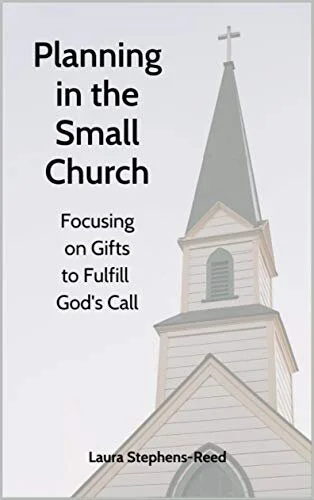
New ebook: Planning in the Small Church

Guess what? It’s my ordiversary! Eighteen years ago today I was ordained to the Christian ministry by the saints at Oakhurst Baptist Church in Decatur, Georgia. In many ways that occasion feels like a lifetime ago. Since then my vocational journey has taken me through a range of roles, congregations, and even denominations. I am grateful for all of the experiences - even the ones you couldn’t pay me to repeat - that have brought me to the ways in which I now serve as a coach to clergy and congregations. In my coaching I use everything I’ve learned and all the strengths I’ve uncovered and honed.

And so I am choosing to celebrate my ordiversary by releasing my first-ever ebook, which is a guide for churches and leaders on how to dream, discern, and plan out of all that they have to be grateful for. Planning in the Small Church: Focusing on Gifts to Fulfill God’s Call is a quick, practical, and inexpensive (at $2.99) read that draws out all of the individual and collective, tangible and intangible gifts of a congregation and community in order to notice where God is at work and how God might be extending new invitations. The ebook starts with the formation of a team to help the church tell stories and gather data and goes all the way through the first steps in implementing new initiatives. Each step is grounded in worship and best practices.

Planning in the Small Church was written with congregations that have one clergyperson - whether that person is the sole staff member or supervises some part-time employees - in mind. That’s because I believe spiritually rich, deeply creative ministry is possible in those contexts, but there’s no budget (and often no need) for a consultant to come in and lead a visioning process. It’s also because smaller congregations can have a hard time refocusing from what they don’t have to all that they do, largely due to our misguided cultural and denominational defaults that bigger, that more, is better.

I am grateful for my calling. I am thankful for the call extended to you and your congregation as well. I hope Planning in the Small Church will help you celebrate your gifts, train you to notice God glimmers, and enable you to live out of abundance, hope, and joy.

Book recommendation: Part-Time Is Plenty

According to a 2018-2019 National Congregations Study, 43% of mainline congregations in the United States do no have a full-time (paid) clergyperson.

43 %.

That’s almost half, and the number is rapidly increasing.

The default perspective is to see a church’s lack of a full-time pastor as a step toward closure. But in the newly-published Part-Time Is Plenty: Thriving Without Full-Time Clergy, UCC minister G. Jeffrey MacDonald makes the case for revitalizing a congregation by distributing the traditional workload of a full-time pastor among part-time clergy and laypeople. Drawing on his own experience as a part-time minister and on research he conducted among various mainline denominations, MacDonald asserts that intentionally claiming this distributed model does not just save a church money. It also allows the pastor to explore other facets of vocation and the laity to reclaim the fullness of the priesthood of all believers, all the while tapping back into a leadership approach that was the norm pre-Industrial Revolution.

For the move to a part-time, paid pastorate to take deep root, MacDonald says that a church must have the courage and creativity to choose it before finances necessitate it. The congregation must develop clear expectations of both staff and members. Laypeople must have access to practical, low-cost training to draw out and build upon their gifts, and pastors must understand how to unleash the strengths of these laypeople. MacDonald calls upon denominational leaders to shift their mindsets from “part-time as a prelude to death” - which is rooted in fear and scarcity - to “part-time as an opportunity for innovation and vitality.” He also urges seminaries to re-think how they offer education, to whom, and at what price tag in order to support a distributed pastorate.

MacDonald’s premise might cause heartburn those of us who trained and planned for a full-time career in ministry - and have the debt to show for it. But for pastors who are looking for a steady (if not lucrative) income that frees them up to parent, create, work in another field, or keep a hand in ministry without burning out or feeling the burden of others’ unrealistic expectations, part-time as plenty might be very good news.

New clergy cohorts now forming

I know. You're Zoomed out, and you have been for a while. And yet, most of these meetings have probably been with rotating groups of people or with fixed groups (such as your staff) for whom you've felt like you've had to show up as your best self. That's exhausting.

I want to offer something different - an ongoing small group with set participants in which you can bring your full self and real concerns and tap more deeply into your innovation and resourcefulness. These cohorts are intended to energize and empower you to lead and live well in our current reality. They will be:

Flexible in focus. The cohort will be geared toward the needs of the participants. (You can note some of those initial needs on the interest form.)

Facilitated to draw out and share your wisdom and strengths. The cohort is designed help you create the actions that will work for you and your context, on which you are the expert.

Intentionally ecumenical. Denominations can be small worlds, making it hard to know how much you can safely share. The cohort will be ecumenical so that you can feel free to be honest and so that you can learn how other denominations approach issues.

Mutually supportive. This cohort will not be a space to compete or call out but a place to encourage, get curious with, and gently challenge one another.

Cohorts will meet twice per month for an hour mid-June through mid-September (6 sessions), with the option to continue after those six sessions. There will be 4-5 participants per cohort, and the total cost will be $150 per participant ($125 for former/current coachees). We will gather by Zoom or Google Meet.

You can indicate your interest on this form, which will be open through June 8. I will then assemble the cohorts and contact participants to schedule meetings at times convenient for them. Once the cohort’s first gathering is set, I will send group information and a PayPal invoice.

Please don't hesitate to contact me with any questions!

Interrupted cycles of firsts

Back in the olden days (read: before mid-March 2020), every pastor new to a church would experience a twelve-month cycle of firsts. There would be your first [insert liturgical season here], your first [insert signature congregational event here], your first conflict, your first death of a church pillar. Through all of these events, the clergyperson and congregation would get to know each other’s gifts and passions and quirks much better, and hopefully this deeper knowing would solidify the pastor-parish relationship going forward.

Well, if you’re a minister who started a new call later than April 2019, you had a pandemic dropped into your initial twelve months, meaning you might not have experienced (or maybe even learned about) that obscure but much-loved Easter tradition or the unexpected level of activity in the summer months. Your cycle is incomplete. So what does this mean?

If we’re able to re-gather physically when that first comes around next year, you’ll have a learning curve. Remind people that you haven’t experienced it. Otherwise, they might expect you to know all about it, leading to hurt feelings.

You might feel really excited to participate in that first you missed - or you might not. That event could represent a return to something resembling “normal.” On the other hand, your level of commitment to it could be low.

You’ll get to probe the importance of that event you missed. You’ll have the blissful lack of awareness to ask any question you want, and you’ll have built more trust so that you can probe deeper.

Be gentle with yourself when you don’t feel too attached to what you missed, and allow yourself to grieve what you anticipated at your new call but didn’t get to enjoy. Pandemic-flavored ministry is hard for everyone, but in some ways it is hardest for those pastors who changed congregations just before or even during the outbreak.

Photo by Photos by Lanty on Unsplash.

The collapse of childcare and the implications for women

Two months after most of the United States began feeling the sucker punch of Covid-19, states are moving at various speeds to “re-open” the economy. I have a number of feelings about this, many of them related to the dangers faced by vulnerable populations and the likelihood that we’ll all be sheltering at home again soon.

And then, there’s this: the reality that many of the people whose work drives the economy will be unable to return to their positions because childcare is so scarce. (It was virtually non-existent pre-Coronavirus in my rural Alabama county, where there was one daycare, no extended day at the schools, and no summer programming.) Schools are closed for the rest of the 2019-2020 academic year, as are many childcare centers for the foreseeable future. Parents can’t ask neighbors or family to look after kids because of the possibility of spreading the virus or because they’re taking care of their own children.

We all know what this means, right? Disproportionately, the responsibility of caring for kids in the absence of outside help will fall to women. Women generally earn less, so they’re the ones to give up their jobs when there isn’t adequate childcare. Both women and men have internalized misogyny that characterizes childrearing as women’s work. And these two issues are for two-parent households. Single parents face a range of additional barriers to work when reliable childcare is out of reach.

We simply cannot lose women’s work in any sphere, ministry included. We cannot sacrifice their innovation, their perspectives, their gifts, their tenacity, their tendencies toward collaborative leadership - especially now, when the world is topsy-turvy and demands grit and fresh thinking. I don’t have any answers for solving the childcare dilemma, unfortunately, but I would urge that women consider the following:

Accept that the ongoing crisis is hard for everyone - and that its not changing anytime soon. It would be easier to ride out a time-bound frustration, but there’s no expiration date on this pandemic. We need to make shifts, then, where we’re able.

Notice ongoing and new patterns that de-prioritize your vocation. The pandemic is exacerbating pre-existing problems at every level of society and creating new fault lines. Reflect on what is happening in your household and community so that you can make the aforementioned shifts.

Ask your partner (if you have one) clearly for the time and space you need to work. I, for one, have a bad habit of believing that if I sulk enough, my spouse will intuit the nature of my resentment. It never works.

Support other women in naming what they need. When we encourage one another, it becomes easier to say hard things and harder to take the easy (but soul-crushing) way out.

Raise your voice. The lack of available (and affordable while still paying workers fairly) childcare is a long-running problem, and we’re about to see what happens when an untenable system collapses entirely. Raise a ruckus with those who might be able to do something about the short- and longer-term needs.

Moms, I see you. You are trying to care for kids with big feelings and help them with schoolwork and squeeze work in here and there and maintain your own physical and mental health. Don’t be afraid to seek out whatever support is available to you right now.

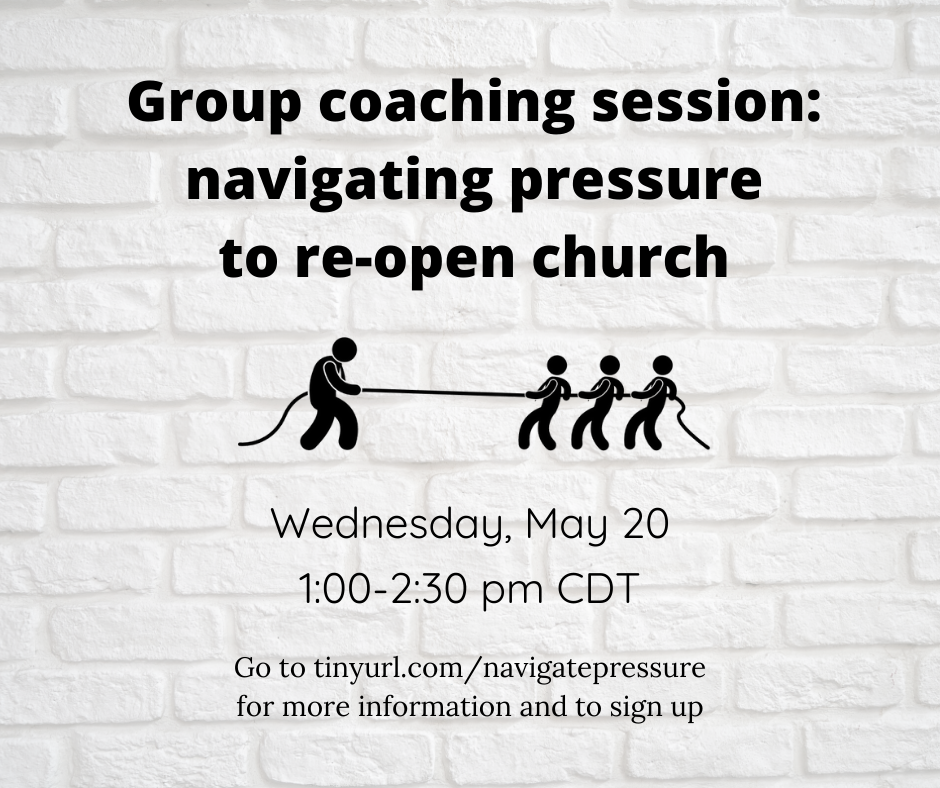
Group coaching session: navigating pressure to re-open church

Yesterday a clergy friend shared this article about a church in Calgary. The congregation had gathered at 25% of the building’s capacity, observed social distancing, and was careful about handwashing. In other words, those present - none of whom had symptoms or had been around (to their knowledge) anyone with the virus - had taken all the precautions recommended at the time. Within two weeks, half of the attendees had tested positive for Covid-19. Two have since died.

This incident highlights the danger of gathering as church in person too soon. And yet, pastors are under duress to re-open as soon as possible. Some of the pressure comes from knowing that other sectors of society are easing restrictions. Some comes from church members, who are eager to see people they have missed and to enjoy the comfort and routine that worship offers. Some comes from ministers’ own worries that they will be perceived as too cautious or even lazy for not moving church back to the building at the first opportunity.

It is an odd sensation - and an emotional burden heaped on top of those that clergy usually bear - to know that our decisions have impact on people’s very existence. And yet, here we are. So how do we navigate the messages and lead faithfully at this critical juncture?

I am offering a group coaching session via Zoom on Wednesday, May 20, from 1:00-2:30 pm CDT. We’ll use this time to process the external and internal messages participants are receiving, consider what pastoral leadership looks like when ministers' decisions impact public health, discuss what that means for how you function with faithfulness during this time, and identify sources of support as you navigate the tension.

This session will be limited to no more than five participants. The cost will be $25, payable via PayPal or check. Registration is available here. If you have questions, I welcome you to contact me. Together we will reflect, learn, and reinforce one another's abilities to do hard things.

Surveys and re-opening church

Several clergy have mentioned lately that they are putting together surveys to distribute to their church members around easing back in to in-person gatherings. I’d like to suggest a few things to keep in mind as you create these surveys:

  • Be clear with yourself about what you hope to gain from the survey. Now is not the time for busywork. Ask the questions that give you the information you need.

  • Overcommunicate the purpose of the survey, the means of completing it, the deadline, and the people who will lay eyes on individual submissions. This takes more effort in a time when we cannot physically be together, but establishing expectations builds trust. That trust will be essential as you make hard decisions in the coming days.

  • Don’t include anything that isn’t up for negotiation. This is very important. If you won’t budge on a matter for ethical or theological reasons, don’t ask for opinions on it. You might get backup for what you think needs to happen, but soliciting feedback could also backfire.

  • Make sure the survey is accessible in a number of ways. You’re getting to be a pro at using all the ways to connect with people! Use them to distribute the survey.

  • Utilize the results. This goes back to the first two bullet points. Don’t make more work for yourself - you’ve got enough - and don’t blow trust by asking for feedback and then disregarding it.

Finally, I want to give you permission not to survey the congregation about issues related to re-opening. Surveys are most helpful when they attempt to glean what the takers experience, think, or believe or what they’re willing to do. We’re currently dealing with a public health situation in which the main focus cannot be personal preference. The priority must be placed on what will keep the people in our care safe. It is ok to trust yourself, your lay leaders, your judicatory, and the scientific community in order to do just that.

Photo by Tim Mossholder on Unsplash.

New resource: recorded webinar for clergy on searching for a new call during a pandemic now available

Two weeks ago I offered a couple of webinars for search teams addressing the challenges of looking for a pastor during a pandemic. The responses were very positive. I received questions from several searching clergy, though, asking whether the content would be helpful for them as well. I welcomed them to participate - and then I began mulling whether a separate resource might be more useful.

As a result I have just released a 43-minute webinar providing searching pastors with pandemic-related questions that search teams are asking, questions for candidates to ask search teams, questions for candidates to ask themselves, new opportunities for telling one's story to search teams, new challenges for searching, and things to consider when starting a call during a new normal.

Access to the webinar is $10 and can be purchased here. (Note that I have also created a recording of the version for search teams, and it can be found here.)

I hope that these resources about the particular considerations the pandemic has prompted will be useful to you. I am available for coaching around these challenges as well, and you can schedule a free exploratory call here.

Group coaching session: pandemic gleanings

Let me be clear. Priority one during this pandemic is simply to make it through. If this is where you are hunkered down, then I say - with all sincerity - “You’re doing great. Keep it up.” Full stop.

If you have the privilege of breathing space, though, you might have some new awareness on your periphery. It might be about your own functioning or your call. It might be about your congregation’s resilience or the over-programming (now stripped away) that has been distracting from your church’s purpose. Whatever those foggy realizations are, they are Spirit promptings worth clarifying and holding onto for now and for the emerging new normal(s).

On Tuesday, May 12, I am offering a group coaching session to tease out and lock in these valuable gleanings. This call will take place 1:00-2:30 pm CDT by Zoom and is limited to five participants. The cost is $25 and will be invoiced through PayPal (payable through PayPal or by check).

If you’d like to get more information or register, you can do so here. If you have questions, I encourage you to contact me. I look forward to our time together to reflect, learn, and reinforce our ability to do hard things.

Free 30-minute coaching sessions on May 6

The International Coaching Federation has designated Wednesday, May 6, as International Coaching Day. On that day all ICF-accredited coaches are encouraged to offer free sessions in order to introduce those who have not experienced coaching to the personal and professional value it offers.

I am pleased, then, to have blocked off Wednesday morning for 30-minute sessions at no charge. Any minister who has never been individually coached by me is welcome to sign up. You can visit my calendar here to reserve your time. I look forward to talking with you!

An innovative, thoughtful way to hold a congregational vote

I was talking today with a pastor whose church is facing a time-sensitive congregational vote around a big issue. She had thought through the most obvious options - voting virtually or by mail - but neither seemed like a fit for either her people or the subject of the vote. Working with her judicatory leader and church council, then, she developed a way for her members to vote in person. Here is what she came up with:

  • Dividing the church directory into much smaller segments (10-12 voting members)

  • Assigning each segment a day and a two-hour window to come to the (heavily-sanitized before and after) church to cast their ballots

  • Asking people to wear masks and having extras available for those who don’t have access or who forget

  • Marking socially-distanced spots on the floor in case multiple people arrive at the same time to vote (and offering reminders as needed to avoid physical contact)

  • Having voters pick up their own ballots and deposit completed ones directly into a box

  • Making mail-in ballots available on request, with a postmark deadline

Note that it is essential in situations like these to consult your by-laws about voting parameters, to run your plans by your judicatory leader to test for validity and proper safety precautions, and to consider all the risks involved and mitigations required. But an in-person vote might be an option - in smaller congregations, at least - for calling a pastor, deciding whether to sell property, or other big congregational issues.

Photo by Element5 Digital on Unsplash.

Group coaching session on balancing pastoring and parenting

Recent scenes from my house:

I am sending emails from my desk, my seven-year-old curled around my feet as he plays with Lego minifigures.

I am wrestling internally with how hard to push my kid to complete the math worksheets assigned by his teacher, even as I seek to lower work expectations for myself.

I am coaching in my office, noting the sounds of my son humming the Jurassic Park soundtrack filtering through multiple walls.

I am closing the lid of my laptop as my child comes to me with a book and a need to snuggle.

I am wondering, as I drift off to sleep, how well I served anyone that day with my attention pulled in multiple directions.

Pastor-parents, I salute you. You are walking a tightrope right now, learning how to do - and doing - all the church things in new ways while your children also need your attention. And, of course, your own exhaustion requires tending as well. How do we strike that balance?

I am offering a group coaching session next Tuesday, April 28, in which we’ll work through that struggle for ourselves. How we want to show up for the people in our care (both at church and at home), what is essential to us right now for both pastoring and parenting, and what shifts would we like to make as a result? The session will take place 12:00-1:30 pm CDT via Zoom and limited to no more than five participants. The cost will be $25. Click here to sign up.

Pastor-parents - I see you. Thank you for the ways you care for the people in your personal and professional lives.

Welcome to the new website!

If you’ve been visiting laurastephensreed.com for a long time, welcome back. If you’re new to this site, I’m glad you’re here. I have relaunched my online presence in an effort to serve all the constituencies I serve - clergy, congregations, and pastor search teams - more effectively.

Here’s what you need to know about this new and improved website:

It is easier than ever to get to my scheduler. There are buttons in the footer (and in the main content of many pages) for current and potential coachees.

I update the blog weekly. You can stay current by subscribing to the blog or by following me on Facebook or Twitter.

You can search blog content by constituency. I have categorized all posts as applicable to clergy, congregations, and/or pastor search teams.

My newsletter is designed to be a handy resource for you. I send a monthly edition with links and tools. If you didn’t respond to the pop-up invitation extended when you first arrived at laurastephensreed.com, you can sign up for the newsletter here. (If you signed up on the old website, don’t worry, I’ve still got you on my list.)

As you poke around, I welcome your feedback. Where have I missed a link? What is hard to find? What do you need that isn't there? My goal with this new online presence is to serve you as best I can.

Photo by Belinda Fewings on Unsplash.

Webinar for pastor searches impacted by Covid-19

Maybe your pastor search was just getting up and running.

Maybe you were able to complete initial interviews by technology, but now you’re stuck at the phase when you’d normally invite one or more candidates for an in-person conversation.

Maybe your search team was about to introduce a candidate of choice for the congregation to meet and vote on.

And then…Covid-19. Everything shut down, and for who knows how long.

If your church (or a church in your care) is wondering whether to proceed with its pastor search - and what to do no matter the answer - this webinar at 7:00 pm eastern on April 20 and 23 can help. In this one-hour offering, participants will be introduced to the factors to consider and ways to move ahead with searches if they so choose. There will also be space for participants to ask questions particular to their contexts.

This webinar will be offered by Laura Stephens-Reed, creator of Searching for the Called, a pastor search process geared toward hospitality to voices in the congregation and community, the candidates' gifts and experiences, and the Holy Spirit. Laura is a minister and a clergy and congregational coach who has worked with pastors and churches across the ecumenical spectrum.

The cost for this webinar will be $15 per participant or $50 for 3+ search team members. Each participant will receive the 1-page document "Searching During a Strange Season: Questions to Reflect on When Searching During a Pandemic." Registration is available here.

Follow me on Facebook for encouragement!

I am in awe of the ministry you are providing, and I urge you not to burn yourself out. We'll need your creativity and compassion over the long haul.

After writing Covid-19-related blog posts daily the week of March 16, I have shifted my focus to making brief videos and mini-posts to share on Facebook. I hope that these efforts will encourage you and offer reflection points to help you stay grounded as the Coronavirus crisis continues. If there are other ways that I can support you as a pastor and as a person during this trying season, please contact me.

Pastoral transition in a pandemic

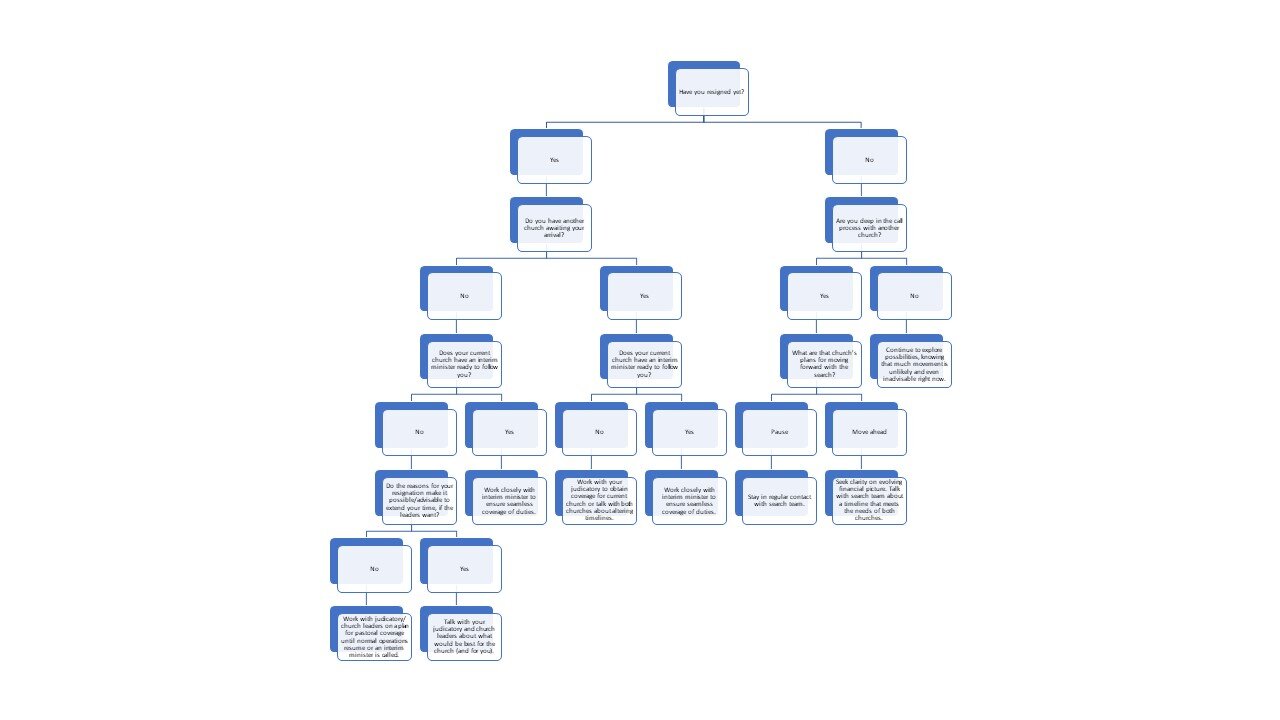
Currently, pretty much everything is more complicated than it was a few weeks ago. That includes ministerial transitions. If you are deep into a search process or are working out your notice, below is a flow chart to help you think through the coverage of pastoral duties and your own needs. (Zoom in so that you can read the fine print. Alternatively, here is a PDF version.)

Obviously, this chart does not address all of the issues to consider. Here are a few more to mull:

Moving. It is inadvisable at best to change locations right now. That might mean that you stay in place and begin a new call virtually. If so, be sure to negotiate now for time to move later. If you live in a parsonage/manse/rectory, you might end up still living on the property of a church you no longer serve. (The person following you will also be unable to move, so at least that might not be an issue.) Work with congregational leadership on issues related to boundaries. Consult your judicatory leader to help you navigate the issues related to housing allowance and an accountant to find out what the tax implications might be.

Closure. How do you say goodbye when you cannot safely be around other people? Two options come to mind. First, say goodbye the way you are going about all your other relational tasks right now: by phone, computer, or mail. Second, this might be one of those rare occasions to bend the rules around a hard end date. You might be able to schedule an in-person send-off for later, but do consider how your reappearance might impact those beloved church members and the minister in place.

In all transition-related matters, lean on your judicatory or denominational leaders for wisdom. This situation is new for them as well, but they might have a sense of the bigger picture and expertise that can greatly benefit you and your sending and receiving churches.

pastoral transition in a pandemic flow chart.jpg